cyprus drought — cyprus drought — Cyprus is facing a once-in-a-century drought, dramatically reducing dam levels to a precarious 13.7% capacity. Water Development Department official Marios Hadjikostis emphasised that recovery is unlikely before summer, as the island’s reservoirs held just 39.925 million cubic metres on 9 February. This stark figure is half of the 26% capacity recorded during the same period last year, when officials were already raising alarms about dwindling water supplies.

Photo: in-cyprus.philenews.com
With mid-February upon us, time for improvement has all but run out. Hadjikostis remarked, “We’re already in mid-February and historically from March onwards no water enters the dams.” He further noted, “It happens once in a hundred years. We’re not going to get quantities from now on that will allow us to exceed last year’s.”

Photo: in-cyprus.philenews.com
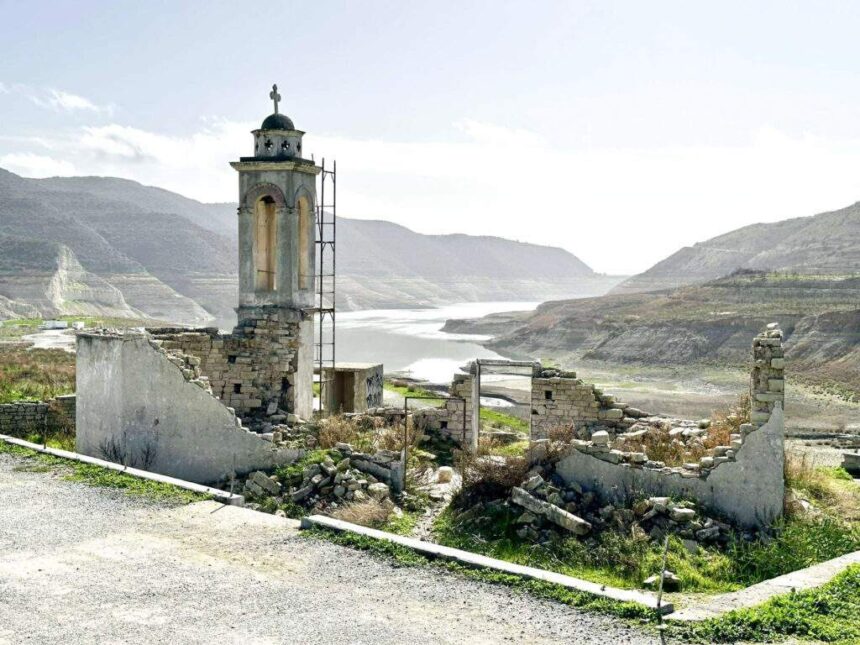
The most striking impact of this drought is visible at Kouris, Cyprus’ largest dam, where the Church of Saint Nicholas, once submerged, now stands fully exposed. Currently, Kouris’ capacity has plummeted to 12.17%, with only 14.001 million cubic metres available against its full capacity of 115 million cubic metres. This represents a stark decline from the 21.67% recorded last year.
Recent data highlights the severity of the drought. Kouris has received only 0.255 million cubic metres of water over the past three days and a mere 3.275 million cubic metres since 1 October. “Our reserves are very low,” Hadjikostis commented. “Unfortunately we don’t have last year’s level and we won’t reach it this year – it’s unlikely.” He added that Kouris had already dropped to 9% in October, a stark reminder of past droughts.
This alarming trend is echoed across the island’s other major reservoirs. Asprokremmos has decreased to 12.46% from 27.85% last year, while Evretou has dropped to 17.88% from 25.13%, and Kannaviou to 16.23% from 28.66%. Such rapid declines paint a troubling picture of Cyprus’ water management amid ongoing climatic challenges.
The drought follows a particularly harsh winter, marked by the worst November in a decade, with only 0.200 million cubic metres flowing into dams. December was not much better, recording the weakest inflow in eight years at just 1.903 million cubic metres.
As the island grapples with these concerning water shortages, the implications stretch beyond immediate environmental effects. Water scarcity has been flagged as a top risk to Cyprus’ economy in recent surveys, raising urgent questions about sustainability and resource management in the face of climate change.