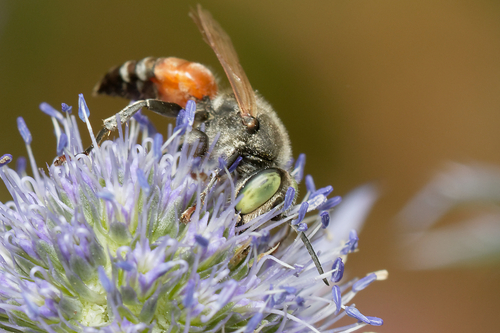
cypriot honeybee — The native Cypriot honeybee is facing significant threats from imported strains, prolonged drought, and insufficient state support. Experts warn that the decline of this local species could jeopardise pollination across the island, ultimately affecting agricultural productivity.

Photo: cyprus-mail.com
A proposal aimed at protecting the Cypriot bee, Apis mellifera cypria, has been submitted to the agriculture department. The Pancyprian Beekeepers’ Association is advocating for the establishment of an accredited apiary dedicated to breeding native queens for local distribution.
This initiative, which seeks to preserve the genetic integrity of the indigenous bee, was submitted in June of last year and includes plans to allocate state land in Athalassa, Nicosia. However, the association reports no formal response from the authorities thus far.
The development of a dedicated beekeeping centre in Cyprus is progressing slowly, with officials citing delays due to administrative procedures and the need for suitable facilities. Despite this, broader efforts to safeguard the native bee continue. Lysandros Lyssandridis, the head of the agriculture department, mentioned to the Sunday Mail that the process hinges on the readiness of the beekeepers to submit a complete application.
“The intention is to allocate a specific building owned by the agriculture ministry so that a beekeeping centre can be created,” he explained. This centre would serve multiple purposes, including providing services to beekeepers and educational opportunities for the public, such as school visits and organised trips to apiaries.
The beekeeping centre is envisioned as part of a long-term strategy to protect the native species. Lyssandridis highlighted that the local breed is threatened primarily due to the importation of queens from abroad, which is gradually altering its genetic makeup. The centre would offer a controlled environment necessary for the preservation and reproduction of the native strain.
As part of this effort, discussions are underway with a research institute to conduct genetic analysis of the Cypriot bee. Lyssandridis noted that there is scientific material and samples of the Cypriot bee dating back 60 to 70 years. By analysing these samples, researchers hope to identify which present-day bees are closest to the original breed.
Margarita Kouloumi, president of the Pancyprian Beekeepers Association, stressed the importance of this initiative. “The immediate solution is not easy,” she remarked. “Research programmes are needed to track how the Cypriot breed is evolving. Imported queens are changing the genetic makeup of local bees. Our goal is to develop actions in Cyprus to preserve the Cypriot breed in its own place.”
The proposed centre would be inclusive, open to all beekeepers working with the native strain, and would focus on educational, research, and visitor purposes. Kouloumi emphasised, “The most important thing is the protection of genetic material so that it is not lost.” Plans for training programmes, academic collaborations, and even the potential establishment of a university chair in beekeeping are also part of the vision.
Efforts will centre on breeding queens that exclusively focus on the Cypriot strain. Kouloumi expressed her commitment, stating, “Through queen breeding, we will pursue the closest possible genetic material of Apis mellifera cypria.” She confirmed that the application for the centre has been in progress for about a year, noting that it began with the previous board and continues with their current leadership.
With historical records indicating a marked decline in the island’s beehives—from approximately 500,000 in 1896 to just 23,170 by 1946—Kouloumi warned of the severe consequences if the Cypriot bee is lost. She noted that Cyprus currently lacks an official beekeeping institute, and while private and international studies exist, no formal scientific body supports local beekeepers.
The adaptation of the Cypriot bee to local conditions has made it more resilient, particularly against threats like the eastern hornet, Vespa orientalis. However, the impacts of drought and the widespread importation of foreign bees are increasingly compromising the species’ survival. Many beekeepers continue to import foreign queens, believing they are easier to manage, but this practice leads to hybridisation, diminishing local biodiversity.
The beekeeping centre is set to reverse this trend by focusing on controlled breeding of Cypriot queens, which display reduced aggression, robust hive defence, and lower swarming tendencies. These queens are intended to be made available to local producers at competitive prices compared to imported options.
In addition to breeding, the centre aims to support training, public engagement, and research initiatives using unspent EU funds. The association is actively seeking academic collaboration, pointing out the absence of a dedicated apiculture chair at any Cypriot university, which hinders beekeepers from receiving essential scientific guidance.
The issue has gained attention in bicommunal discussions focused on environmental protection, with the technical committee examining joint measures to safeguard the Cypriot bee as part of confidence-building initiatives. Michalis Loizides, Greek Cypriot co-chair, noted that only around 25 per cent of bees in the northern region belong to the native strain, with similar trends observed in the south. With four meetings already convened, further actions are planned as the urgency of preserving the native Cypriot bee becomes increasingly apparent.