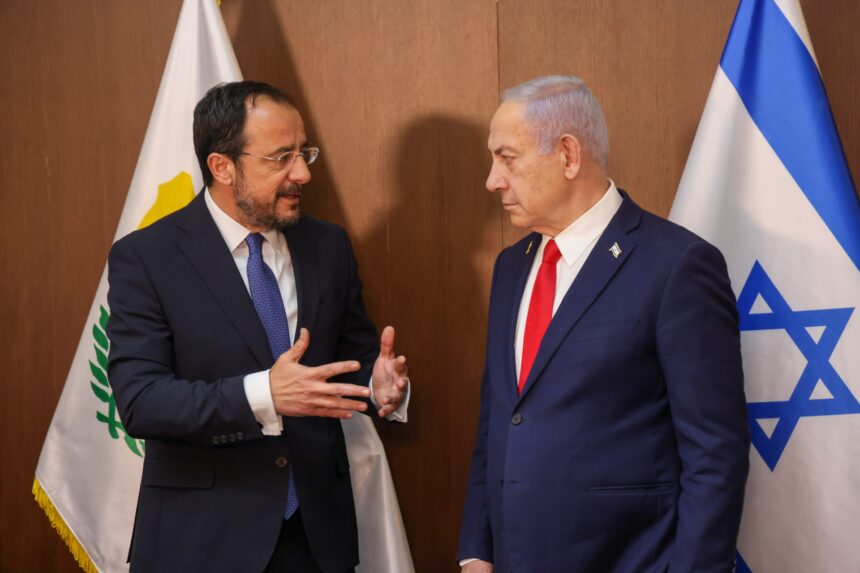
President Nikos Christodoulides and Israeli Prime Minister Benjamin Netanyahu engaged in a telephone conversation on Sunday, focusing on the Great Sea Interconnector and the ‘India-Middle East-Europe Economic Corridor’ (Imec), as confirmed by deputy government spokesman Yiannis Antoniou.
The call followed a trilateral meeting with Greek Prime Minister Kyriakos Mitsotakis last month. During their discussion, the leaders highlighted the importance of energy cooperation and defence collaboration between Cyprus and Israel.
Christodoulides and Netanyahu also touched upon the progress of the peace plan for Gaza, initially proposed by former US President Donald Trump. Antoniou noted that both leaders reaffirmed the strategic significance of the relationship between Cyprus and Israel, expressing their commitment to ongoing close coordination.
The Great Sea Interconnector project aims to link the energy grids of Cyprus, Israel, and Greece, a topic that has garnered attention recently. Cypriot Energy Minister Michael Damianos reassured stakeholders that the project “will not collapse.”
Despite tensions between Cyprus and Greece regarding the interconnection, Damianos stated that the two nations now share a unified stance on the project. This consensus was reportedly reached during a brief exchange with Greek counterpart Stavros Papastavrou at the European Union’s transport, telecommunications, and energy (TTE) council meeting in Brussels last month.
Damianos mentioned that both he and Papastavrou agreed the project is progressing normally, and they received assurances from Nexans, the French company responsible for constructing the interconnector cables. Although Nexans had previously withdrawn tenders related to the project and suggested it was not on track, it clarified that it remains committed to the venture and will provide a revised programme as necessary.
While Cyprus is not a signatory to the memorandum of understanding for Imec, which was established during the 2023 G20 summit in New Delhi, it remains a topic of interest in the regional dialogue. This framework was signed by multiple nations, including India, the US, Saudi Arabia, the UAE, the EU, France, Germany, and Italy.
In the realm of defence, Cypriot Defence Minister Vasilis Palmas recently refuted claims that Cyprus, Israel, and Greece were considering forming a military “rapid reaction force” to counter Turkish influence in the eastern Mediterranean. Palmas asserted that such discussions had not taken place and emphasised that any decisions of that magnitude would be made by the political leadership.
He added that even if a meeting were to occur, it would be inappropriate to disclose confidential matters. This statement underscores the delicate balance of diplomatic relations in a region marked by complex geopolitical dynamics.