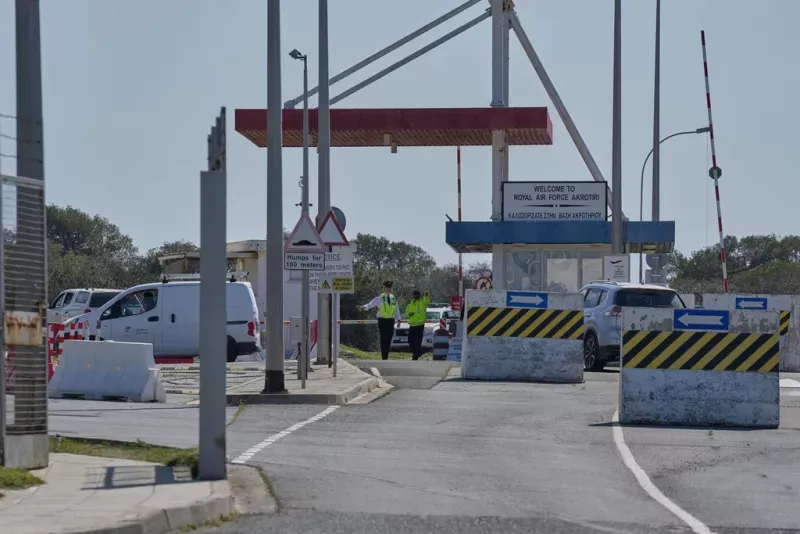
british bases — The call for an end to British claims over military bases in Cyprus has gained momentum as the European Lawyers for Democracy and Human Rights, along with the Cyprus Democratic Lawyers Association, voice their concerns. They describe the bases at Akrotiri and Dhekelia as “a colonial remnant, a democratic insult and a direct attack on the sovereignty of the Cypriot people.”
British bases: Historical Context of the Bases
Since gaining formal independence over 60 years ago, Cyprus has been perceived by these organisations as only partly decolonised. The military bases were established in 1960 as part of the terms of independence, allowing the UK to maintain control over portions of Cypriot territory for military and strategic purposes. This arrangement has been contested by many, who argue that it was imposed under conditions of coercion rather than genuine consent.
Legal Arguments Against British Sovereignty
The lawyers’ groups firmly reject Britain’s assertion that the areas of Akrotiri and Dhekelia constitute sovereign British territory. They argue that this claim lacks legitimacy and violates international law. Referring to the United Nations General Assembly Resolution 1514 of 1960 concerning decolonisation, they emphasise that the integrity of colonial territories must not be disrupted during the decolonisation process.
Additionally, they cite the International Court of Justice’s (ICJ) 2019 advisory opinion regarding the Chagos Archipelago, where the court determined that Britain had unlawfully completed the decolonisation of Mauritius by detaching the archipelago in 1965. The court concluded that Britain has an obligation to end its administration of the territory, a principle the organisations argue is equally applicable to Cyprus.
Colonial Legacy and Its Implications
According to the statement released by the lawyers’ groups, the British bases do not represent lawful sovereignty but rather a continuation of colonial rule. They argue this arrangement fragments Cyprus’ territorial integrity and poses risks, particularly by transforming the island into a platform for foreign military operations.
The organisations stress that the bases have been used for military operations by third states, including the United States. Such activities, they argue, could potentially draw Cyprus into conflicts and jeopardise its territorial integrity.
Concerns Over International Engagements
The statement also references the ICJ’s upcoming 2024 advisory opinion regarding Israel’s policies in the occupied Palestinian territory. They assert that third states must refrain from providing aid or assistance that maintains situations breaching international law. This perspective reinforces their argument that the military bases in Cyprus are incompatible with the principles of international law and the rights of the Cypriot people.
Call for Action and Decolonisation
The lawyers’ groups contend that the presence of British military bases is fundamentally linked to issues of international law, decolonisation, and the protection of the rights of the Cypriot people. They assert that Cyprus has the legitimate right to challenge this colonial arrangement in international forums, invoking the principles established in the Mauritius case and demanding full decolonisation.
In their statement, they urge an end to British claims over Akrotiri and Dhekelia, the abolition of all colonial privileges, and the return of all Cypriot territory to its rightful owners—the Cypriot people.
Government’s Role in the Future
Furthermore, the organisations call upon the Cypriot government to cease what they describe as its tolerance of the British military bases. They urge the government to engage with the British authorities to clarify the necessary steps for the removal of the bases. This call for action reflects a growing sentiment among certain legal and political groups in Cyprus that the current arrangement is outdated and detrimental to the nation’s sovereignty.
Looking Ahead
The discourse surrounding the British military bases in Cyprus highlights ongoing tensions related to colonial legacies and the pursuit of genuine independence. As these lawyers’ groups rally for change, the implications of their demands could resonate not only within Cyprus but also in broader discussions about decolonisation and international law. The path towards addressing these issues will require careful navigation of complex historical, legal, and political landscapes.