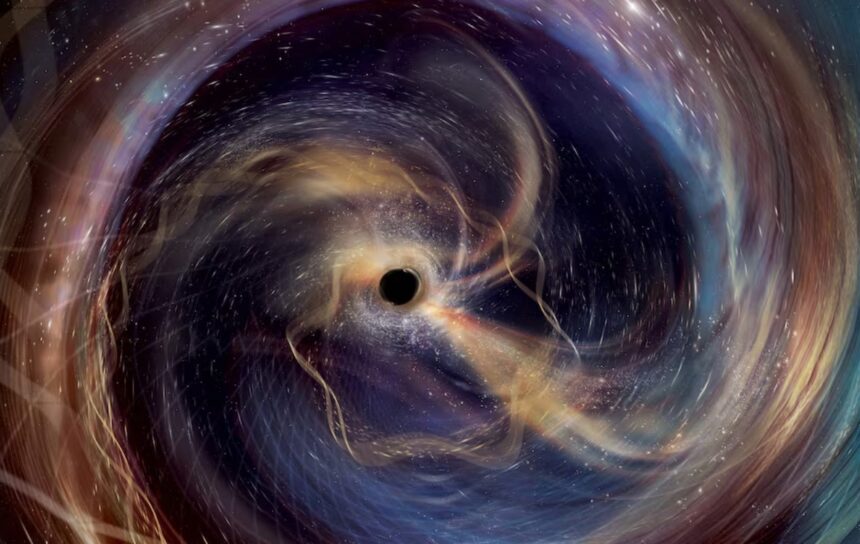
The merger of two black holes has been witnessed in unprecedented detail, unveiling the most extreme configurations of space, time, and gravity known to science. This extraordinary event, occurring 1.3 billion light-years from Earth, has provided researchers with vital insights into the fundamental nature of black holes and their behaviour.
Black holes: Details of the Black Hole Collision
The recent merger involved two black holes, one approximately 34 times the mass of the sun and the other around 32 times its mass. The two entities spiralled toward each other at nearly the speed of light, merging in a fraction of a second and resulting in a single black hole with a mass of about 63 times that of the sun. Notably, this newly formed black hole is spinning at around 100 revolutions per second.
Energy Released Equivalent to Three Suns
The collision unleashed an incredible amount of energy, radiating outward as gravitational waves equivalent to the energy released from the destruction of three sun-sized stars. These gravitational waves were detected on January 14 at the Laser Interferometer Gravitational-Wave Observatory (LIGO) sites in Hanford, Washington, and Livingston, Louisiana. This detection marks a decade since the groundbreaking first detection of gravitational waves in 2015, with this latest observation boasting four times better resolution.
The Science Behind Gravitational Waves
Gravitational waves are ripples in the fabric of space-time, akin to the ripples created when a stone is thrown into a pond. They propagate from their source, providing insights into the dynamics of cosmic events such as black hole mergers. According to astrophysicist Maximiliano Isi from Columbia University, the merging black holes exemplify how space and time are intricately linked, a concept first proposed by Albert Einstein.
Understanding the Frequencies
The researchers analysed the frequencies of the detected gravitational waves to glean fundamental qualities of the black holes before and after their merger. Although these frequencies are not sound waves, they can be likened to the ringing of a bell, where the sound helps to infer the bell’s material composition. This innovative approach allowed the team to validate key aspects of black hole science, particularly those advanced by renowned physicist Stephen Hawking.
Hawking’s Hypothesis Confirmed
Hawking’s hypothesis posited that the total surface area of black holes, specifically the surface area of the event horizon, should never decrease. This principle suggests that the surface area of the resulting black hole should exceed the combined surface areas of the two original black holes. Prior to the merger, the two black holes had a total surface area of approximately 93,000 square miles (240,000 square kilometres). Post-merger, the new black hole’s surface area measures around 155,000 square miles (400,000 square kilometres), confirming Hawking’s hypothesis.
Precision in Measurement
This achievement is particularly significant as it marks the first time such measurements have been made with remarkable precision. Will Farr, an astrophysicist from Stony Brook University, expressed the excitement surrounding this confirmation of a fundamental concept in black hole behaviour.
Significance for General Relativity
The findings from this merger also reinforce the notion that black holes are simpler objects than previously thought, as outlined in Einstein’s theory of general relativity. This theory posits that gravity is a result of the curvature of space-time caused by mass and energy. The recent observations lend credence to the idea that black holes can be fully understood through their mass and spin, a concept articulated by mathematician Roy Kerr in 1963.
Remarkably Rapid Observations
The gravitational wave measurements were acquired in an impressively brief timeframe. Caltech astrophysicist Katerina Chatziioannou noted that the black holes were observed spiralling inward for about 200 milliseconds, with the signal from the merged black hole detected for approximately 10 milliseconds. This rapid observation underscores the advancements in technology and methodologies since the first detection of gravitational waves, enabling a deeper understanding of the universe’s most enigmatic phenomena.
Future Implications
As astronomers continue to refine their detection capabilities, the implications of these findings are profound. The ability to observe black hole mergers with such clarity not only enhances our understanding of these cosmic giants but also solidifies the foundation of modern astrophysics. Each new discovery opens pathways to further exploration, pushing the boundaries of what we know about the universe.