rainbow flags — Incidents involving the burning of rainbow flags on Easter bonfires in two villages in the Larnaca district have prompted activists to call for systemic reform. The LGBTQ advocacy group Queer Collective described these acts as symptoms of deeper societal issues, rather than isolated incidents of hooliganism.
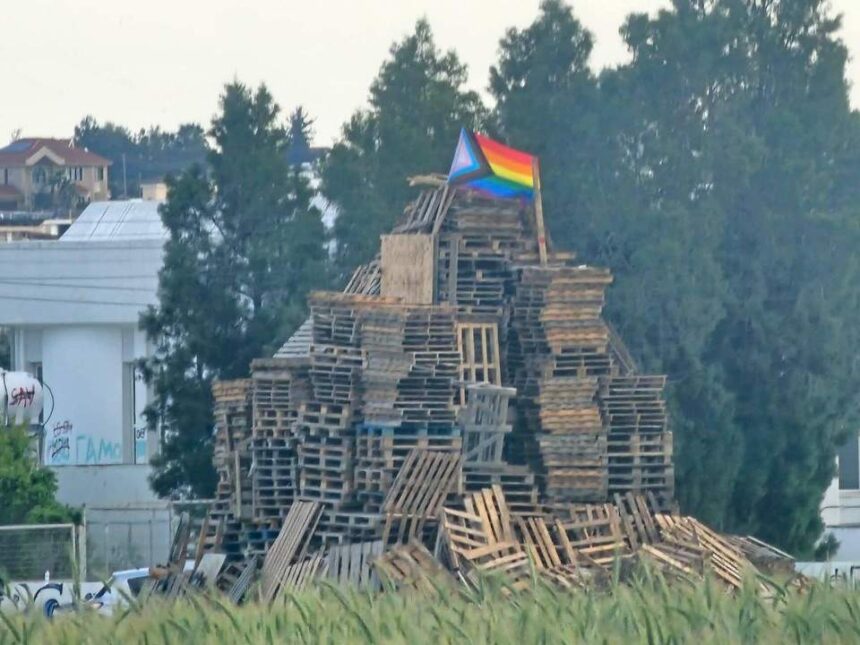
On Holy Saturday, the flags were set ablaze in Vergina and Kalo Chorio, continuing a pattern that has now recurred for the second consecutive year. In 2025, similar incidents were reported in Palodia, Lakatamia, and Limassol. Images of the acts circulated widely, sparking condemnation from various organisations, with the week dominated by discussions on the events rather than the underlying causes.
Queer Collective emphasised the need for the enforcement of existing laws, noting that hate speech based on sexual orientation has been a criminal offence in Cyprus since 2015. However, they argued that mere convictions would not address the root causes of such behaviour. They stated, “You can fine every person who puts a flag on a lambradjia and next year someone else will do it.”
The group pointed out the political implications of these actions. The lambradjia, a traditional Easter bonfire in Cyprus, typically features an effigy of Judas, the biblical traitor. By replacing Judas with a rainbow flag, the act suggests that LGBTQ individuals are viewed as traitors to the nation. This rhetoric, according to Queer Collective, aligns with broader nationalistic sentiments that regard queerness and multiculturalism as threats to Greek Cypriot identity.
Perpetrators of these acts, often teenagers and young men in their early twenties, have been shaped by a digital landscape that feeds them a cycle of edgy humour and bigotry. Queer Collective noted that social media lacks a substantial counter-narrative in Cyprus, where it’s possible for students to complete twelve years of schooling without encountering any positive representation of LGBTQ lives.
The group also highlighted a disconnect between public opinion and institutional responses. Support for same-sex marriage in Cyprus has risen significantly, from 14% in 2006 to 50% in 2023. Yet, the education system, political leaders, and the Church have not kept pace with this change. Following the 2025 incidents, only two political parties, AKEL and Volt, publicly condemned the actions, while the President of the House of Representatives described society as “not ready” for marriage equality, despite the majority support.
In their statement, Queer Collective outlined four key measures to address the situation: firstly, integrating LGBTQ lives into the school curriculum rather than treating them as optional topics; secondly, providing media literacy education to help young people recognise online radicalisation; thirdly, encouraging political leaders to openly condemn hate and ensure accountability; and finally, creating a media landscape that connects individual incidents to the broader societal conditions that foster them.
Another advocacy group, Accept-LGBTI Cyprus, condemned the flag burnings, labelling them “fires of hatred” and warning that targeting LGBTQ flags instead of effigies of Judas represents a dangerous form of societal indoctrination. They asserted that such actions contribute to the education of violence and the potential radicalisation of young people.
Accept-LGBTI Cyprus stressed that various institutions, including the Church, unions, political parties, and the state, are complicit through their silence. They noted, “When they remain silent, when they ‘do not see’ what is burning at the top of a lambradjia, they send a message that some lives are worth less.”
The organisation called upon police to enforce anti-discrimination and hate speech legislation and to issue directives to local stations instructing them to prevent flags or symbols from being placed on bonfires in the future.