gen z — In Nepal, unrest related to a social media ban has led to the tragic loss of at least 19 lives, according to authorities. The protests, primarily driven by the youth, erupted in the capital, Kathmandu, where demonstrators clashed with police in a bid to voice their discontent over the ban and ongoing corruption issues.
Gen z: Youth Protests Surge in Kathmandu
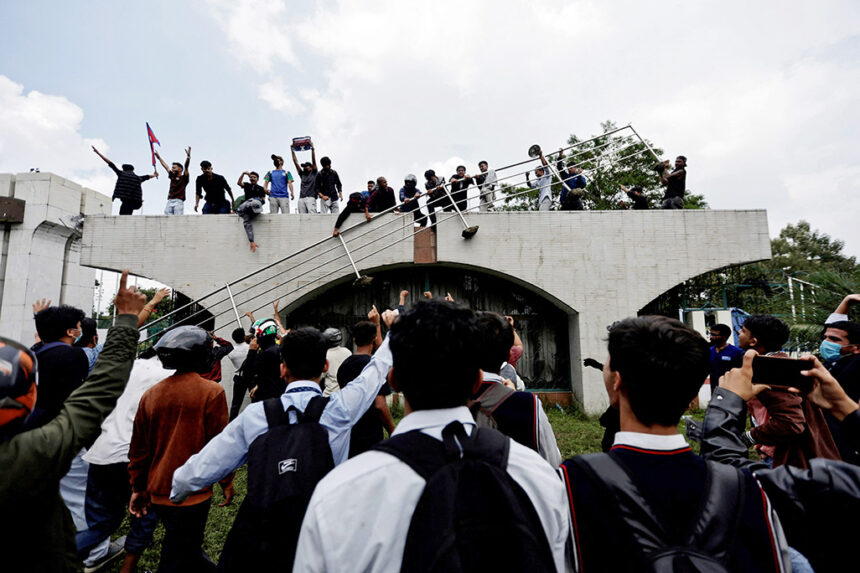
On Monday, thousands of young people, many donning their school and college uniforms, took to the streets of Kathmandu. The rallying cries were clear: “Shut down corruption and not social media”, “Unban social media”, and “Youths against corruption”. Organisers labelled these protests as demonstrations by ‘Gen Z’, reflecting a growing frustration among younger Nepalis towards government actions perceived as detrimental to their freedoms and futures.
Clashes with Authorities
The situation escalated as some protesters managed to breach barricades and enter the parliament complex. Police responded by deploying tear gas and rubber bullets to disperse the crowd, leading to further violence. A local official reported that an ambulance was set ablaze during the chaos, and riot police were targeted with projectiles by the demonstrators.
A protester recounted the harrowing experience, stating, “The police have been firing indiscriminately. They fired bullets which missed me but hit a friend who was standing behind me. He was hit in the hand.” In total, over 100 individuals, including 28 police personnel, required medical treatment following the confrontations. Injured protesters were seen being transported to hospitals on motorcycles.
Casualties Rise Amidst Continued Unrest
The violence was not confined to Kathmandu, as protests in the eastern city of Itahari also turned deadly, resulting in the deaths of two more individuals. The unrest prompted Prime Minister K.P. Sharma Oli to convene an emergency cabinet meeting to address the escalating situation.
Government’s Justification for Social Media Ban
The unrest has been exacerbated by a recent government decision to restrict access to several social media platforms, including Facebook. Officials justified the ban by citing concerns over misuse, such as the proliferation of false accounts that spread hate speech and misinformation. With approximately 90% of Nepal’s 30 million population using the internet, the decision has sparked outrage among the youth.
According to a spokesperson from the Kathmandu district office, police were instructed to employ water cannons, batons, and rubber bullets to control crowds. The army was also deployed to reinforce law enforcement in the parliament area. Following the initial violence, a curfew was imposed, extending until 10 p.m. local time, particularly around key government buildings.
Widespread Discontent and Calls for Change
Despite a decrease in violence later in the evening, protesters remained gathered outside parliament, demonstrating their resolve. Additional protests were reported in other cities, including Biratnagar, Bharatpur, and Pokhara, illustrating the breadth of discontent across the nation.
The Oli government has faced mounting criticism for its perceived failure to address rampant corruption and deliver on economic promises. Many young Nepalis, frustrated by limited job opportunities, seek better prospects abroad. Rameshwore Khanal, a former finance secretary, noted that while job creation has not met expectations, the current unrest stems more from dissatisfaction with government appointments and corruption than from economic conditions alone.
Global Context of Social Media Regulation
Nepal’s social media ban occurs amid a global trend of governments tightening oversight of social media and technology companies due to concerns over misinformation, data privacy, and national security. Critics argue that such measures can stifle free expression, while regulators maintain that stricter controls are necessary to protect users and maintain social order.
The events in Nepal highlight a critical juncture for the younger generation, who are increasingly vocal about their rights and the need for governmental accountability. As protests continue, the government faces a significant challenge in addressing both the immediate demands of its citizens and the broader issues of corruption and social media regulation.