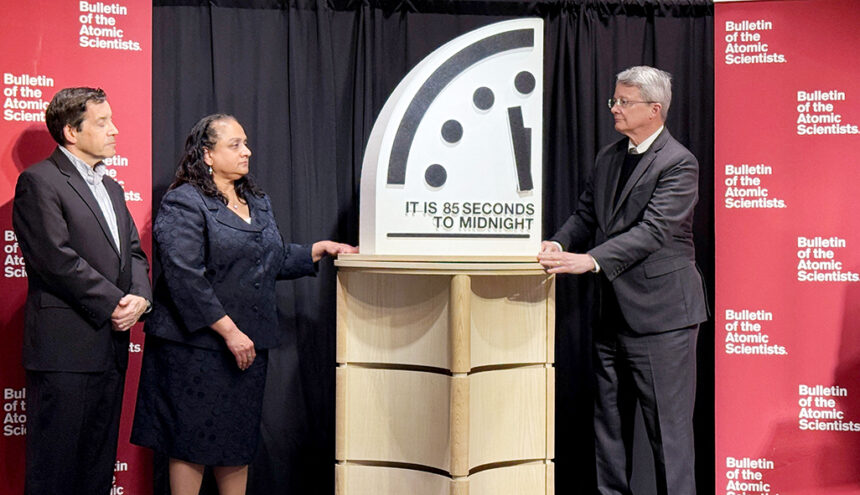
Atomic scientists have set the ‘Doomsday Clock’ to its closest position to midnight ever, now standing at just 85 seconds away. This alarming adjustment reflects escalating risks posed by nuclear powers, including Russia, China, and the United States, alongside a backdrop of conflicts and emerging threats from artificial intelligence.
Established in 1947 by the Bulletin of the Atomic Scientists, the Doomsday Clock serves as a stark metaphor for the existential threats facing humanity. The clock’s latest shift—moving four seconds closer to midnight compared to last year—signals a deepening global crisis. The Bulletin highlighted a combination of factors contributing to this decision, including fraying nuclear arms control, ongoing military conflicts in Ukraine and the Middle East, and the potential dangers associated with unregulated AI.
Doomsday clock: Global Leadership and Nuclear Risks
Alexandra Bell, the Bulletin’s president and CEO, emphasised the role of leadership in these escalating tensions, stating, “Of course, the Doomsday Clock is about global risks, and what we have seen is a global failure in leadership.” She pointed out that a shift towards neo-imperialism and authoritarian governance has only heightened the urgency of the situation.
Bell noted that the past year has shown no positive trends in terms of nuclear risk, with longstanding diplomatic frameworks under significant stress or collapsing altogether. The return of explosive nuclear testing as a concern compounds the anxiety surrounding proliferation. “The risk of nuclear use is unsustainably and unacceptably high,” she warned.
Ongoing Conflicts and Rising Tensions
The spectre of nuclear conflict looms large over current geopolitical landscapes. Russia’s protracted invasion of Ukraine remains a major concern, with the country employing nuclear-capable weapons such as the hypersonic Oreshnik missile. Its deployment, as demonstrated in videos released from Belarus, signifies a strategic move to enhance Russian capabilities to strike targets across Europe.
Moreover, the Bulletin has expressed apprehension about incidents in the Middle East, including U.S. and Israeli military actions against Iran, as well as border skirmishes between India and Pakistan. Tensions in Asia, particularly regarding North Korea and China’s assertive posture towards Taiwan, further complicate the global security environment.
The Implications of AI
Artificial intelligence poses additional risks that have not gone unnoticed. The Bulletin’s scientists are particularly concerned about the unregulated integration of AI into military operations, which could lead to misuse and the exacerbation of existing threats. Bell remarked on the peril of AI in spreading disinformation, adding layers to an already complex global narrative.
Maria Ressa, a Nobel Peace Prize laureate, spoke at the Bulletin’s announcement, highlighting the rapid dissemination of misinformation through technology. “We are living through an information Armageddon that’s brought about by the technology that rules our lives, from social media to generative AI,” she warned. Ressa’s insights underline the urgent need for accountability in the digital age.
The Future of Nuclear Arms Control
The New START treaty, the last standing nuclear arms agreement between the United States and Russia, is set to expire on February 5. Russian President Vladimir Putin’s proposal to extend the treaty for another year has yet to be formally accepted by the U.S. government. This uncertainty continues to hang over international relations, with Western analysts divided on the merits of adhering to Putin’s offer.
In a significant shift, former President Donald Trump has ordered the U.S. military to resume preparations for nuclear testing, a move that raises eyebrows given the global moratorium on such tests for over three decades. Bell notes that a return to nuclear testing would primarily benefit China as it seeks to expand its arsenal, highlighting the competitive nature of global nuclear dynamics.
A Shifting World Order
The current geopolitical climate is marked by aggressive nationalism among major powers, with Bell stating that “Russia, China, the United States and other major countries have become increasingly aggressive and nationalistic.” This environment undermines the necessary international cooperation to tackle the multifaceted risks posed by nuclear weapons, climate change, and biotechnology misuse.
The trajectory of the Doomsday Clock serves as a grim reminder of the collective responsibility of nations to work towards a safer future. The Bulletin of the Atomic Scientists, founded by luminaries such as Albert Einstein and J. Robert Oppenheimer, continues to advocate for awareness and action against threats that could lead humanity to the brink of destruction.