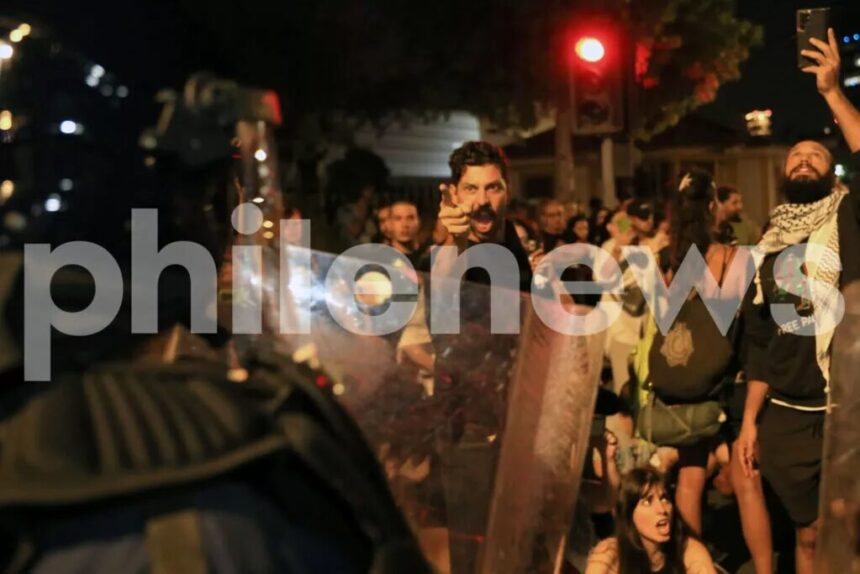
Protesters are set to file complaints with Cyprus’s police watchdog following allegations of police abuse during a demonstration on Thursday evening. This rally took place outside the Foreign Ministry to condemn Israel’s interception of a humanitarian aid flotilla bound for Gaza.
According to a police statement released on Friday, officers employed what they termed “proportionate force and individual spray” to disperse the crowd, claiming demonstrators resisted their instructions. The police reported facing pushing and resistance while attempting to move participants.
Massimiliano Sfregola, a freelance journalist for Italian daily Il Manifesto, witnessed the police action and described it as indiscriminate. He stated, “The spray was used 360 degrees. It was not targeting one person. It was pretty random. The purpose was to create damage to everybody that was there.” His experience highlights the chaotic nature of the officers’ response.
A member of the Global Movement for Gaza Cyprus, the group that organised the protest, confirmed that demonstrators plan to report the alleged police abuse, including the use of pepper spray that caused significant discomfort. They stressed that the protest was intended to be peaceful and that the police response was unprovoked.
Corina Demetriou, a spokesperson and lawyer for the group, noted that police cited violations of Cyprus’s new protest law as the reason for their intervention. She argued that the law does not prohibit emergency, unannounced demonstrations, especially in urgent situations like the interception of the humanitarian flotilla.
Demetriou also stated that demonstrators received no prior warnings about restrictions on their gathering, nor were they instructed to stay within a specific area to justify police action. In an ironic twist, she mentioned that even traffic police officers were affected by the pepper spray when demonstrators sought their assistance in alleviating the irritation caused by the chemical.
Among those allegedly subjected to excessive force was Neoklis Sylikiotis, a former minister and member of the AKEL party. Demetriou speculated that officers may not have recognised him, suggesting that his non-Cypriot background could have contributed to their response. She expressed a lack of faith in the complaints process, stating, “We will file complaints with ADIPA [Independent Authority for the Investigation of Allegations and Complaints Against the Police], without much hope, because we haven’t had the best experience.”
Demetriou pointed out that previous complaints regarding police conduct at demonstrations had gone unanswered, raising concerns about the accountability of law enforcement. She asserted the importance of filing complaints to ensure institutions are monitored effectively.
The issues surrounding police conduct will be discussed at the upcoming session of the Parliamentary Committee on Human Rights, where an OSCE report concerning the new protest law will also be examined. Demetriou expressed more confidence in parliament’s ability to act than in ADIPA.
In their statement, protest organisers refuted the police narrative, emphasising that the demonstration was a legitimate exercise of the constitutionally guaranteed right to protest. They condemned the police’s “disproportionate and violent reaction” and called the use of chemical irritants against unarmed participants a serious abuse of power. They reiterated the peaceful nature of the protest and lamented the lack of communication from police, which they argued endangered the safety of attendees, including vulnerable individuals.
Nikos Loizides, president of the Isotita trade union’s police branch, acknowledged that individuals who believe excessive force was used have the right to submit complaints. He reiterated that citizens have the right to demonstrate, asserting that police actions are guided by safety criteria rather than the content of protests.
The Cyprus News Agency attempted to reach both the justice minister and the police for comments, but no response was received by the time of publication. As the situation unfolds, the dialogue surrounding police conduct and the right to protest in Cyprus remains critically relevant.