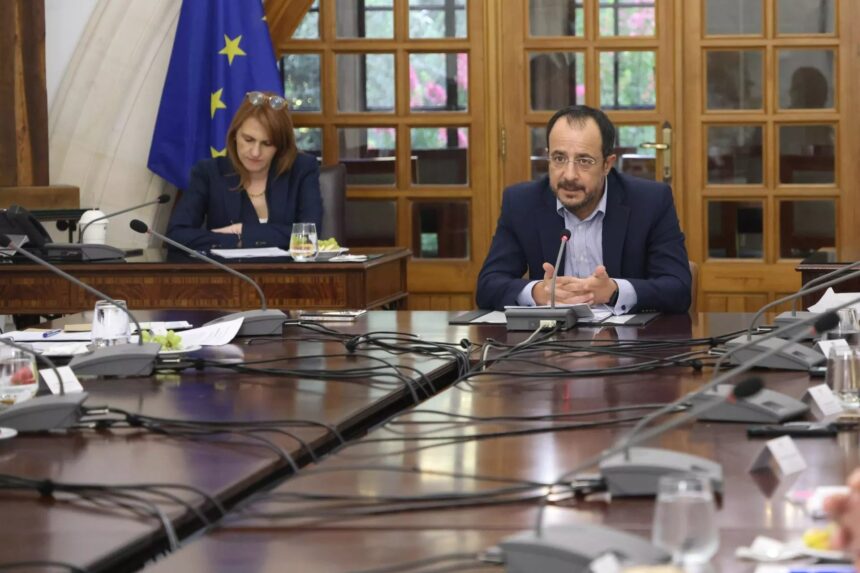
The Cabinet convenes this morning at the Presidential Residence in Troodos to discuss Cyprus’s upcoming role in the EU Council Presidency, set for the first half of 2026. Government Spokesperson Konstantinos Letymbiotis announced that Deputy Minister for European Affairs Marilena Raouna will outline the priorities for the Cypriot Presidency during the session.
Letymbiotis emphasised that this meeting will involve comprehensive coordination among ministers, who have already been briefed on relevant matters concerning their portfolios. Ahead of today’s Cabinet session, individual meetings between Raouna and various ministries have taken place to ensure a unified approach.
Eu presidency: Presidential Insights on EU Leadership
President Nikos Christodoulides expressed that assuming the EU Presidency represents a significant national mission, offering an opportunity for Cyprus to assert its voice within the European Union. He stressed the importance of thorough preparation as the start date approaches.
Infrastructure and Visitor Expectations
During the Cabinet meeting, the President provided details on the logistical preparations for the Presidency. A total of 258 meetings are scheduled to be held across Cyprus, with an anticipated influx of 28,000 visitors. Of these meetings, 84 will take place in Nicosia, while an additional 33 will be held in each of the other provinces of free Cyprus.
Strategic Priorities for the Presidency
Christodoulides outlined a two-level priority approach for the upcoming Presidency. The first level focuses on EU dossiers that Cyprus will inherit from Denmark, with particular emphasis on the Multiannual Financial Framework, which is known for its challenging negotiations among member states.
The second level targets the simplification of EU procedures that impact competitiveness, security, and defence. These efforts aim to bolster the EU’s strategic autonomy during a time of heightened global challenges.
Key National and EU Priorities
The President identified several national priorities crucial to Cyprus’s role during its EU Presidency. Defence and security topped the list, highlighting the importance of discussions among Foreign Ministers, Defence Ministers, and at the European Council level.
Migration is another significant focus, with the President noting positive developments in recent figures compared to 2022. He expressed optimism that other EU member states are keen to adopt Cypriot practices in this area, particularly with the implementation of the Migration Pact.
Water security also features prominently on Cyprus’s agenda, as it poses challenges not only for Cyprus but for numerous states across the EU. Christodoulides aims for meaningful progress beyond mere declarations.
Housing issues are another concern, affecting several member states, including Portugal, Spain, Greece, and Italy. Cyprus seeks economic support from the EU to tackle these challenges, particularly those impacting young people.
Engaging with the Middle East
Lastly, the President highlighted the importance of strengthening the EU’s relationship with the broader Middle East region. He referred to a recent meeting with Egypt’s Foreign Minister, which underscored the necessity for the EU to engage regional states as partners. As part of this initiative, Cyprus will host the Informal European Council on 23 April, aimed at enhancing collaborative efforts.