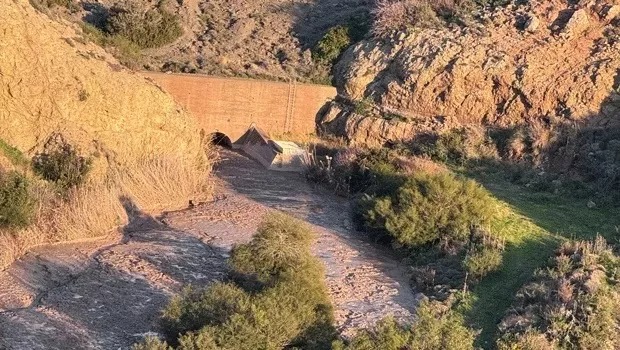
Experts estimate that hundreds of fruit bats fled the Mavrokolympos dam’s drainage tunnel before it flooded due to unexpected damage in January. Agriculture Minister Maria Panayiotou provided this information during a parliamentary session, responding to inquiries from MP Charalambos Theopemptou regarding the fate of the Egyptian fruit bats (Rousettus aegyptiacus) known to inhabit the dam’s drainage pipeline.
- In light of these developments, the future looks hopeful for the Egyptian fruit bats, with expectations for their return to the Mavrokolympos dam after the necessary repairs are made.
The incident occurred on 19 January 2025, when damage to the base of the dam’s drainage tower led to uncontrolled water leakage. Panayiotou described the situation as unforeseen, prompting immediate concern over the welfare of the bats.
As authorities became aware of the flooding and leakage, they sought to determine whether any bats had been trapped inside the tunnel. However, access was compromised due to the substantial leak and mud accumulation, making it impossible to enter safely.
Utilising specialised bat detection equipment, officials were able to confirm that no animals remained trapped. “The estimation of experts was that the animals abandoned the tunnel before it filled with water and mud,” the minister stated, alleviating concerns over the potential loss of life among the bat population.
The Environment Department had previously acknowledged the presence of the bat colony, as the Mavrokolympos dam is situated within the Natura 2000 Koili-Mavrokolympos protected area. This raised questions from Theopemptou about whether an Environmental Impact Assessment had been conducted prior to actions leading to the flooding.
Panayiotou clarified that the incident was a case of force majeure, not a result of planned actions. “No gate opening occurred, but the dam emptied due to leakage,” she explained, emphasising that the situation was unexpected and not a deliberate act by authorities.
According to the minister, the European Union Directive 92/43/EEC provisions regarding environmental assessments did not apply in this instance due to its nature as a force majeure event. She reassured that there are numerous natural caves and cavities in the surrounding area that could have served as refuge for any bats that fled the tunnel.
Additionally, authorities are considering the possibility that the bats may have integrated into existing colonies in nearby locations. The Egyptian fruit bat species has seen a notable population growth across Cyprus in recent years, with old colonies re-establishing and new ones forming.
Once repairs to the damaged drainage infrastructure are completed and the tunnel is cleaned, authorities anticipate that the habitat will once again become suitable for recolonisation by the bats. Relevant departments will monitor the area closely to track any potential return of the colony.
Panayiotou reiterated that there was no obligation to notify the European Commission regarding this incident under the applicable environmental directive provisions, given its classification as a force majeure event.
In light of these developments, the future looks hopeful for the Egyptian fruit bats, with expectations for their return to the Mavrokolympos dam after the necessary repairs are made.