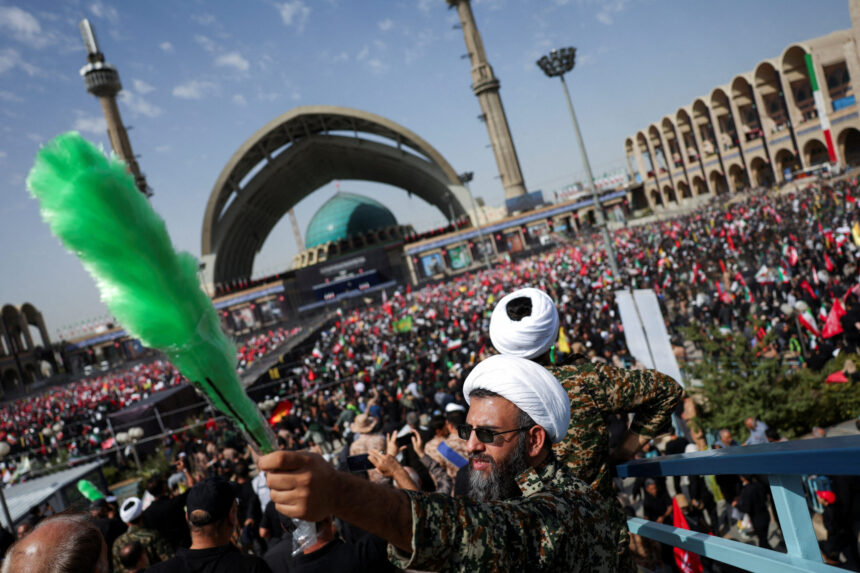
khamenei funeral — khamenei funeral — The mass grief at the funeral of Ayatollah Ali Khamenei underscores the hardline grip on post-war Iran. Tens of thousands gathered at the Imam Khomeini Grand Mosalla in Tehran on Saturday to pay their respects to the supreme leader, who was killed at the outset of the U.S.-Israeli war on Iran.
Mourners dressed in black and adorned with the red, white, and green flags of the Islamic Republic displayed portraits of Khamenei alongside those of his son and designated successor, Mojtaba. This week-long mourning period has been marked by fervent displays of loyalty to the theocratic state, reinforcing the regime’s narrative amidst escalating tensions.
On the day preceding the public display, Khamenei’s coffin was laid in state for high-ranking Iranian officials and foreign dignitaries. Once unveiled to the public, the coffin was placed under glass, accompanied by the remains of his family, including his daughter and 14-month-old granddaughter. Despite the profound loss, there has been no public sighting or image released of Mojtaba, who is reported to have sustained injuries in the same attack that took his father’s life.
The atmosphere at the funeral was charged with emotion, as attendees chanted slogans such as “Death to America,” reflecting a collective sentiment of vengeance for the perceived injustices inflicted by foreign powers. Arash Rahimi, a 40-year-old attendee, articulated the prevailing mindset: “Everyone here has come to avenge the blood of their supreme leader… Our relations with the United States will never be good.”
The timing of this event is significant, as tensions remain high following a pause in hostilities due to a ceasefire agreement with Washington. Iranian officials assert that this truce holds the promise of substantial economic advantages, framing it as a victory over a superpower. The interim deal is said to involve unfreezing billions in assets and alleviating financial sanctions that have long crippled the Iranian economy.
However, the public’s loyalty to the leadership remains ambiguous. Just weeks prior to the war, major protests erupted against the government, leading to a violent crackdown in which thousands perished. Since the onset of hostilities, this dissent has largely dissipated, replaced by a fervent display of solidarity towards the regime. The war has already claimed over 3,000 lives, with significant losses among political and military leaders, and has resulted in extensive damage to Iran’s infrastructure.
In the context of Iran’s theocratic structure, Khamenei was more than just a political leader; he was viewed as the earthly representative of the last Imam in Shi’ite Islam. His death, particularly in an attack by enemies, evokes a powerful narrative of martyrdom, deeply rooted in the fabric of Iranian society. This sense of martyrdom is echoed in the traditions surrounding mourning, harking back to the historic death of the Prophet Mohammad’s grandson, Hussein, which has long defined the Shi’ite identity.
Although Islamic tradition calls for burials to occur within a day, the ongoing conflict necessitated a delay until after the ceasefire was brokered. Khamenei’s body was laid in state in a grand hall designed to honour his predecessor, Ayatollah Ruhollah Khomeini, and will be transported across various cities for further commemorations. Following the massive procession planned in Tehran, the remains will be taken to Qom, the heart of Iran’s Shi’ite hierarchy, before travelling to Iraq for ceremonies in the sacred cities of Najaf and Kerbala.
Authorities are mobilising resources to ensure that millions participate in the forthcoming processions, providing transport, food, and accommodation for the mourners. This effort illustrates the regime’s commitment to reinforcing its narrative and maintaining control over public sentiment in these turbulent times.