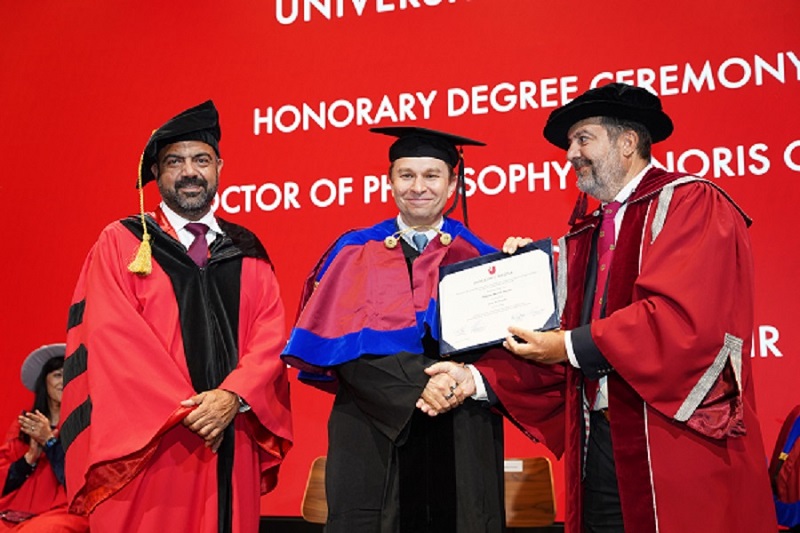
David Sinclair, a leading figure in longevity science, was honoured with an honorary Doctor of Philosophy by the University of Nicosia (UNIC) on June 5, 2026. This prestigious accolade was bestowed by UNIC’s School of Life and Health Sciences, recognising Sinclair’s remarkable contributions to the biology of ageing and his influence on public understanding of health.

Photo: cyprus-mail.com
A Ceremony of Distinction
The conferment ceremony brought together academics, students, and special guests, marking a significant occasion in the academic calendar. The Rector of UNIC, Professor Philippos Pouyioutas, opened the event with welcoming remarks, emphasising that the title of Honorary Doctorate is the highest distinction the University can offer, reserved for those whose contributions to science and culture are of exceptional significance.
Celebrating Scientific Achievement
Following the Rector’s address, the Dean of the School of Life and Health Sciences, Professor Kyriacos Felekkis, presented a detailed overview of Professor Sinclair’s extensive scientific career. He highlighted Sinclair’s role as the founding director of Harvard’s Glenn Center for Biology of Aging Research from 2005 to 2023. Under his leadership, the centre became a pioneering institution, with Sinclair’s laboratory among the first to elucidate the role of sirtuins in lifespan regulation.
Professor Felekkis elaborated on Sinclair’s Information Theory of Ageing, a groundbreaking concept proposing that ageing is partly due to the gradual loss of epigenetic information. He also referenced Sinclair’s landmark publication in Nature in 2020, which showcased how cellular reprogramming could restore youthful gene expression patterns in the nerve cells of mice. This innovative work aligns closely with the School’s mission, focusing not just on treating ailments but on preventing them, aiming to enhance functionality, dignity, and quality of life.
A Personal Reflection from Professor Sinclair
During the ceremony, Professor Sinclair expressed profound gratitude for receiving this recognition, describing it as one of the highlights of his career. He acknowledged the crucial support he has received throughout his journey, including from his partner Serena, his son Benjamin, and his father, Andrew, who, at nearly 87, embodies the principles of longevity that Sinclair studies.
Professor Sinclair passionately articulated his views on ageing, stating, “When you see an elderly person in the street who can barely walk, you are not really seeing an old person. You are simply seeing someone whose cells need resetting, a fresh software installation.” His insights challenge conventional perceptions of ageing and inspire a more optimistic perspective on the potential for rejuvenation.
Inspiring Future Generations
Addressing the gathered students, Sinclair encouraged them to discover purpose in their lives. He highlighted that having a passion and sense of mission not only enriches life but also, according to research, contributes to longevity. His admiration for UNIC was evident; he referred to it as “a gem of the Mediterranean” and expressed his intention to promote the University upon returning to the United States.
Professor Sinclair’s Legacy
David Sinclair is not only a Professor of Genetics at Harvard Medical School but also an accomplished author, having penned the international bestseller Lifespan: Why We Age and Why We Don’t Have To. His innovative approach has led to the founding of numerous biotechnology companies, and he holds over 50 patents. Sinclair’s contributions to medical research have earned him a place on Time magazine’s list of the 100 most influential people in the world, as well as an appointment as an Officer of the Order of Australia.
His honorary doctorate at UNIC coincided with his visit to Cyprus, which included a lecture at UNIC Athens as part of the Evolve Lecture Series. This lecture focused on reversing ageing and the forefront of human clinical trials, showcasing Sinclair’s commitment to advancing the field of longevity science.
The Future of Longevity Science
The recognition of Professor Sinclair by UNIC not only celebrates his past achievements but also highlights the ongoing importance of longevity research. As the scientific community continues to unravel the complexities of ageing, figures like Sinclair inspire both innovation and a shift in societal attitudes towards health and ageing.
As we look to the future, Sinclair’s work serves as a beacon for aspiring scientists and researchers, encouraging them to question the status quo and pursue groundbreaking discoveries in the realm of longevity.