us-venezuela tensions — us-venezuela tensions — Tensions between the United States and Venezuela are rising as the U.S. navy strengthens its presence in the Southern Caribbean, primarily to tackle threats posed by drug cartels in Latin America. This military escalation aligns with President Donald Trump’s ongoing efforts to combat drug trafficking, which he has identified as a key objective of his administration.
As part of this large-scale naval deployment, U.S. officials have confirmed that seven warships, including the USS San Antonio, USS Iwo Jima, and USS Fort Lauderdale, along with a nuclear-powered submarine, are either currently in the region or expected to arrive shortly. This significant military presence surpasses typical operational levels seen in the area.
In a statement made on Thursday, a U.S. official, who requested anonymity, highlighted that approximately 4,500 service members, including 2,200 Marines, are involved in this operation. The U.S. military is also utilising P-8 spy planes to gather intelligence over the waters, maintaining operations in international airspace.
Amidst this backdrop, Venezuelan President Nicolas Maduro has vocally opposed the U.S. military movements, asserting that the presence of nuclear submarines threatens Venezuela and violates international treaties. He characterized the U.S. actions as provocations that could destabilise the region.
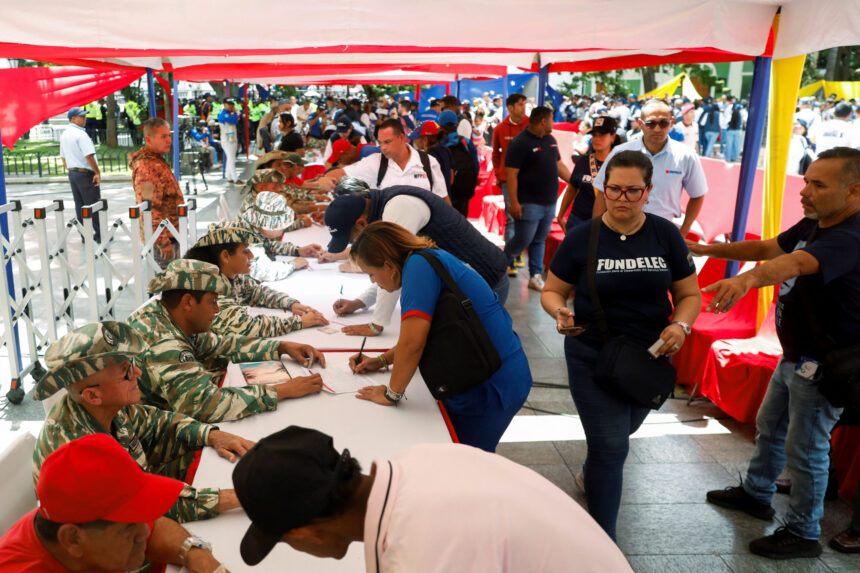
Maduro has responded by mobilising Venezuelan troops, announcing the deployment of 15,000 soldiers to the western border with Colombia to combat drug trafficking. He has also called for local civil defence groups to conduct training sessions, underlining the government’s commitment to countering what they perceive as foreign aggression.
The Trump administration has justified its military strategy by asserting the right to combat cartels and criminal enterprises, recently designating Mexico’s Sinaloa Cartel and the Venezuelan Tren de Aragua as global terrorist organisations. White House press secretary Karoline Leavitt noted that many Caribbean nations support the U.S. counter-drug initiatives, reflecting a degree of regional backing for the operations.
While the White House maintains that its diplomatic efforts are not rooted in threats or military force, the significant naval presence signals a shift in approach. Trump’s rhetoric has intensified in relation to drug trafficking, with his administration prepared to deploy “every element of American power” to stem the flow of drugs into the United States.
Maduro, on the other hand, has consistently accused the U.S. and opposition forces of conspiring against his government, framing economic sanctions as acts of “economic war.” The tensions between these two nations appear to be at a critical juncture, with military posturing on both sides suggesting a more volatile environment in the Caribbean.