Timur Turlov presented the Freedom case at Stanford Graduate School of Business, marking a significant academic milestone for Central Asian corporate strategies.

Photo: en.philenews.com
- Timur Turlov presented the Freedom case at Stanford Graduate School of Business, marking a significant academic milestone for Central Asian corporate strategies.
Freedom case: Pioneering Central Asian Corporate Strategy
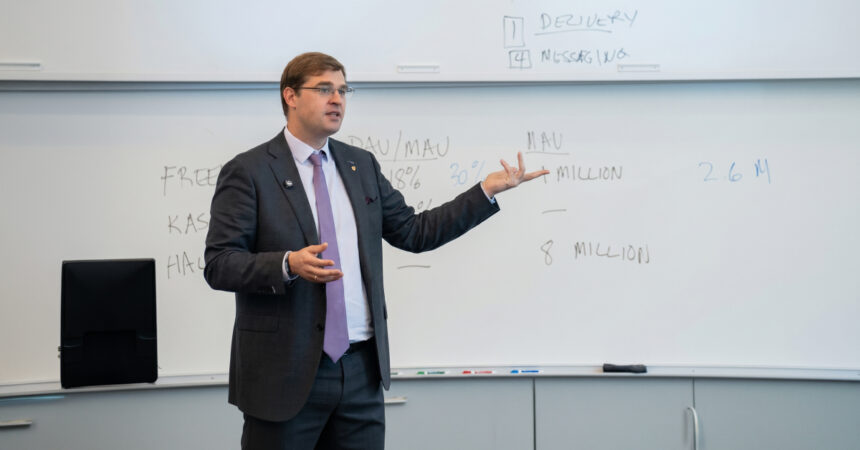
On 26 May, Timur Turlov, CEO of Freedom Holding Corp., addressed MBA students at Stanford University in California. This session was notable for being the first academic case study at Stanford GSB focused on the corporate strategy of a Central Asian company. The teaching material, published by Stanford GSB in June 2025, delves into the group’s strategy, business model, Nasdaq listing, IT product launches, and the construction of a corporate ecosystem.

Photo: en.philenews.com
Understanding Product-Market Fit
The session was conducted by Professor Howard Rosen, who positioned Freedom Holding as a benchmark for examining product-market fit. He highlighted that this case study enables students to analyse key metrics that define high-growth companies, including customer lifetime value, cost of acquisition, and the daily-to-monthly active user ratio. In a follow-up Q&A, Turlov elaborated on how Freedom’s group structure enhances credibility with new customers across various sectors, with the bank serving as a foundational element that fosters trust in the broader ecosystem.
Building a Cohesive Ecosystem
Turlov explained that the individual businesses within Freedom would not have thrived independently, asserting that the holding was intentionally structured so that each company supports the others. He stated, “We’re not just a holding company that owns everything. We consciously built Freedom as an ecosystem where each company’s presence makes sense. Our SuperApp clearly demonstrated why we’re competitive together, but not separately. Neither the bank nor the insurance companies could have survived or achieved significant success on their own.”
Expanding into Digital Markets
During his presentation, Turlov discussed Freedom’s international expansion as part of a broader transformation in how economies generate value, shifting focus from raw materials and manufactured goods to high-margin digital products. With a Nasdaq listing and operations in over 20 countries, Freedom is expanding its footprint in Europe, anchored by Freedom24 in Cyprus and active retail operations across the European Union.
Turlov remarked, “I think our technology export stories will definitely emerge. Just as everyone initially competed in the export of raw materials, and then in the export of manufactured goods, now everyone is competing in the export of digital products. The highest added value lies in the creation and exploitation of digital technologies.”
Strategic Moves into New Markets
Looking ahead, Turlov identified the next wave of geographical expansion, highlighting ongoing projects in Tajikistan and efforts to secure a licence in Georgia. He cautioned against the misconception that the SuperApp can be easily exported as a turnkey solution, stating, “The idea that you can bring a ‘box’ with SuperApp, install it, and everything will unfold on its own is an illusion. The integration needs to be rebuilt and adapted to different regulatory regimes and reporting requirements.” He noted that Kazakhstan’s existing business processes provide a robust foundation that can be adapted for new markets rather than completely overhauled.
Educational Impact and Future Insights
Wrapping up the discussion, Professor Rosen emphasised that the Freedom case study teaches students to identify unique niches within familiar markets. He remarked, “It’s not where you start, the problem or the technology, it’s where you end up.” The inclusion of this case study in the Stanford curriculum serves as a testament to the significant progress Freedom Holding has made and serves as a reference point for its subsequent international growth.