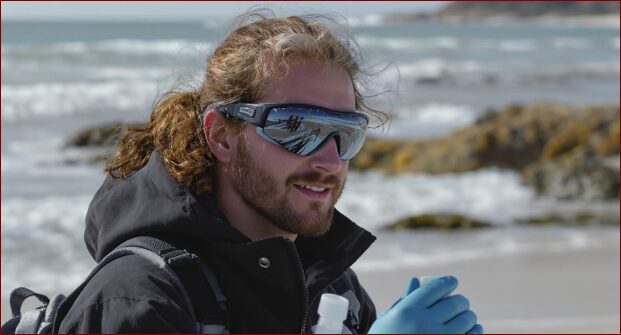
field science — Taylor Thomson brings field science into classrooms, transforming the way students engage with their environment. At Alwyn College in Auckland, students were exposed to real scientific work for the first time as they immersed themselves in the reserve behind their school. Equipped with water testing gear and field notebooks, they learned how to assess ecosystem health through hands-on observation.
This initiative reflects a growing trend in environmental education, where researchers like Thomson step outside the confines of traditional classrooms to offer immersive field experiences. As an environmental scientist currently pursuing his master’s degree at Waikato University, Thomson has dedicated the past year to bringing authentic research practices into schools throughout New Zealand. “I wanted students to get out and observe nature and upload data or pictures using devices they are familiar with so they can appreciate nature,” he shared after completing an extensive five-day educational tour.
Field science: Bridging Theory and Practice in Environmental Education
Thomson’s teaching methodology stems from his research on estuarine tipping points, which predicts when healthy coastal ecosystems may deteriorate and become resistant to recovery. Instead of keeping this complex research confined to academia, he has tailored his protocols for younger audiences, making them accessible and engaging.
At Roseville College, students participated in habitat assessments, actively searching for macroinvertebrates, measuring water quality, and exploring the connection between land use and stream health. “They had strong links to our kaupapa, they supported knowledge building but allowed for practical and hands-on experiences as well,” Thomson noted, highlighting how field-based learning intertwines cultural values with scientific inquiry.
Learning Through Direct Observation
The hands-on approach adopted by Thomson simplifies complex ecological topics. Instead of relying solely on diagrams, students engage with the ecosystem directly. They observe algal blooms, measure water clarity, and identify species that indicate the health or stress of their environment. Younger students at Parkade School utilised smartphone cameras and simple data sheets to document environmental conditions, proving that effective observation can be achieved without advanced tools.
Transforming Classroom Experiences with Real-World Science
Thomson’s journey from environmental monitoring officer to educator has profoundly influenced his teaching style. His previous role with the Waikato Regional Council involved collecting water samples in diverse environments, providing him with firsthand insight into the challenges faced by environmental professionals.
This practical experience informs his lesson design, allowing him to present science in a way that mirrors real-world scenarios rather than relying on textbook examples. Students learn to navigate incomplete data and unexpected results—key aspects of genuine scientific research. “It’s really nice to be able to take that to the students and get them to learn from a really young age and get them thinking about how they can preserve these environments for themselves,” Thomson explained. His ongoing research in ecological modelling ensures that students are engaged with contemporary science.
Engaging Diverse Learning Styles
With training in both environmental science and psychology, Thomson adeptly tailors his lessons to accommodate different learning styles. He understands that fostering engagement requires both intellectual and emotional connections. His activities give students a personal stake in environmental issues, making the subject matter resonate more deeply.
Cultivating Scientific Literacy Early On
Thomson’s initiatives aim to fill a critical gap in science education, where many students do not encounter authentic scientific practices until they reach university. By introducing real-world methodologies to younger students, he helps nurture scientific literacy before misconceptions can take root. “Field-based STEM opens so many doors to kids and teachers just to experience all these things that they never would otherwise,” he reflected.
Moreover, his approach addresses communication challenges he faced while working as a monitoring officer, where misconceptions about water quality testing arose. By involving students directly in research, Thomson clarifies the purpose and importance of environmental science.
Preparing Informed Environmental Citizens
The skills students acquire through these programmes extend well beyond environmental studies. They gain valuable experience in data collection, analysis, and interpretation, fostering competencies essential for evidence-based reasoning and problem-solving—regardless of whether they choose to pursue careers in science.
Thomson’s current role as an Environment Specialist at BHP enhances the relevance of his teaching, showcasing how scientific training can be applied in industry. His success in engaging students across various age groups suggests that field-based environmental education can enrich science curricula at all levels, transforming the learning experience from passive information transfer into active knowledge creation.