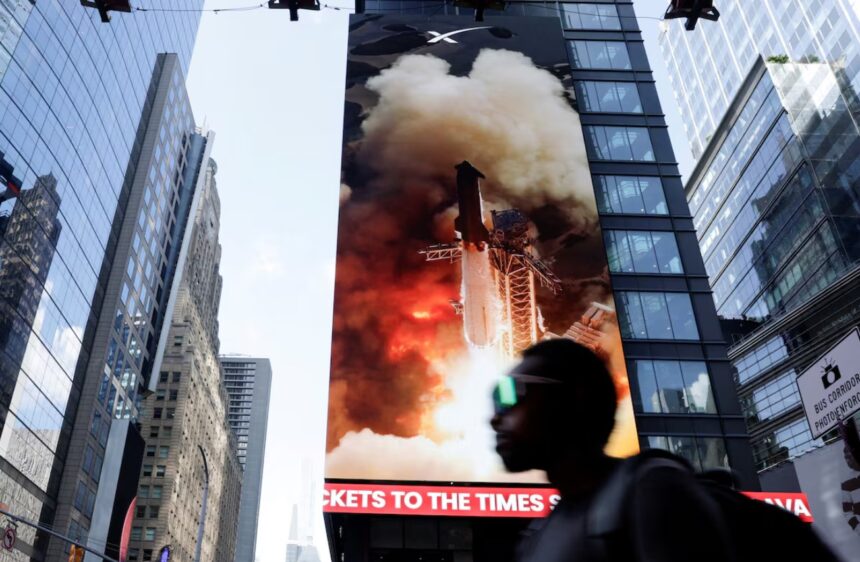
spacex shares — spacex shares — SpaceX’s shares are teetering near their initial public offering price, presenting a significant confidence test for investors. The company, known for its advancements in rockets and AI, made a splash in the market when it debuted on June 12, initially soaring to a valuation exceeding $2 trillion.
However, the excitement has dwindled as trading turned volatile. As of July 14, the stock closed at $136.08, down 2.2 per cent and dipping as low as $135.52, which is just above the $135 offer price. Analysts warn that if the stock falls below its IPO price of $150, it could be a psychological blow for investors.
Matthew Maley, chief market strategist at Miller Tabak, emphasised that a drop below this threshold could suggest that the stock is buoyed by speculation rather than solid fundamentals. “It raises the narrative that the stock is up on fluff,” he stated, highlighting concerns about the sustainability of its valuation.
Investors who anticipated significant gains from SpaceX’s listing may face disappointment, according to Greg Halter, director of research at Carnegie Investment Counsel. He pointed out that the current weakness in the stock could align it more closely with the historical trend of heavily hyped IPOs, which often see negative returns in their early stages.
Although a decline below the IPO price would not be unprecedented, it certainly raises eyebrows. Other recent IPOs, such as Cerebras Systems and even Meta, have experienced similar drops shortly after their market introductions. Ryan Lee, senior vice president at Direxion, noted that this phase is part of the price discovery process for newly listed companies.
Gabriel Shahin, CEO at Falcon Wealth Planning, acknowledged that while a short-term dip below $135 would be painful, it would not significantly alter their investment strategies. He explained that many investors and employees typically sell shares after lockups expire, contributing to market fluctuations.
As the market watches closely, SpaceX’s performance could have far-reaching implications for future IPOs. Companies like OpenAI and Anthropic are contemplating their own market debuts, and Halter mentioned that investment firms are observing SpaceX’s trajectory with caution. “No one wants an IPO to flop or have the initial price ratcheted down,” he said, suggesting that some companies may reconsider their listings if the market does not stabilise.
Conversely, Lee expressed that SpaceX’s capital raise might encourage firms with significant funding needs to expedite their IPO plans. He suggested that companies in the competitive AI sector might wish to act swiftly to secure capital before potential market shifts.
Retail investors, who account for about 20 per cent of SpaceX’s allocation, may feel the brunt of any downturn. Shahin warned that many novice investors approached SpaceX with a speculative mindset, risking investments they cannot afford to lose. He cautioned that losses could reinforce the perception that the market favours insiders, highlighting the need for a clearer understanding of post-IPO volatility.
The upcoming earnings report from SpaceX will be a critical moment for the stock, with underwriters typically supporting shares in the initial 30 days. Given the high-profile nature of this offering, additional support may be provided. Maria Llerena, director of financial research at Domini Impact Investments, noted that loss-making companies without a clear path to profitability often experience significant volatility, with the potential to fall below their IPO price.