SK Hynix has overtaken Samsung Electronics to become South Korea’s most valuable listed company, showcasing a remarkable turnaround for a firm that faced near collapse two decades ago.
- SK Hynix has overtaken Samsung Electronics to become South Korea’s most valuable listed company, showcasing a remarkable turnaround for a firm that faced near collapse two decades ago.
- By 2025, SK Hynix captured an impressive 61 per cent of the global HBM market, vastly outperforming competitors Samsung and Micron, which held 17 per cent and 21 per cent, respectively.
- “Previously, the difference in manufacturing scale meant there was simply no way for rivals to close the profitability gap with Samsung,” Kim remarked.
A Shift in Market Leadership
This shift marks a significant transformation for SK Hynix, which is now the predominant supplier of high-bandwidth memory (HBM) chips critical for AI systems, serving major clients like Nvidia and Alphabet’s Google.
As of the latest market close, SK Hynix’s shares surged by 5.6 per cent, elevating its market capitalisation to 2,080.4 trillion won (approximately $1.35 trillion). In contrast, Samsung’s stock dipped by 0.14 per cent, resulting in a market value of 2,066.7 trillion won, not accounting for preferred shares.
The AI Boom and Memory Chips
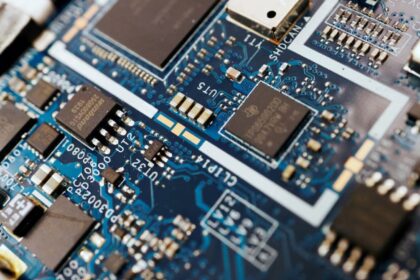
The rise of AI has significantly reshaped the semiconductor industry, turning specialised memory chips from mere commodities into essential components of the technology that powers applications like ChatGPT and other advanced AI models. SK Hynix has capitalised on this trend, solidifying its place at the forefront of the memory chip market.
“The emergence of customised AI memory fundamentally changed the industry’s economics and allowed SK Hynix to establish itself as the market leader,” noted Kim Sunwoo, a senior analyst at Meritz Securities.
A Historic Journey
SK Hynix’s path to the top has been anything but smooth. The company, formerly known as Hynix Semiconductor, was on the brink of being sold to Micron in 2002, overwhelmed by debts from aggressive expansion. The sale was ultimately called off, leading the company to operate under creditor control for nearly a decade.
At its lowest point in 2003, SK Hynix’s shares plummeted to just 135 won, relegating it to the status of a penny stock, or “Dongjeon-ju” in Korean. However, the memory industry’s cyclical nature saw the company navigate various booms and busts, which have influenced its fortunes over the years.
Resilience Amidst Market Challenges
Despite facing a challenging downturn in the memory market in 2023, when it reported an annual operating loss of 7.73 trillion won, SK Hynix began to recover as investments in AI from tech giants like Microsoft, Google, and Meta surged. This resurgence propelled the company to announce a record annual operating profit of 23.5 trillion won in 2024.
Strategic Investments in HBM
Analysts attribute SK Hynix’s pivotal role in the global AI ecosystem to its commitment to investing in HBM technology during market downturns. These specialised memory chips are designed to work closely with AI processors, creating higher barriers to entry and providing suppliers with increased pricing power.
By 2025, SK Hynix captured an impressive 61 per cent of the global HBM market, vastly outperforming competitors Samsung and Micron, which held 17 per cent and 21 per cent, respectively.
The Vision Behind the Acquisition
Founded in 1983 as a subsidiary of Hyundai, SK Hynix was later acquired by SK Group, a family-run conglomerate with diverse business interests. Chey Tae-won, the Chairman of SK Group, faced considerable opposition during the acquisition but remained steadfast in his vision.
In a book published earlier this year, Chey articulated his ambition: “What I really wanted to accomplish when we acquired Hynix was to transform it from a commodity memory producer into a mainstream semiconductor company whose products are indispensable.” He emphasised the significance of HBM technology, stating, “If SK Hynix’s HBM is replaced with another product, the AI system may not function properly. What used to be a peripheral component has become a core component.”
Future Prospects for SK Hynix
As SK Hynix continues to gain ground, analysts believe Samsung’s position as the world’s largest DRAM producer could be at risk. Bank of America estimates that SK Hynix’s monthly DRAM output will reach approximately 589,000 wafers this year, compared to Samsung’s roughly 691,000 wafers. However, projections indicate that SK Hynix may expand its DRAM output by about 38 per cent between 2025 and 2028, while Samsung’s growth is expected to be around 17.5 per cent.
This trajectory could narrow the production gap between the two companies to less than 10 per cent by 2028, down from 23 per cent in 2025, a noteworthy accomplishment given Samsung’s larger manufacturing scale.
“Previously, the difference in manufacturing scale meant there was simply no way for rivals to close the profitability gap with Samsung,” Kim remarked.
Expanding Global Presence
In a move to enhance its global presence, SK Hynix is reportedly planning to list on the Nasdaq, which would diversify its investor base and elevate its profile among international investors. This strategic step aligns with the company’s growth ambitions as it continues to innovate in the memory chip sector.