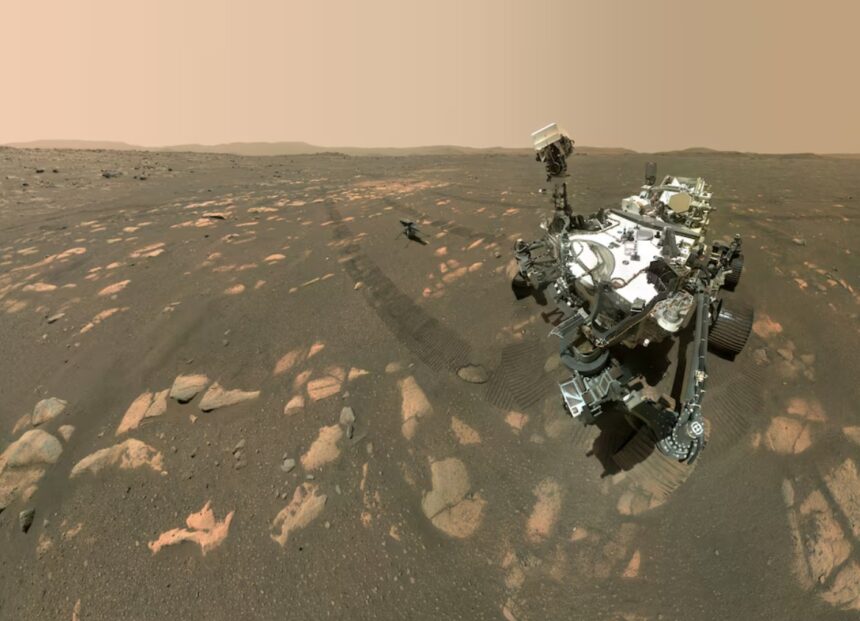
perseverance rover — NASA’s Perseverance Rover has been on a marathon journey across the Martian surface, exploring the planet for over five years. The six-wheeled robotic explorer has traversed 26.09 miles (41.99 km) so far, closing in on the official marathon distance of 26.22 miles (42.2 km). Mission manager Robert Hogg has indicated that the rover is expected to surpass this distance within the next month.
Perseverance rover: Exploring Jezero Crater
Since its landing on February 18, 2021, Perseverance has been focused on Jezero Crater, a site believed to have once housed a lake. This area of the Martian northern hemisphere is rich in geological features indicative of its watery past. The rover carries a suite of scientific instruments to study the geology, climate, and potential signs of ancient life in this intriguing environment.
Mission Longevity and Objectives
Originally, the Perseverance mission was slated to last one Martian year, approximately 687 Earth days. However, according to Ken Farley, the rover’s deputy project scientist at Caltech, Perseverance remains in good health with its power source expected to last at least another decade. The mission’s duration will ultimately depend on decisions made by NASA.
Significant Discoveries
Among Perseverance’s most notable contributions is the collection of rock samples from Jezero Crater, particularly a reddish rock formed from ancient lake sediments. Some findings suggest these minerals might indicate signs of microbial life, although Farley cautions that further analysis in terrestrial laboratories is necessary to confirm any biological origins.
Water and the Search for Life
Water is an essential ingredient for life, and Jezero Crater’s history suggests it once had a thicker atmosphere and a warmer climate conducive to liquid water. Scientists are keen to determine whether ancient microbial life ever existed on Mars. The rover’s studies in this region may provide critical insights into the planet’s past and its potential to support life.
Additional Findings and Observations
In addition to its search for ancient life, Perseverance has gathered evidence about organic molecules on Mars. The rover documented that Mars’ atmosphere is electrically active, detecting electrical discharges commonly associated with dust devils. Furthermore, it observed an aurora on Mars in visible light for the first time, illuminating the Martian sky with a soft green glow.
Investigating Ancient Environments
Perseverance has meticulously documented the life cycle of the lake that filled Jezero Crater approximately 3.7 billion years ago. Initially shallow, the lake evolved into a deeper body of water, depositing various sediments on the crater floor and forming a delta as it deepened to at least 30 feet (9 meters).
Key Research on Early Mars
The rover is currently operating just outside Jezero Crater, examining ancient rocks that potentially date back over four billion years. This timeframe is particularly significant, as it may mirror conditions on Earth during the origin of life. Farley emphasises that Mars offers a unique opportunity to investigate pre-biotic chemistry and the possible beginnings of life, given that similar rocks have been destroyed on Earth.
Comparative Analysis with Other Missions
Perseverance is not NASA’s only rover on Mars; Curiosity has been exploring Gale Crater since 2012 and has travelled 22.93 miles (36.91 km). The record for the most mileage driven on Mars is held by the Opportunity rover, which logged 28.06 miles (45.16 km) during its mission from 2004 to 2019.
The Ingenuity Helicopter
Alongside Perseverance, a small helicopter named Ingenuity has made history as the first powered aircraft to achieve controlled flight on another planet. It has completed 72 flights in Mars’ thin atmosphere, covering a distance of 10.5 miles (17 km) and reaching altitudes of around 79 feet (24 metres).
Ongoing Scientific Contributions
The diverse environments around Jezero Crater have made it a rich site for scientific exploration. Farley notes that Perseverance’s ability to study both a lake-river system and the ancient Martian crust, separated by hundreds of millions of years, continues to yield valuable scientific data even after five years on the Martian surface.