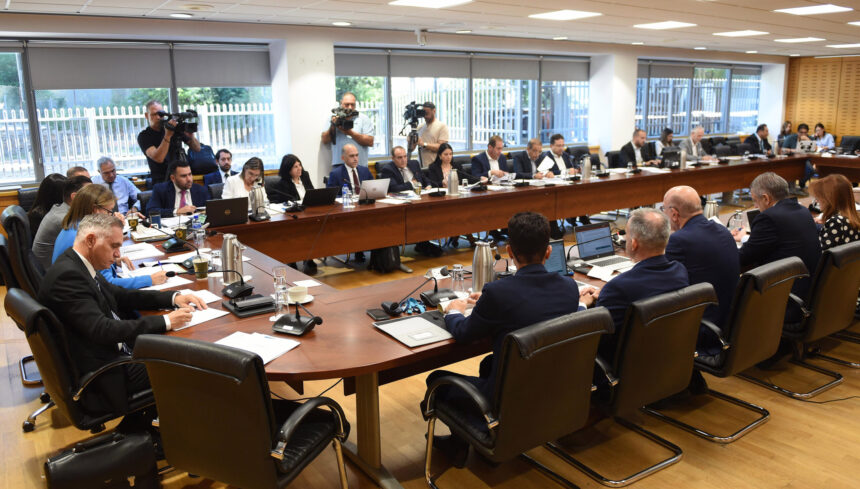
state budget — Opposition parties expressed strong disapproval of government policies as outlined in the state budget for 2026. During a session at the House finance committee, they contended that while some economic indicators appear favourable, they fail to truly represent the economic conditions and welfare of the public.
State budget: Mixed Reactions from Government and Opposition
The finance minister presented the state’s balance sheet, prompting MPs from the ruling coalition to commend government actions aimed at fiscal stability. Notably, Diko’s Christiana Erotokritou acknowledged the budget’s direction, stating that it successfully maintains fiscal stability and emphasising the reduction in public debt as a percentage of GDP. Under current EU regulations, countries with public debt exceeding 60 per cent of GDP and deficits above 3 per cent face monitoring, a situation Cyprus has managed to avoid.
Historical Context of Economic Monitoring
“The Cypriot economy and the Cypriot people have bad memories of being not just under monitoring, but even worse situations,” Erotokritou remarked, referencing the financial crisis of 2013 and its aftermath. Her comments highlighted the significance of maintaining a sustainable economic framework, particularly in light of past challenges.
Concerns over Economic Management
Contrasting the government’s optimistic portrayal, opposition figures expressed concern over potential mismanagement. Harris Georgiades from the Disy party acknowledged the economy’s current positive state but warned against complacency. “Mistakes are made in good times,” he cautioned, pointing to the growing public payroll, which increases by approximately €1 billion annually.
Stalled Reforms and Delayed Projects
Georgiades outlined a series of important reforms that seem to stagnate despite ongoing discussions. He specifically mentioned the electricity interconnector project with Greece as emblematic of the administration’s “double speak.” He argued that the government’s approach to growth and security requires decisive actions rather than mere rhetoric.
Defence Spending and Economic Security
Another point of contention raised by Georgiades involved Cyprus’s defence spending, which stands at just 1.7 per cent of GDP, significantly lower than the approximately 3 per cent average across Europe. “Growth and security, as well as meeting the needs of society, are not achieved with words and PR, but rather with decisions, measures and an ongoing reform drive,” he asserted, underscoring the need for a more proactive stance.
Social Inequality and Economic Disparities
Akel’s Andreas Kafkalias joined the critique, acknowledging that while key economic indices indicated a positive performance in 2025, this progress was not reflected in the lived experiences of many citizens. He pointed out that income inequality continues to rise, the cost of living is climbing, and housing affordability remains a significant issue for a substantial portion of the population.
Critique of Proposed Tax Reforms
Kafkalias expressed discontent with the government’s proposed tax reforms, labelling them as having “the wrong philosophy.” He described the ongoing disparity between profit accumulation and stagnant wages as the prevailing model of the economy, further exacerbating social inequality.
Public Sentiment and Future Directions
The criticisms from the opposition parties reflect a growing sentiment among some segments of the population who feel disconnected from the economic recovery narrative. As discussions around the budget continue, the government will face increasing pressure to ensure that economic gains translate into tangible improvements for everyday citizens.
The dialogue surrounding the budget is likely to intensify as various stakeholders, including civil society groups, begin to voice their concerns regarding the projected economic direction. The effectiveness of government policies will ultimately be judged by their impact on the welfare of the populace and the ability to address pressing societal issues.