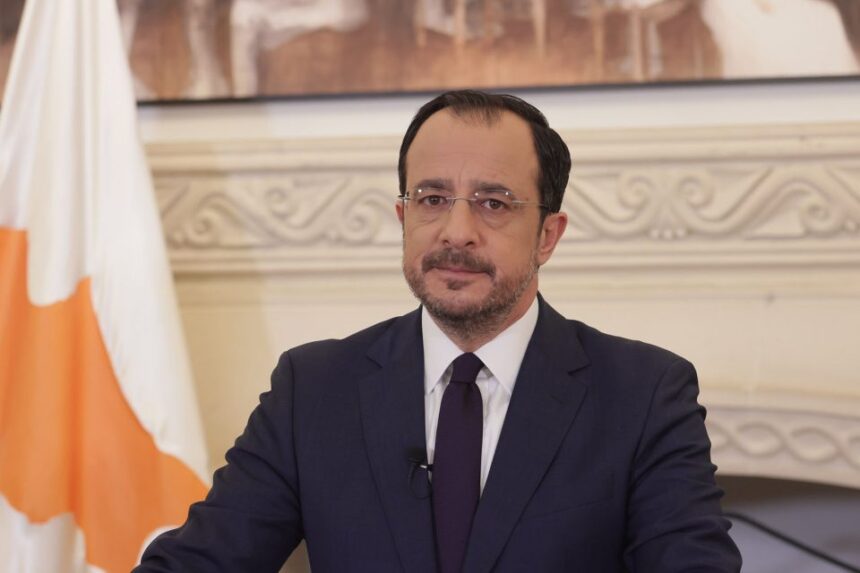
President Nikos Christodoulides has emphasised that future progress in Turkey-EU relations must be closely tied to significant developments regarding the Cyprus issue. In a recent interview with Kathimerini, he articulated his belief that European incentives are the primary means to encourage movement towards a settlement.
- “Turkey is not going to get something without compensation,” he asserted, making it clear that any concessions made to Ankara must be preceded by tangible progress on the Cyprus issue.
- Even if a final settlement is not achieved, he remarked, the objective should be to establish an irreversible political process directed towards a solution.
Christodoulides stated that his administration has intentionally sought to connect the Cyprus problem with Ankara’s relationship with the EU. He expressed a sense of “cautious optimism” about ongoing efforts to restart meaningful negotiations, underscoring the importance of existing convergences achieved in prior discussions as the foundation for future processes.
“I have said many times that Turkey is not going to proceed with the resolution of the Cyprus issue unless it feels that it will benefit from this solution,” he noted. The president highlighted that the European Union is the only entity capable of providing those benefits to Turkey.
Among the critical issues he pointed out are visa liberalisation, the modernisation of the EU-Turkey customs union, and broader cooperation with Brussels, all of which are of considerable importance to Ankara.
According to Christodoulides, Cyprus has made strides to ensure that Euro-Turkish relations are reflected in European Council conclusions and EU policy. He referenced decisions made by the European Council in 2024, noting that any advancements in relations with Turkey would follow a “gradual, proportionate and reversible” approach.
“Turkey is not going to get something without compensation,” he asserted, making it clear that any concessions made to Ankara must be preceded by tangible progress on the Cyprus issue.
While discussing ongoing talks with UN Secretary-General Antonio Guterres, Christodoulides did not divulge specifics, highlighting the sensitivity of the current efforts. He reiterated that preserving previous convergences is key to any future negotiations.
Rejecting the idea that a future negotiating framework could rely on ‘constructive ambiguity’, he warned that such ambiguity on fundamental issues would be unacceptable. He cited security and guarantees as critical areas where clear decisions are necessary, asserting that there can be no middle ground regarding Turkey’s guarantor role.
Christodoulides also managed expectations about a potential settlement, stating that any resolution would require compromise and would not fully restore the conditions that existed before 1974. “The solution to the Cyprus problem will not be completely fair because a solution to be completely fair would have to restore the state of things as they were before 1974,” he explained. “What matters is whether the solution we end up with is workable and sustainable.”
He maintained that functionality and long-term stability should be the principal criteria for evaluating any settlement. When asked if a comprehensive agreement could be reached by the end of the year, he responded that it remains a possibility if sufficient political will exists among all involved parties. “If there is political will, this goal is in complete touch with reality,” he affirmed.
Even if a final settlement is not achieved, he remarked, the objective should be to establish an irreversible political process directed towards a solution.
Shifting to foreign policy, Christodoulides highlighted Cyprus’ expanding international relationships, specifically with countries like India, Kazakhstan, and the UAE. He asserted that recent diplomatic initiatives have positioned Cyprus as a stable and reliable partner on the global stage.
On relations with France, he welcomed the newly signed Status of Forces Agreement (SOFA), calling it a significant advancement in defence and security cooperation. He noted that the agreement provides a necessary institutional framework for hosting French forces in Cyprus for humanitarian reasons, further contributing to the EU’s strategic autonomy.
In terms of energy policy, the President reiterated his support for the Great Sea Interconnector (GSI) project linking Cyprus and Greece, labelling it as a “strategic necessity and a key pillar of our energy policy.” He mentioned that updated technical and economic studies are underway in collaboration with the Greek government and that discussions with regional partners and potential investors are ongoing.
Despite exploring alternative interconnection options, he confirmed that connecting Cyprus to the European energy network remains the government’s primary objective. Additionally, he projected that the first revenues from natural gas development could begin to flow by the end of 2027 or in 2028, citing progress in negotiations with Egypt and energy companies operating in Cyprus’ exclusive economic zone.
Turning to domestic matters, Christodoulides defended his government’s economic performance, highlighting strong growth, reduced unemployment, and improved international credit ratings. However, he acknowledged ongoing concerns regarding living costs, housing affordability, and income inequality, asserting that economic success must increasingly benefit middle-income and lower-income households.
He stated, “The success of a country is measured by the strength of its middle class,” and outlined measures such as tax reform, pension reform, and housing initiatives aimed at addressing these issues while supporting long-term economic stability.
Addressing political dynamics, Christodoulides dismissed claims that recent parliamentary election results had weakened his position. He maintained that cooperation with parties supporting government policies remains constructive and reiterated that decisions regarding the presidential election in 2028 are yet to be made. “I haven’t made any final decisions,” he remarked. “I’ll be preoccupied with 2027.”