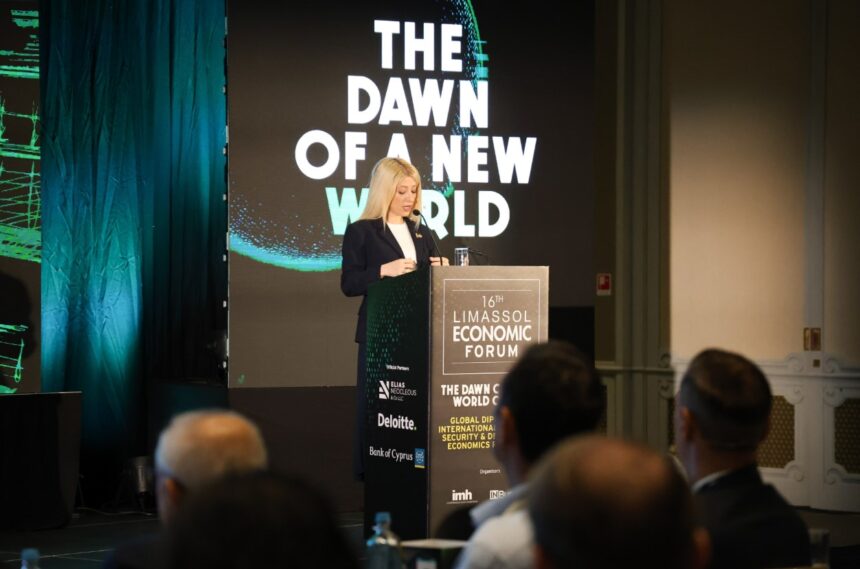
limassol economic — The 16th Limassol Economic Forum highlighted the need for Europe to lead, not just react, in the face of global disruptions. On Friday, policymakers, diplomats, and business leaders convened to discuss how these disruptions are reshaping economies, governance, and trade.

Photo: cyprus-mail.com
- In her address, she also urged the EU to expand its membership to include Ukraine, Moldova, and the Western Balkans, asserting that this would bolster peace and stability in the region.
- The forum concluded with a commitment to explore further how to address the challenges posed by a fragmented world, with emphasis on the need for cohesive action and leadership from Europe.
Opening the forum, Yousef Gamal El-Din, host of You’re in Business, remarked on Cyprus’s impressive economic standing, noting upgrades from global rating agencies. He pointed out that geopolitical variables will significantly influence the global economy this year, which set a tone for discussions centred on the themes of uncertainty and adaptation.

Photo: cyprus-mail.com
Limassol economic: Building Economic Resilience Through Reform
Deputy Minister to the President, Irene Piki, asserted that resilience is cultivated through vision, discipline, and collaboration. She outlined the Cypriot government’s strategy to enhance economic resilience, focusing on reform, investment, and institutional integrity. Piki emphasised that these elements are crucial for transforming challenges into opportunities, fostering an innovative economy that remains connected internationally.
She reiterated that reform is essential for future growth, with President Nikos Christodoulides prioritising it within his administration. Significant initiatives are already in progress, including modernising the justice system, tax reforms, and advancing digital transformation within the state.
Strategic Investments and Human Capital Development
Piki also highlighted the government’s aim to leverage reform momentum into strategic investments that move beyond mere capital inflow, fostering genuine partnerships with businesses. Initiatives like the recently launched Business Support Centre are pivotal to these efforts. She noted that Cyprus enjoys conditions of full employment, low inflation, and a robust fiscal position, all indicative of economic vitality.
The Deputy Minister pointed out that Cyprus’s recent engagement with India’s Prime Minister aligns with broader efforts to position Cyprus as a gateway to the European market. She also discussed the importance of climate resilience and sustainability, indicating their integration into national strategies.
Panel Insights on Market Challenges and Opportunities
A panel of business leaders, moderated by Gamal El-Din, delved into the pressing challenges businesses face today, such as inflation, geopolitical risks, and regulatory burdens. Elias Neocleous, Managing Partner at Elias Neocleous & Co LLC, remarked on the rapid pace of change, stating that the world is evolving faster than the laws that govern it, making certainty a rare commodity.
Neocleous described the current landscape as characterised by overlapping crises, which are reshaping borders and trade routes, while raising concerns about cyber threats and the erosion of the rule of law. He noted that clients are increasingly seeking predictability, governance options, and security, where agility has become the hallmark of success.
George Pantelides, Partner at Deloitte Cyprus, added that European companies are hampered by excessive regulation and require simpler, purpose-driven frameworks. He stressed the importance of maintaining a competitive cost base in Cyprus to attract investment and emphasised that tax certainty is crucial as the government’s tax reform nears completion.
Encouraging Innovation and Addressing Skills Shortages
Pantelides also highlighted the urgent need to address Europe’s skills shortage through continuous professional development and support for young entrepreneurs. He called for increased focus on export-oriented industries, such as pharmaceuticals and manufacturing, noting that technological adoption is fundamental for growth.
Charis Pouangare, Deputy CEO at the Bank of Cyprus, noted that Cyprus cannot remain isolated from global economic shocks. He reported an increase in bank lending this year, reflecting robust private sector activity and a growing sense of urgency among businesses to adopt scenario-based planning for future uncertainties.
Geopolitical Context and European Leadership
The discussions also turned to geopolitical issues, with House Speaker Annita Demetriou asserting that Europe must take proactive steps rather than simply react to global events. She underscored the importance of strategic autonomy in light of ongoing conflicts such as the war in Ukraine and the situation in Israel, stressing that Europe’s security framework remains incomplete.
Demetriou laid out three interlinked pillars of European strength: economic stability, technological leadership, and defence capability. She advocated for closing the competitiveness gap and fully utilising the Single Market, alongside calls for greater defence cooperation among EU nations.
In her address, she also urged the EU to expand its membership to include Ukraine, Moldova, and the Western Balkans, asserting that this would bolster peace and stability in the region.
The forum concluded with a commitment to explore further how to address the challenges posed by a fragmented world, with emphasis on the need for cohesive action and leadership from Europe.