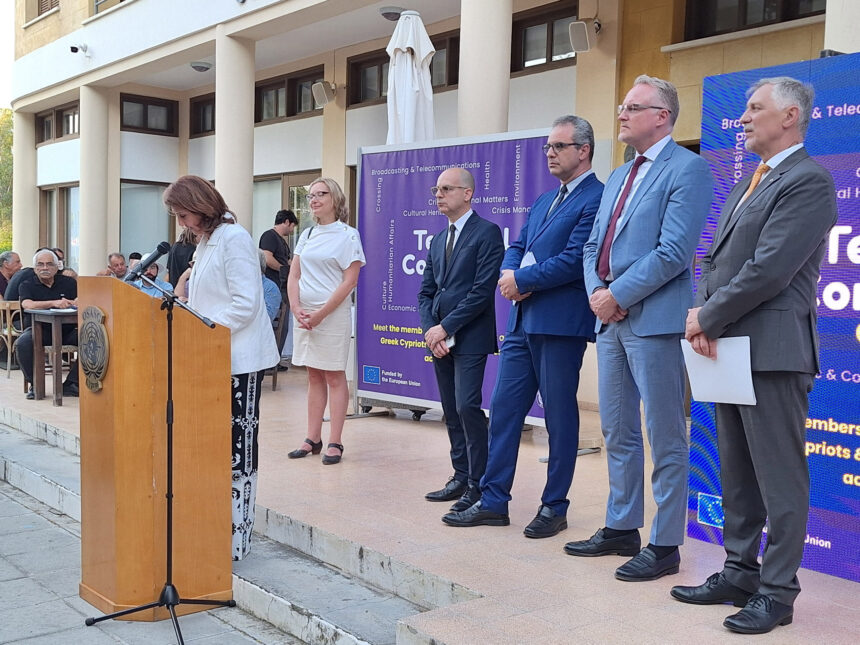
The bicommunal technical committees in Cyprus are hailed by UN secretary-general’s personal envoy Maria Angela Holguin as vital in fostering cooperation and mutual understanding between Greek Cypriots and Turkish Cypriots. Speaking at a public event organised by UNDP Cyprus at the Home for Cooperation in Nicosia, Holguin emphasised the significance of these committees in promoting dialogue that yields tangible outcomes.
Bicommunal technical: Committees as a Model of Collaboration
During her address, Holguin referred to the bicommunal technical committees as “the best example in Cyprus” of how collaborative efforts can successfully bridge divides. Her remarks came as part of her visit to the island, aimed at laying the groundwork for potential negotiations regarding the long-standing Cyprus issue.
The Importance of Dialogue
Holguin expressed her strong belief that cooperation and dialogue are essential components for progress in Cyprus. “Significant progress is achieved through relationships built over time, through dialogue and continuous contact between people. The technical committees are the best example of this in Cyprus,” she stated, highlighting the critical role these groups play in fostering relationships across communities.
Achievements of the Technical Committees
The envoy highlighted various accomplishments since the establishment of the committees in 2008. These achievements include efforts to preserve Cyprus’ cultural heritage, enhance public health collaboration, advance environmental initiatives, and implement practical projects that improve daily life for residents across the island. Holguin noted that although these contributions often go unnoticed by the media, their significance cannot be overstated.
Recognition of Volunteer Efforts
Holguin extended her gratitude to the members of the technical committees for their voluntary service and unwavering commitment. She encouraged them to persist in their efforts to build communication bridges and promote a collective vision for the future of Cyprus. “Your dedication and perseverance are a source of inspiration and a reminder that solutions can be found,” she remarked.
Perspectives from Leaders
Menelaos Menelaou, the Greek Cypriot negotiator, echoed Holguin’s sentiments, asserting that the technical committees exemplify the benefits of collaboration when approaching the Cyprus issue from a Cyprus-wide perspective. He characterised the committees as a manifestation of the aspiration for a peaceful and unified Cyprus, illustrating the tangible results of cooperative efforts.
Similarly, Mehmet Dana, the special representative of the Turkish Cypriot leader, described the technical committees as one of the most successful cooperation mechanisms established on the island in the last two decades. He pointed out that their contributions have yielded measurable benefits across various sectors, including public health, environmental protection, youth affairs, and gender equality.
Enduring Mechanisms Amid Challenges
Throughout the event, a consensus emerged among speakers regarding the resilience of the technical committees in the face of political obstacles. They reaffirmed that despite periodic challenges, these committees remain effective mechanisms for fostering cooperation in Cyprus, helping to cultivate trust and develop practical solutions that benefit all island residents.
Future Prospects for Cooperation
As Holguin continues her mission in Cyprus, her interactions with local leaders and communities are part of broader efforts to create conditions conducive to the resumption of negotiations aimed at achieving a comprehensive settlement of the Cyprus issue. The ongoing work of the bicommunal technical committees is viewed as a foundational element in this process, providing a model of how positive interactions can lead to substantial outcomes.
The commitment shown by committee members, alongside the support from international bodies like the UN, illustrates a pathway towards fostering a culture of cooperation and understanding on the island. As Holguin poignantly stated, the continuous efforts of these committees can inspire hope and demonstrate that collaborative solutions are indeed possible.