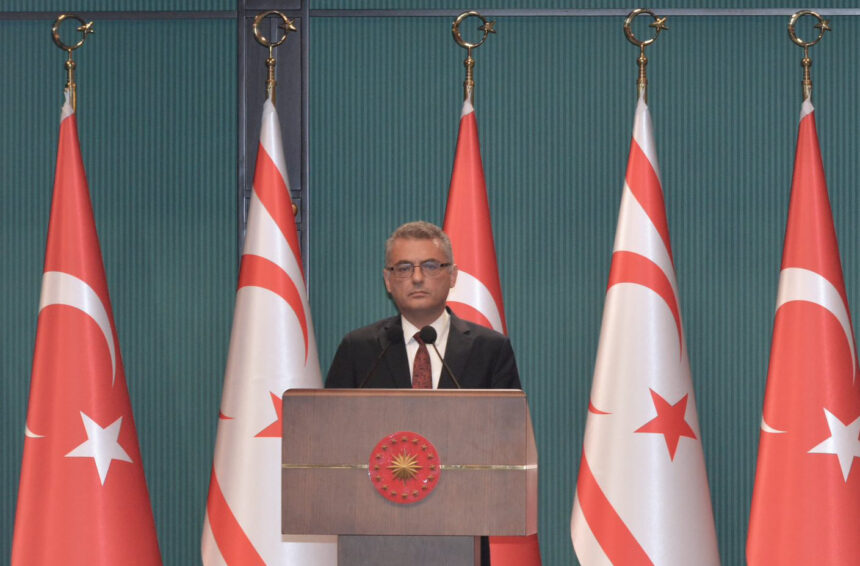
cyprus talks — Turkish Cypriot leader Tufan Erhurman firmly believes that Cyprus talks should not occur “just for the sake of it”. Instead, he advocates for negotiations that yield genuine solutions, highlighting that previous conferences in Geneva and New York have proven to be “pointless”.
In his first comprehensive interview since taking office in October, Erhurman expressed concerns over the legitimacy of any discussions that do not acknowledge the Turkish Cypriots as one of the island’s two constituent parties. He asserted that anything detrimental to their interests cannot be regarded as legitimate.
Addressing the ongoing Cyprus issue, Erhurman introduced his ten-point list of proposals, which he believes could benefit both communities on the island. He also commented on statements made by US ambassador in Ankara, Tom Barrack, who remarked that Cyprus is like an “abscess in the middle of an otherwise healthy body”. Erhurman responded by emphasising that the Cyprus problem is an international concern and that US influence in the region is on the rise.
“If a solution to the Cyprus problem is not found, as Mr Barrack envisions it, this regional image will not be concluded in a healthy way,” Erhurman remarked, underscoring the interconnected nature of regional stability.
When pressed about President Nikos Christodoulides’ comments regarding the termination of guarantees in Cyprus, Erhurman noted that he had chosen to “ignore” the statement. He reiterated that the Turkish Cypriots have a unanimous position in parliament regarding guarantees, stating, “If we are to table them on the first day, this discussion will not work.”
Erhurman also stressed the importance of Turkish Cypriots having a say in agreements made with third countries, such as Lebanon, Israel, France, and the US, which are closely monitored by the north. He criticised Christodoulides for pursuing international agreements that involve military cooperation, arguing that this strategy fails to balance relations with Turkey and directly concerns the Turkish Cypriots.
He accused the Greek Cypriots of attempting to establish contact with Turkey while bypassing the north, describing this behaviour as contemptuous towards the Turkish Cypriots. Additionally, he voiced that Cyprus’ accession to the EU has granted an “unfair advantage” to the southern part of the island.
Erhurman shared his views on the Great Sea Interconnector (GSI), deeming it neither financially nor politically feasible, and contending that it does not contribute to peace since it excludes Turkey and the north.
On the broader geopolitical landscape, Erhurman expressed confidence that conflicts in the Middle East would not extend to Cyprus. He suggested that if the EU genuinely desires peace and stability in the region, it must include Turkey and Turkish Cypriots in its considerations.
While discussing the possibility of fresh negotiations, Erhurman indicated a willingness to engage in talks in a broader format, provided that some groundwork is laid in Nicosia first. He reiterated his view that past meetings in Geneva and New York did not yield useful outcomes.
Progress in negotiations, he suggested, could involve practical measures such as improving crossing points and establishing solar panels in the buffer zone. Erhurman’s remarks reflect a readiness for dialogue, but with a clear expectation that any discussions must lead to tangible solutions for both communities in Cyprus.