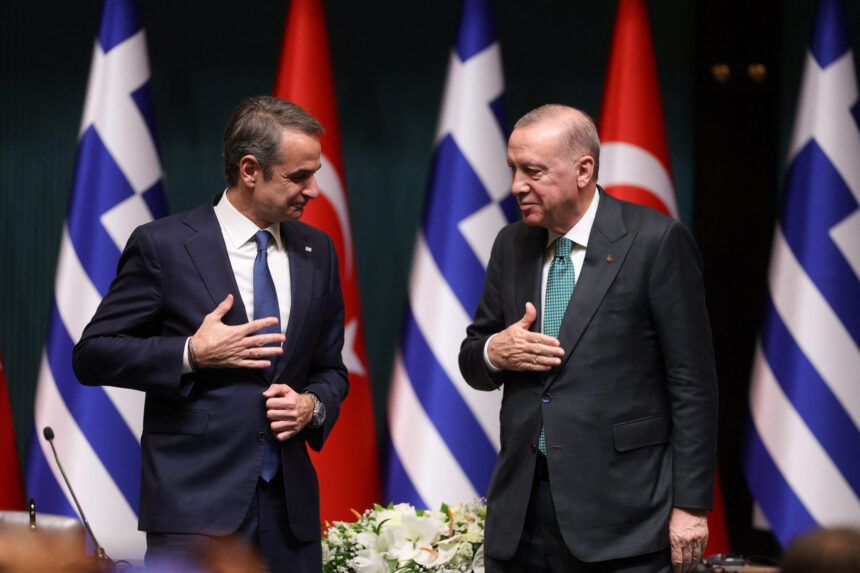
Greek Prime Minister Kyriakos Mitsotakis has expressed optimism about a potential solution to the Cyprus problem, stating that there is now a “window of opportunity” for progress. This remark was made during a meeting with Turkish President Recep Tayyip Erdogan in Ankara on Wednesday, where the two leaders discussed recent developments regarding the long-standing issue.
Cyprus problem: Significance of the Meeting
Mitsotakis emphasised the importance of ongoing dialogue, referencing initiatives by United Nations Secretary-General Antonio Guterres as pivotal in creating conditions conducive to discussions. He remarked, “We discussed with the president the latest developments on the Cyprus problem, on which the Greek position remains clear. United Nations Secretary-General Antonio Guterres’ initiatives are creating a window of opportunity for the restart of a substantive dialogue from where it left off in 2017.”
Conditions for Progress
During the press conference, Mitsotakis noted that any move towards a resolution must align with the UN Security Council’s resolutions, reinforcing Greece’s commitment to a lawful and orderly approach. Erdogan, while not directly addressing Cyprus, acknowledged their discussions on related issues such as Aegean and eastern Mediterranean tensions. He stated, “While these issues are complex, they are not insurmountable under international law. All that is needed is good faith. I saw that my friend Kyriakos and I agree on this. The issues must be resolved on the basis of the law. I believe that our relations will make progress towards a solution.”
Context of the Current Talks
The meeting occurred shortly before Guterres was set to meet with Turkish Cypriot leader Tufan Erhurman in New York, marking their first engagement since Erhurman’s election in October of last year. Greek Foreign Minister Giorgos Gerapetritis, who accompanied Mitsotakis, remarked that Erhurman’s election heralds a new chapter of hope for the island’s reunification.
European Perspective on Cyprus Talks
European Enlargement Commissioner Marta Kos recently acknowledged Turkey’s engagement in discussions regarding the Cyprus problem. Following a meeting with Turkish Foreign Minister Hakan Fidan, she remarked on the potential for Turkey to advance its EU accession process through these negotiations. Kos stated, “We know that any progress is connected to bilateral relations, not just Cyprus, but also with the … new Cyprus settlement talks. It is now a big opportunity to continue.”
Future Meetings and Expectations
Looking ahead, the next direct engagement between Greece and Turkey concerning Cyprus is expected to involve an enlarged meeting with representatives from both sides, the UN, and the UK as a guarantor power. However, a date for this meeting has yet to be established. A recent tripartite meeting involving President Nikos Christodoulides and Erhurman concluded without agreements, highlighting the ongoing challenges faced by both communities.
Need for Confidence-Building Measures
After the last meeting, UN envoy Maria Angela Holguin indicated that no enlarged meeting would occur until confidence-building measures between the two sides are achieved. She expressed anticipation for future progress, stating, “I am waiting for something more.” Reports suggest that Guterres is concerned about the lack of advancement since the previous tripartite meeting and has urged Cypriot leaders to take immediate steps to facilitate interactions between the communities. He is reported to have instructed Holguin to convey that without action on confidence-building measures, an enlarged meeting will not be convened.
Next Steps for Cypriot Leaders
Christodoulides and Erhurman are scheduled to meet next in Nicosia on February 24, an engagement that will be closely watched in light of recent discussions. The outcome of these meetings will be crucial in determining the trajectory of the Cyprus problem and the potential for a renewed dialogue.
The ongoing discussions reflect a complex interplay of local, regional, and international interests, all of which will shape the future of Cyprus. As both nations navigate these sensitive topics, the hope for resolution remains tempered by the realities of historical tensions.