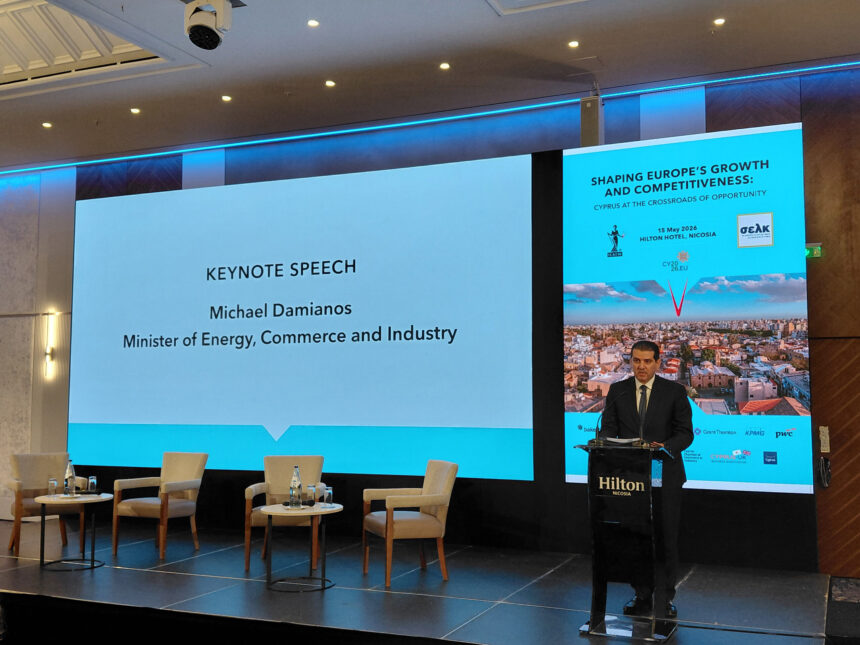
Strengthening the Single Market is a top priority for Cyprus, as stated by Energy, Commerce and Industry Minister Michalis Damianou during a keynote address on Friday. Speaking at the “Shaping Europe’s Growth and Competitiveness” conference in Nicosia, the minister outlined the ambitious agenda for Cyprus’s EU Presidency.
Damianou emphasised the challenges Europe faces today, which include geopolitical instability, technological disruption, and climate transition. Despite these hurdles, he highlighted Europe’s considerable advantages as the world’s largest integrated market, supported by robust institutions and competitive businesses.
“We have the largest unified market in the world, strong institutions, leading research capabilities, world-class talent and businesses that continue to innovate and adapt,” he noted. However, he pointed out that the real question lies in how to harness this potential more efficiently through collective action.
The minister elaborated on how the Cyprus EU Presidency aims to enhance competitiveness by fostering a more innovative, productive, and resilient economy. He reiterated that the Single Market represents Europe’s greatest economic achievement but acknowledged existing challenges faced by businesses, particularly SMEs and scale-ups, due to fragmented rules and administrative burdens when operating across borders.
To address these issues, Cyprus is actively engaging in discussions surrounding the European Commission’s “Terrible Ten” initiative, designed to eliminate persistent barriers hindering cross-border business activity. This initiative targets complex establishment procedures and inconsistent application of EU rules, which often complicate operations for businesses.
Additionally, preparations are underway for the “28th Regime” initiative, aimed at deepening economic integration, as highlighted by prominent figures such as Mario Draghi and Enrico Letta. “For Cyprus, a stronger Single Market does not simply mean deregulation. It means better regulation,” Damianou stated, emphasising the need for innovation-friendly regulations that alleviate administrative burdens.
He argued that Europe cannot rely solely on labour costs for global competitiveness and must instead focus on innovation and industrial strength. “Europe must compete through innovation, advanced manufacturing, clean technologies and industrial excellence,” he stressed, underscoring the importance of prioritising issues that support Europe’s industrial future.
Progress is also being made on the proposed European Competitiveness Fund, with Cyprus aiming for a partial agreement by June. This fund seeks to consolidate funding instruments, streamline administrative processes, and address Europe’s investment gap in strategic industrial sectors. Moreover, discussions are advancing on legislation for a European Industrial Accelerator to support the decarbonisation of energy-intensive industries.
Efforts are ongoing to provide practical solutions for businesses, including the eDeclaration initiative aimed at simplifying cross-border service provision. “These are not technical exercises but reforms that directly affect whether European companies choose to invest, innovate and grow here in Europe,” he explained.
Energy is another crucial aspect of the competitiveness discussion. “Affordable, secure and sustainable energy has become one of the defining economic issues for Europe,” Damianou noted, asserting that energy policy is a central pillar of the Cyprus Presidency’s agenda.
As Cyprus leads negotiations on the EU Grids Package, which aims to improve cross-border electricity interconnections, the minister highlighted the necessity of competitive energy pricing for European industries. “Competitiveness depends on a fundamental reality that European industries cannot remain globally competitive if energy remains structurally more expensive than in competing regions,” he stated.
Damianou also reflected on Cyprus’ geographical significance, positioned at the crossroads of Europe, the Middle East, and Asia. “Historically, we have been a bridge between continents, markets and cultures,” he remarked, expressing a desire for Cyprus to serve as a bridge of ideas and cooperation through its Presidency.
The commitment to enhancing Europe’s competitiveness extends beyond economic objectives. “Competitiveness is about prosperity and resilience, it is about strategic autonomy and ultimately it is about preserving the European way of life,” he articulated. Cyprus aims not only to manage legislative files but also to foster consensus and drive reform.
“Most importantly, we are committed to helping Europe act with greater ambition, greater speed and greater unity,” he concluded, highlighting Cyprus’ proactive role in shaping a competitive future for Europe.