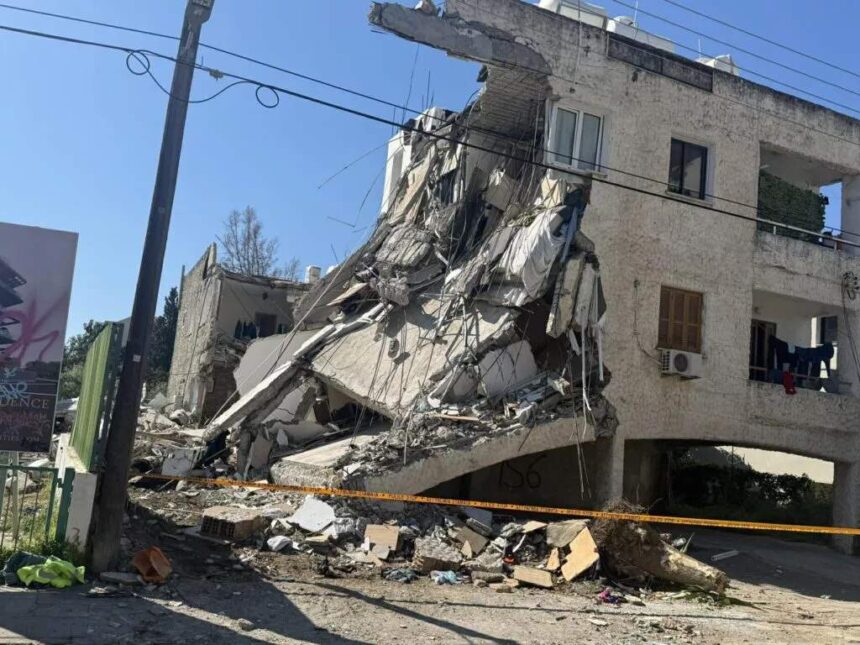
cyprus buildings — cyprus buildings — In Cyprus, more than half of buildings are over 25 years old and lack any law mandating inspections, a situation that has prompted concern following a recent tragic incident. Just days after a building collapse in Germasogeia claimed the lives of two individuals and left many others homeless, displaced tenants gathered outside the remains of the structure, holding signs that read, ‘Please help’ and ‘We lost our home and everything.’ The residents reported that they had never been warned about the building’s dangerous condition.
Cyprus buildings: Community Reacts to the Collapse
One resident, who paid €950 a month for a second-floor studio, lamented that his passport, identity documents, and life savings were now buried under the rubble. This disaster has been described by Germasogeia Deputy Mayor Christos Papamichael as a dire humanitarian crisis, as survivors have lost their basic belongings and struggle to meet daily needs.
Disputes Over Emergency Housing
In the aftermath of the collapse, a public dispute erupted between local and state authorities regarding emergency housing for the affected tenants. Amathus Municipality offered temporary accommodation for survivors until Sunday, citing a lack of support from the state. However, Civil Defence responded by claiming that 18 individuals had already been provided with hotel accommodation and essential supplies in coordination with the Cyprus Red Cross since the disaster occurred. They noted that nine tenants remained in state-funded hotel units, while others had left without informing authorities.
The Scale of the Building Issue in Cyprus
The collapse in Germasogeia has drawn attention to a larger issue in Cyprus: around 270,000 buildings are over 25 years old, with maintenance left entirely to individual owners. Currently, no law exists that requires buildings to undergo inspections. Data from the Statistics Service, last updated on August 9, 2024, shows concerning numbers: 114,436 homes were constructed before 1981, making the youngest among them at least 45 years old. Additionally, 155,759 homes were built between 1981 and 2000, with even the newest ones in that range being 25 to 26 years old.
Age Breakdown of Buildings
- 1,440 homes predate 1919
- 7,874 were built between 1919 and 1945
- 19,133 between 1946 and 1960
- 85,989 between 1961 and 1980
- 155,759 between 1981 and 2000
- 136,404 between 2001 and 2010
- 30,331 between 2011 and 2015
- 45,831 between 2016 and 2021
- 8,784 buildings have no declared year of construction
Why Cyprus Faces Increased Risks
In many countries, older buildings are maintained through periodic inspections, but in Cyprus, such maintenance is not mandatory. This places the onus entirely on property owners. The Technical Chamber of Cyprus (ETEK) has been advocating for mandatory structural inspections for about a decade.
Two additional factors exacerbate the situation. The first relates to the aftermath of the 1974 Turkish invasion, which caused the Republic of Cyprus to lose access to high-quality building materials from the Pentadaktylos quarries. Consequently, many constructions relied on beach gravel, often unwashed, leading to structural weaknesses, particularly evident in balcony collapses in Limassol.
The second issue pertains to seismic standards. Between 1981 and 1990, before Cyprus implemented seismic regulations in 1994, a significant number of homes were constructed without adequate supervision. This lack of oversight continues to pose risks to public safety.
Findings from Refugee Estate Inspections
The situation is underscored by findings from the KtiZO scheme, which conducted laboratory checks on 358 apartment blocks in government refugee housing estates. Alarmingly, 43 of these buildings were classified as unfit for demolition, while another 70 required extensive reconstruction. A former Town Planning official noted that even refugee estate buildings underwent some supervision during construction, suggesting that conditions in the broader private sector could be even worse.
Legislative Inaction on Building Inspections
Despite the evident need for action, efforts to address the building inspection issue have stalled. ETEK’s calls for regulation have largely gone unheeded. An attempt to introduce legislative measures by Labour Minister Marinos Mousiouttas faced delays, and despite support from the Interior Minister, a proposed building inspection law was never formally submitted.
On September 26, 2024, Aristos Damianou, chairman of the House Interior Committee, reached out to the Interior Minister for an update on the stalled bill, which directly impacts public safety and health. He reminded the minister about assurances given in September 2023 that the proposed law would undergo further consultation before being submitted to parliament.
With parliament now facing dissolution, time is running out to pass crucial legislation, even if there is political will to do so. The lack of legal requirements for maintenance allows property owners to avoid costly upkeep, perpetuating the risks associated with ageing buildings.
The tragic collapse in Germasogeia serves as a stark reminder of the pressing need for legislative change to protect the inhabitants of Cyprus from the dangers posed by its ageing building stock.