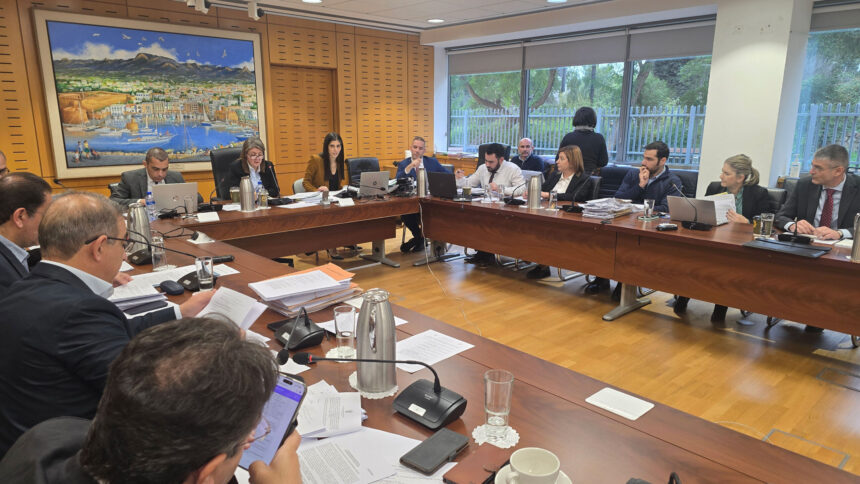
cyprus budget — The Cyprus budget debate has exposed deep divisions as political parties take contrasting stances on the proposed 2026 state budget. The discussion commenced on Monday, with a vote scheduled for Wednesday, highlighting divergent views on living costs, energy, defence, and public investment priorities.
Cyprus budget: Disy Supports Budget Amid Criticism
The Democratic Rally (Disy) has confirmed its support for the budget despite expressing concerns over the government’s priorities. Disy leader Annita Demetriou stated that her party’s commitment is to protect economic stability. “With the economy, we do not gamble,” she emphasised, indicating a cautious approach to financial governance.
Demetriou announced plans to propose amendments related to tax reform and teacher evaluations, asserting that even as a responsible opposition, Disy must address what it considers misaligned priorities. She refuted criticisms from other parties, attributing the current fiscal landscape to past Disy policies and maintaining that much of the budget comprises fixed spending, which restricts long-term investment capabilities.
Concerns Over Social Inequality from Akel
The left-wing party Akel has voiced strong objections to the budget, declaring it unfit for the citizens. General Secretary Stefanos Stefanou stated that this budget prioritises fiscal results over the welfare of the people. He lamented that for the third consecutive year under President Nikos Christodoulides, the budget lacks a clear social direction.
Stefanou presented stark statistics, revealing that 45% of citizens struggle with basic expenses while pensioner poverty exceeds 31.5%, significantly above the EU average. He contended that improved economic indicators do not reflect the hardships faced by many, highlighting the budget’s failure to adequately address rising living costs, particularly with housing and energy.
Other Party Perspectives on Budget Priorities
Elam and Diko have also introduced their concerns into the debate. Elam member Loukas Papayiannis pointed out that positive economic assessments do not resonate with the daily realities of many families. He advocated for reduced state spending and adjustments to welfare criteria to better support citizens.
Diko leader Nicolas Papadopoulos acknowledged Cyprus’s robust economic performance, citing forecasts for significant growth in 2025. However, he echoed calls for pension reform and housing planning adjustments, recognising that inflation continues to exert pressure on households.
Key Issues in the Budget Discussion
One of the crucial themes emerging from the debate is the need for enhanced public investment. Demetriou highlighted the necessity for sustained investment in various sectors, including energy, water management, and rural development, warning that delays in implementing major projects could hinder future progress. She specifically mentioned defence spending levels, arguing that they remain inadequate given Cyprus’s geopolitical situation.
Meanwhile, Akel’s Stefanou critiqued the budget’s reliance on indirect taxation, which disproportionately affects low and middle-income families. He emphasised that productive investment in Cyprus is alarmingly low at 13% of GDP, compared to the EU average of 22%, suggesting significant room for improvement.
Tax Reform and Social Spending Considerations
The conversation around tax reform has also been central to the debate. Demetriou proposed amendments aimed at supporting the middle class, which she noted carries a significant tax burden. She stressed that the proposed social spending increase of €142 million should not be misconstrued as a genuine social focus, as much of it merely covers state contributions to the health system.
In juxtaposition, Elam’s Papayiannis advocated for raising the tax-free threshold and linking tax relief to family size, aiming to alleviate financial pressure on families. He reiterated the need for full defence funding at 2% of GDP and modifications to migration policies due to what he termed an unfair burden on Cyprus.
Looking Ahead to the Vote
As the debate progresses, the political landscape remains fragmented, with parties divided over whether the 2026 budget will provide the necessary stability or fail to address the pressing social and economic needs of the populace. With differing views on key issues such as taxation, public investment, and social welfare, the upcoming vote on Wednesday is set to be a significant moment for Cyprus’s political future.
As Cypriots await the outcome, the emphasis on transparency, oversight, and a unified approach to national challenges remains critical, as highlighted by Demetriou’s call for coordinated action against external pressures. The ongoing discussions reflect the complexities of governance in Cyprus, where economic stability and social equity must be balanced amid competing party agendas.