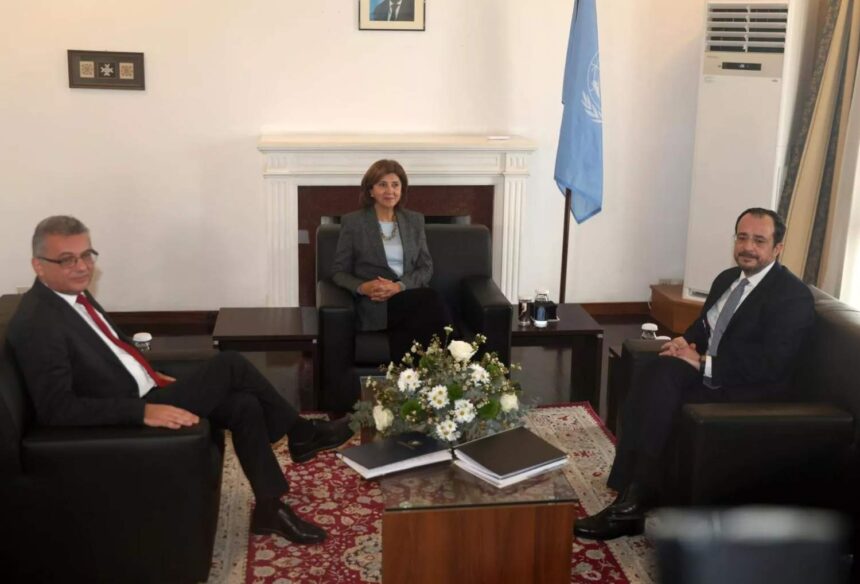
cyprus negotiations — President Nikos Christodoulides has submitted a five-point proposal to advance Cyprus negotiations during a trilateral meeting, while UN envoy María Ángela Holguín remains focused on confidence-building measures. Holguín’s approach reflects a need to follow the Turkish Cypriot side’s pace, prioritising initial trust-building efforts over substantive discussions regarding the Cyprus issue.
At the meeting, which included Turkish Cypriot leader Tufan Erhürman, Christodoulides outlined his proposal aimed at reaffirming the solution basis for the Cyprus issue. This includes references to political equality and UN Security Council resolutions, notably the joint communiqué of December 11, 2025.
The first point of Christodoulides’ plan seeks to reaffirm these foundational elements, while the second point confirms the existing convergences that have been achieved so far. He emphasised the importance of sharing these convergences with both communities, stating that only those points agreed upon should remain documented.
Moving on to the third point, Christodoulides indicated that convergences concerning all five parties involved should be communicated to each respective party. He brought to the meeting a record of convergences and divergences noted up to the Crans-Montana discussions.
The fourth point of his proposal calls for a formal conference that relies on documented agreements rather than informal discussions. This is aimed at ensuring that discussions are structured and result-oriented.
Lastly, Christodoulides proposes the discussion of four new crossing points during this conference: Kokkina, Louroujina, Mia Milia, and Athienou-Aglantzia. He expressed readiness to open the Mia Milia crossing point immediately, stating, “At that meeting to announce the opening of four checkpoints, as the UN proposed last July, I am ready to act.”
When asked about Erhürman’s response to the proposal, Christodoulides noted their mutual agreement not to speak on each other’s behalf. Erhürman later remarked that the suggestions were not new and had been previously raised in fragmented discussions.
During the meeting, the two leaders reviewed recorded convergences using a colour-coded system: blue representing Greek Cypriot positions, red for Turkish Cypriot positions, and black for agreed-upon points. Christodoulides expressed hope that the document prepared reflects both sides’ political will and readiness, stating, “I believe it’s a proposal that shows both our political will and our readiness. Let’s hope there will be positive developments.”
Regarding the proposed checkpoints, Christodoulides reiterated the Greek Cypriot side’s readiness to open Mia Milia, even that day. He also referred to the UN Secretary-General’s suggestion regarding Athienou-Aglantzia, clarifying that it was not solely a Greek Cypriot proposal but rather an initiative shared with them by the UN. He expressed openness to establishing a crossing point on Lidhinis Street in old Nicosia.
On the topic of political equality, he reaffirmed that the joint communiqué from December 11 has resolved the issue, clarifying that this had never been disputed by the Greek Cypriot side. He pointed out that previous misunderstandings arose from the Turkish Cypriot leadership’s framing of political equality as sovereign equality, which he asserted does not exist.
In her written statement, Holguín indicated that the two leaders would continue their efforts on various confidence-building initiatives, stating that they had a constructive discussion covering both substance and confidence-building measures. She highlighted the importance of their ongoing dialogue, suggesting that even if no immediate results were achieved, it was beneficial to exchange views.
Holguín mentioned that any future meetings would depend on the leaders themselves, emphasising the need for tangible results in confidence-building measures. She noted that, although there was some progress in their discussions, a new 5+1 meeting would not occur in the near term.
Christodoulides also suggested maintaining direct contacts with Erhürman without waiting for Holguín’s next visit, a suggestion Erhürman later echoed, proposing that they could meet independently. He expressed the belief that the recent meeting had fostered a better understanding between the two sides.
Despite acknowledging that the desired level of trust had not yet been fully realised, Erhürman stated that they had conveyed their views on the proposed confidence-building measures. He expressed a desire for progress before any future meetings in the 5+1 format, indicating that more groundwork was needed.