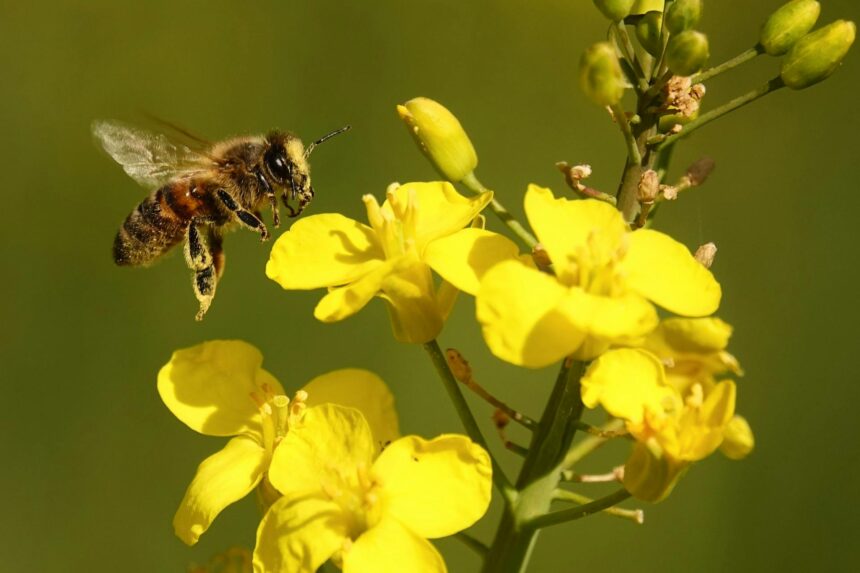
Bee brains are shaping the next generation of computer chips, guiding efforts to create tiny, low-power devices that could revolutionise robotics and environmental monitoring.
- Bee brains are shaping the next generation of computer chips, guiding efforts to create tiny, low-power devices that could revolutionise robotics and environmental monitoring.
- “Our chip can only do one task,” Mikkelsen notes, “but it can do it extremely energy efficiently and in a tiny size. It’s a completely different strategy from other computer chips.”
When a bee leaves its nest, it possesses an innate system that functions much like GPS, allowing it to navigate with remarkable precision. By analysing patterns in the sky and its flying speed, a bee can determine its location and find its way home safely. Researchers are now looking to these natural navigational skills to innovate computer chip design.
Professor Anders Mikkelsen from Lund University in Sweden, who is part of the EU-funded initiative InsectNeuroNano, highlights the efficiency of bees in navigation, stating, “A bee finds its way back without a smartphone or satellite navigation. They do this by looking at the polarisation of the sky, and their speed. Based on that, they don’t get lost.”
The goal of Mikkelsen and his team is to replicate the bee’s internal navigation system on a computer chip. Current chips can mimic how bees navigate, but they are far less efficient. “If you take a lightweight chip, it will easily weigh more than 80 grams and use more than 7 watts of power,” he explains. “A bee weighs under one gram and uses less than one hundredth of a watt to power its brain. Imagine if you could make a chip that efficient.”
This ambitious project involves collaboration among researchers from several European countries, aiming to create an insect-inspired chip capable of self-positioning. Such a device could have a wide range of applications, from low-cost environmental sensors to tiny robots that can assist in ecological tasks.
“We could make small, insect-sized robots with this,” Mikkelsen adds. “It would be like having a bee colony, but you get to tell it what to do. You could, for example, use these little bots to clean up pollution, build a structure, or artificially pollinate a field.”
While traditional computer chips are designed for versatility, handling numerous tasks from sending emails to running video games, the InsectNeuroNano chip is specialised for a singular purpose. It uses light signals and speed to ascertain its position, mimicking the efficiency of an insect’s brain that has evolved for navigation.
“Our chip can only do one task,” Mikkelsen notes, “but it can do it extremely energy efficiently and in a tiny size. It’s a completely different strategy from other computer chips.”
The research team is also comprised of biologists and engineers who are keen to learn from the intricacies of insect brains. Professor Elisabetta Chicca from the University of Groningen in the Netherlands, who focuses on bio-inspired circuits, points out, “For some problems, nature has already found a solution that is compact, low-power and efficient. Insect brains offer one such solution.”
Chicca’s work involves creating virtual models of the chips, a challenging task given that insect brains remain somewhat of a mystery. “You need to make hypotheses about how they work so you can translate it to the chips,” she explains.
This interdisciplinary approach is mutually beneficial; biologists gain insights from the engineers’ findings, while engineers learn about insect brain functionalities. “We are learning from biologists,” Chicca states. “But the biologists are also learning from us. It’s great to see that.”
The initiative is pushing the boundaries of chip technology, moving away from the traditional model where electrical signals travel through wires. Instead, the InsectNeuroNano team is employing nanophotonic circuits, which transport light through minuscule structures on the chip, enhancing energy efficiency and data transmission capabilities. Mikkelsen emphasises, “You can send more data with light in a more energy-efficient way. Also, our sensor detects light, so we’re using light to sense and to think, which simplifies things.”
Although the researchers have successfully developed a prototype chip that mimics insect brain functions, they acknowledge that it will take approximately a decade before this technology is realised in everyday applications. Mikkelsen underscores the complexity involved in creating such small chips with innovative design principles like nanophotonic computing.
“There are many steps we still have to take before we’ll have a robot bee flying around,” he admits. “But we have made a huge leap in this project. We went from a theoretical concept to something on a lab table that mimics insect brains.”
As the team continues to refine their work, they remain optimistic about the potential for insect-sized robots that could one day navigate their environments using the same skills as real bees. “Now we have to put together a whole system,” Mikkelsen concludes. “We need to scale up everything we learned in the lab. The first steps have been made – now the real progress can begin.”