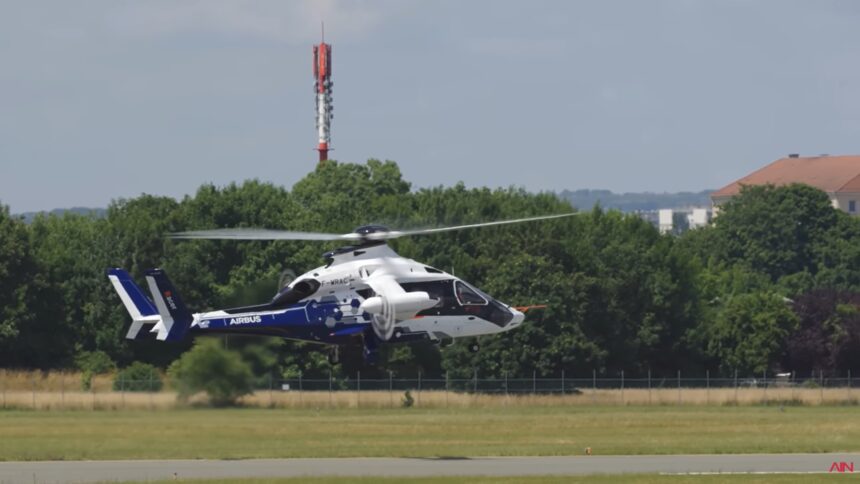
The Airbus RACER, a revolutionary prototype, is a testament to Europe’s commitment to clean aviation. At the Paris Airshow in June 2025, engineers Brice Makinadjian and Stephane Deport proudly watched as their sleek blue-and-white helicopter soared above the crowd.
- “Working with people outside aerospace is invigorating,” Makinadjian said, reflecting on the advantages of incorporating diverse expertise into the project.
- With the RACER pushing the boundaries of rotorcraft technology, it stands as a beacon for the future of aviation, promising a new era of enhanced efficiency and sustainability in European skies.
Designed with groundbreaking aerodynamics, the RACER (Rapid and Cost-Effective Rotorcraft) aims to enhance helicopter performance by combining the speed of an aeroplane with the agility of a rotorcraft. This innovative rotorcraft is not only faster and quieter but also boasts a remarkable reduction in CO2 emissions—approximately 25 per cent lower than conventional helicopters of a similar weight.
Clean aviation: Roots in European Collaboration
The development of the RACER is a significant product of the EU’s Clean Sky 2 programme, which ran from 2014 to 2024. As the largest aviation research initiative in Europe, this public-private partnership between the European Commission and the aeronautics industry has successfully funded the evolution of cutting-edge technologies aimed at minimising the sector’s environmental impact.
Makinadjian emphasised the importance of this collaboration, stating, “We could not have done this without European collaboration and support.” Over 40 European companies and research organisations from 13 countries contributed to the project, embodying the spirit of teamwork that defines this ambitious venture.
Aviation’s Green Future
The RACER aligns with the European Green Deal, which aims for climate neutrality by 2050. With aviation contributing significantly to the economy—supporting 13.5 million jobs and over €1 trillion in GDP—there’s a pressing need for innovation in the sector. The EU’s Sustainable and Smart Mobility Strategy sets an ambitious target for zero-emission aircraft by 2035, marking a pivotal step towards a greener aviation landscape.
As Axel Krein, executive director at the Clean Aviation Joint Undertaking, noted, “Currently, Europe has a market share of 58 per cent of new civil aircraft worldwide, so Europe’s aviation leadership is strong. But it is not guaranteed.” The RACER’s advancements are crucial in maintaining this competitive edge amidst global challenges.
Redefining Performance
After over a decade of research and development, the RACER prototype made its first flight in April 2024, logging approximately 35 hours in the air since then. Its design incorporates a cruising speed exceeding 440 km/h, which is over 50 per cent faster than standard helicopters, thanks to a revolutionary aerodynamic profile that reduces drag by 2.5 times compared to its peers.
Makinadjian pointed out, “We have a lower drag than the smallest helicopters on the market today.” This efficiency is achieved through a redesigned main rotor and the addition of lateral rotors, allowing the RACER to glide like an aircraft during certain flight phases.
Innovative Features for Efficiency
One of the standout features of the RACER is the Eco Mode system, akin to the start-stop function in modern vehicles. Developed by Safran, this system allows one of the two engines to go into standby mode during cruise flight, enabling the other to operate more efficiently. This innovation not only cuts CO2 emissions and fuel consumption by around 15 per cent but also extends the helicopter’s range.
“We can fly at 350 km/h on only one engine,” Deport explained, highlighting the RACER’s potential for various applications, from commercial transport to emergency medical services, where speed and noise reduction are paramount.
Collaborative Spirit and Future Prospects
The development journey of the RACER also involved unexpected partnerships, such as that with KLK Motorsport, a German SME known for its expertise in high-performance engineering. This collaboration led to the co-development of the helicopter’s canopy, showcasing the power of interdisciplinary teamwork.
“Working with people outside aerospace is invigorating,” Makinadjian said, reflecting on the advantages of incorporating diverse expertise into the project.
As testing continues at Airbus Helicopters’ headquarters in Marignane, the team is focused on fine-tuning the RACER’s features. Makinadjian and Deport, despite their deep involvement in the project, are still eager to experience the RACER themselves, as only a select few have had the opportunity to fly it thus far.
With the RACER pushing the boundaries of rotorcraft technology, it stands as a beacon for the future of aviation, promising a new era of enhanced efficiency and sustainability in European skies.