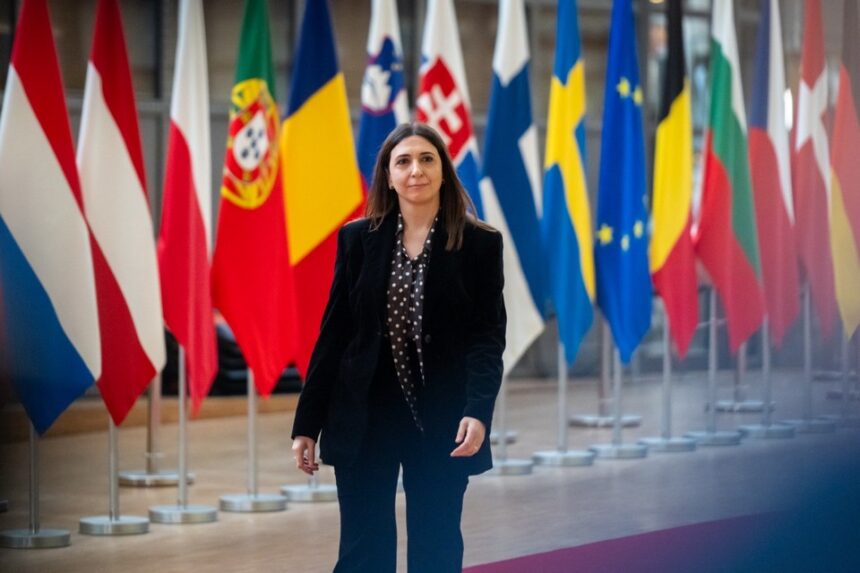
eu presidency — eu presidency — Undertaking the Council of the European Union’s rotating presidency is “a moment of pride”, European Affairs Deputy Minister Marilena Raouna stated on Thursday. In her remarks to the Cyprus News Agency, she emphasised Cyprus’s commitment to serving as an honest and reliable mediator, representing all member states equally while striving for consensual solutions amid a challenging geopolitical landscape.
Raouna conveyed the government’s view of this role as not merely an institutional duty, but a national mission and strategic opportunity for the Republic of Cyprus to make significant contributions to the European project. “This presidency allows us to elevate our role within the union and on the international stage,” she noted.
The Deputy Minister outlined the government’s priorities for its six-month term, which include enhancing European defence and security, as well as improving the union’s preparedness for crisis management. Another focus will be on promoting a credible EU enlargement policy, a point highlighted recently by President Nikos Christodoulides, who underscored the necessity for the EU to take decisive action on enlargement.
Raouna’s mention of enlargement is particularly pertinent given the current landscape, where ten countries outside the EU have applied to join the bloc. Among these, six countries—Albania, Moldova, Montenegro, North Macedonia, Serbia, and Ukraine—are in the negotiation phase to become candidate members. Meanwhile, Bosnia and Herzegovina and Georgia are candidates yet to begin negotiations, with Georgia having suspended its application process. Negotiations with Turkey have been stalled since 2016, and Kosovo, which Cyprus does not recognise, applied for membership in 2022 but has not been granted candidate status.
It has been 13 and a half years since Croatia joined the EU in 2013, marking the longest interval between the accession of new member states. The previous longest gap was 20 and a half years between the establishment of the European Coal and Steel Community in 1952 and the accession of Denmark, Ireland, and the UK in 1973. During this time, the UK has exited the bloc, further complicating the dynamics of European integration.
Beyond foreign affairs and defence, Raouna expressed aspirations to advance EU policies on affordable housing, safeguarding minors online, and bolstering the European health union. This initiative aims to enhance the bloc’s health system, ensuring better preparedness for future crises while fostering greater collaboration among member states in health-related matters.
The upcoming presidency offers Cyprus a platform to influence key conversations around these pressing issues, reinforcing its role within Europe and addressing the broader challenges facing the continent. As the world watches, Cyprus is poised to take on this crucial responsibility with a mix of ambition and resolve.