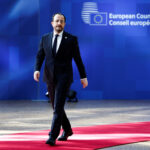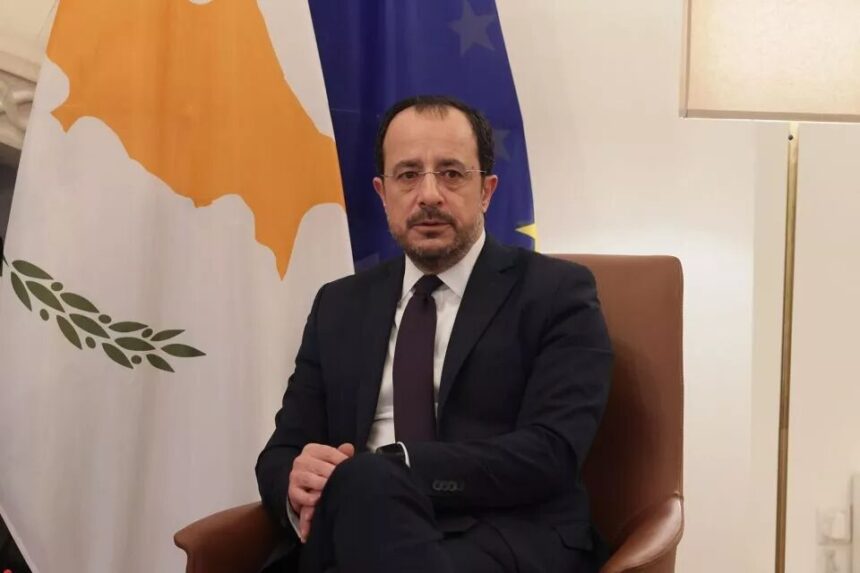
The position of the Republic of Cyprus regarding the SAFE funding tool has been officially adopted by the European Union, as confirmed by President Nikos Christodoulides on Thursday. This announcement came just before the commencement of the European Council proceedings in Brussels.
President Christodoulides emphasised that no third country that threatens or occupies the territories of a member state will be permitted to participate in European financial instruments aimed at defence and security. “I am pleased because our position concerning the participation of non-member states in the SAFE funding instrument has been adopted,” he stated, underlining that such countries cannot utilise any EU financial instruments within this realm.
The President also highlighted the strategic significance of the inaugural European Union – Egypt Summit, asserting that Cyprus, alongside Greece and other Mediterranean nations, has consistently advocated for this vital partnership. He noted that this collaboration was set in motion during the visit of the President of the European Commission to Cairo in 2024, which he also attended.
During the summit, the President of Egypt requested the EU’s active role in implementing the United States President’s plan regarding Gaza. Christodoulides mentioned that he shared Cyprus’s plan, developed in conjunction with the President of the European Commission, the United Arab Emirates, Egypt, Jordan, and Israel. “Today, I have the opportunity within the framework of the European Council to present it in detail, asking my colleagues from the EU to adopt the plan of the Republic of Cyprus as a European Union plan,” he remarked.
He noted that the response from European partners regarding the Gaza plan was overwhelmingly positive, particularly during a tripartite meeting involving the President of the European Commission, the President of the Council, and the President of Egypt. There, the Cypriot proposals were presented as European initiatives.
“What needs to be done now is to work so that these proposals are implemented in combination with other existing proposals,” he added, warning of the potential risks of a new crisis in the region if the American plan fails to progress. He argued that the EU cannot afford to discuss issues like migration while neglecting the broader Middle East, where many migrants originate.
With the Cypriot Presidency of the Council of the EU approaching in less than 70 days, Christodoulides expressed goals to translate the Pact for the Mediterranean from text to tangible actions that would enhance the EU’s role in the Mediterranean and Middle East. He expressed a commitment to strengthening the EU’s strategic autonomy across various sectors including defence, security, and digital transition.
Moreover, he indicated that for the first time, the European Council will potentially delve into the issue of housing, which he described as a “major European challenge.” He stated, “A pan-European problem, an issue that some argue is more the competence of the member states, but since it concerns all European states… we expect the Commission to present and develop a funding tool in the near future that can be utilised by all member states.”
Addressing the ongoing war in Ukraine, President Christodoulides confirmed the adoption of the 19th package of sanctions against Russia. He remarked, “There are the American sanctions, which mainly concern the energy sector, and proposals have been submitted by leaders of EU member states that can replace the energy which, based on the United States’ sanctions, cannot be channelled to Europe.”
In light of discussions around a potential meeting between the American and Russian Presidents, he insisted that the President of Ukraine must be involved, asserting that the future of Ukraine cannot be discussed without his presence. He also noted that the sanctions imposed thus far have been effective, adding that if certain associated states or nations aspiring to join the EU adhered to these sanctions, their impact would be significantly amplified.
In response to inquiries about discussions during the European People’s Party meetings concerning voting processes in the occupied territories, Christodoulides clarified that there were no such discussions. “I had the opportunity with some of my counterparts at a bilateral level to discuss this development. You understand that we will all be judged at the negotiating table,” he concluded.