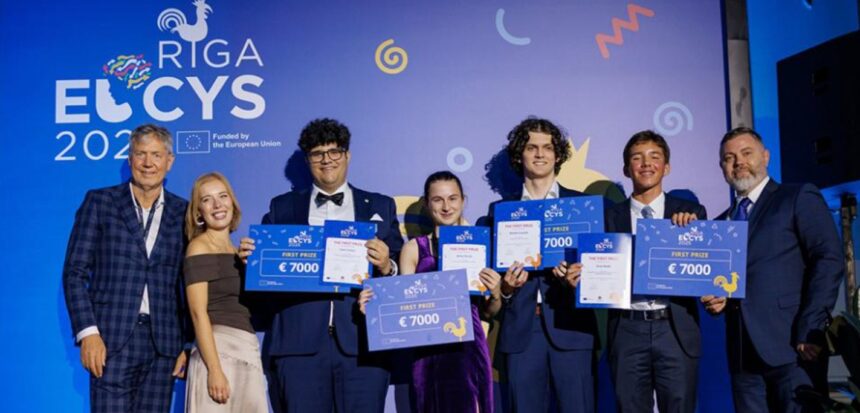
This year’s EU Contest for Young Scientists showcased hard science with a social edge, with young scientists presenting innovations ranging from robot turtles to quantum discoveries. For Evan Budz, a 15-year-old science student from Canada, learning that his turtle-like undersea robot had earned him one of the four first prizes at this year’s EU Contest for Young Scientists (EUCYS 2025) was overwhelming.
- Langeveld was struck by the young scientists’ passion for science. “Some of them spend months in labs because they are interested in something. That is incredible.”
“It all still feels surreal,” said Budz, still disoriented in the middle of the award ceremony reception in Riga, Latvia. He built the robot himself and tested it in his grandparents’ pool. “I want to use it to study ecosystems and problems like coral bleaching,” he explained. “By mimicking a turtle, I will be impacting the ecosystem less, and not distracting the animals that live there.”
Young scientists: Gathering Young Innovators from Around the Globe
Budz was one of 133 young scientists aged 14 to 20 who came from 37 countries around the world to participate in EUCYS 2025 from 15 to 20 September. The EUCYS competition is funded by the European Commission and was organised this year by the State Education Development Agency of Latvia.
Most participants were there because they had won a similar contest in their home country. An international jury composed of 21 European scientists evaluated 90 science projects, some carried out by teams. In the end, four first prizes, each worth €7,000, were handed out to contestants from Poland, Sweden, Czechia, and Canada.
A Focus on Hard Sciences and Innovative Solutions
EUCYS was first held in 1989, during a time of great change in Europe, to promote cooperation and exchange among the continent’s young scientists. True to that spirit, the contestants spent most of the week at their booths, presenting their projects to visitors, judges, and each other.
Zuzanna Kassner, an 18-year-old from Poland, was keen to explain her project to visitors. “I love plants,” she said. “That is why I looked at the use of chitosan, a sugar found in the shells of shrimps and in fungi, to better fertilise crops and make them more resistant to drought.” With droughts on the rise due to climate change, farmers are seeking new ways to make plants more resilient. Kassner used chitosan nano-particles, in aquatic solution form, to accomplish that.
When irrigated with this liquid, plants turned out to be more resistant to dry periods. “I do not yet know why this happens,” she said. “But I suspect it is because the substance mimics a fungal infection, causing a defensive reaction by the plant.”
She conducted her research in her parents’ attic, where she constructed an experimental greenhouse to expose plants to different conditions and observe how they evolved. “Building that greenhouse alone took me a year,” she said. “My plants kept dying because of the cold, so I had to keep redesigning it.” Kassner received one of the Luxembourg International Science Expo awards, earning her an invitation to the Luxembourg International Science Expo in October.
Passion for Science Shines Through
A team of 21 judges, comprising scientists and engineers, reviewed the projects and decided on the awards. The final deliberation was coordinated by Hans Langeveld, a Dutch tropical agronomist and president of the jury in this edition of EUCYS. “This year we saw a clear trend towards harder sciences,” he noted. “Subjects like physics, engineering and biology did well. Fields like biology are also becoming more high-tech, as they are using technology like artificial intelligence.”
Langeveld was struck by the young scientists’ passion for science. “Some of them spend months in labs because they are interested in something. That is incredible.”
Groundbreaking Research in Emerging Fields
The experience was just as energising for the contestants, including 19-year-old Dani Zuhair from Sweden, another first prize winner. “It feels crazy, just crazy,” he exclaimed as he was surrounded by well-wishers after the ceremony. His project researches quantum magnetic structures to help advance a new field of science called spintronics, which uses the “spin” of electrons to store and process information.
“Regular computing is running into physical barriers,” he explained. “My project is about very fundamental research. But there are lessons here for how to better store data and do it more energy-efficiently.” Zuhair, currently on a gap year, will test some of his theories at the Swiss university ETH Zurich.
Mathematics and Social Sciences Also Take Centre Stage
Another first-place winner, Antoni Łuczak from Poland, was pleasantly surprised by his award. “My project is about pure mathematics,” the 18-year-old said. “I expected the jury to like it, but I did not imagine they would be so enthusiastic.” He studied the geometric and algebraic properties of Apollonian Cubic Curves, finding his new approach useful in tackling other geometric problems.
For Łuczak, even though his work is abstract, there is beauty in it. “Mathematics is just beautiful,” he smiled. “It shows how things that seem disconnected are actually connected into one big whole.”
Not everything at this year’s EUCYS was about hard sciences. Anna Marina Roos, a 19-year-old from Switzerland, researched the influence of hippie pop culture, particularly music, on the Vietnam War. For this, she received a Luxembourg International Science Expo award. “I started the project after an exchange year in the US,” she said. “I was surprised they did not mention the Vietnam War in history class.”
Building Connections Beyond Awards
Eventually, she created a book about the music of the Vietnam War, planning to apply the lessons learned to peace education. “In order to find peace, there has to be dialogue and cultural understanding,” Roos said. “Back then, music was such a dialogue between classes, races, and generations.” She expressed hope that her example will inspire more social scientists to participate in EUCYS.
The awards came with various prizes, including trips to the CERN laboratory and scientific conferences. Budz already has plans for his prize money. “I want to expand my robot,” he said. “I also want it to be able to do water sample collection. The prize money will come in very handy for that.”
However, for these teenagers, the connections made at the event were the most impactful. “The people are the best part of EUCYS,” said Zuhair. “We all share a passion for science. I met some amazing people here. I will remember this for a long time.”