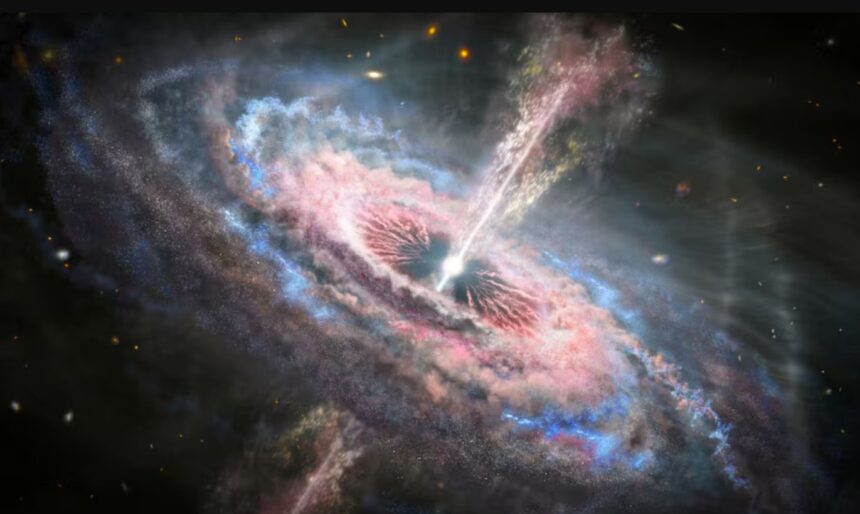
Ancient quasars are challenging our understanding of astrophysics with their unexpected existence in the early universe. These luminous entities, powered by supermassive black holes, have recently been identified by researchers using the European Space Agency’s Euclid space telescope.
Ancient quasars: Discoveries of Early Quasars
Researchers have pinpointed 31 quasars dating back to a time shortly after the Big Bang, around 13.1 billion years ago. This period marks a mere 670 million years post-Big Bang, when the universe was only 5% of its current age. The unprecedented brightness of these quasars, estimated to be about a trillion times greater than that of the sun, raises significant questions about their formation and evolution.
The Nature of Quasars
A quasar represents the core of a galaxy, where a giant black hole devours gas and dust. Daming Yang, a doctoral student in astrophysics at Leiden University, explains, “Black holes themselves are dark, but the black hole’s gravity pulls in gas and dust, which spiral toward it like water going down a drain.” As this material spirals inwards, it heats up and emits immense energy, outshining the entire galaxy.
The Epoch of Reionization
The two earliest quasars identified belong to a period known as the “epoch of reionization,” a time when the universe was dense and shrouded in neutral hydrogen. Yang notes, “The universe back then was much smaller and denser, and filled with a fog of neutral hydrogen.” This era was crucial for the formation of the first stars, galaxies, and black holes, which began to illuminate and transform the universe.
Unraveling the Mystery of Black Hole Growth
The discoveries made by Euclid and other telescopes like the James Webb Space Telescope indicate that supermassive black holes were present much earlier than previously thought, leading to a significant conundrum in astrophysics. Joseph Hennawi, an astrophysicist and co-author of the study, states, “The most important thing these distant quasars tell us is that these supermassive black holes were already present in the extremely early cosmic times.” This finding suggests that black holes must have grown at a rate previously deemed impossible given the youth of the universe.
Implications for Cosmic Evolution
The existence of these ancient quasars forces scientists to reconsider current models of black hole formation. Yang suggests, “Either the first black holes were born already massive through some exotic channel, or they grew much faster than we thought possible.” Each new discovery pushes the boundaries of our understanding, making the puzzle of black hole evolution more complex.
A New Era of Observation
Launched in 2023, the Euclid space telescope aims to explore dark energy and dark matter but has also provided insights into early quasars. Prior to Euclid’s observations, only a handful of quasars from this early era had been identified due to limitations in telescope technology. Yang remarks, “With this sample, we are entering a new era: studying these earliest supermassive black holes as a population, and finally addressing how they were born and grew so quickly when the universe was very young.”