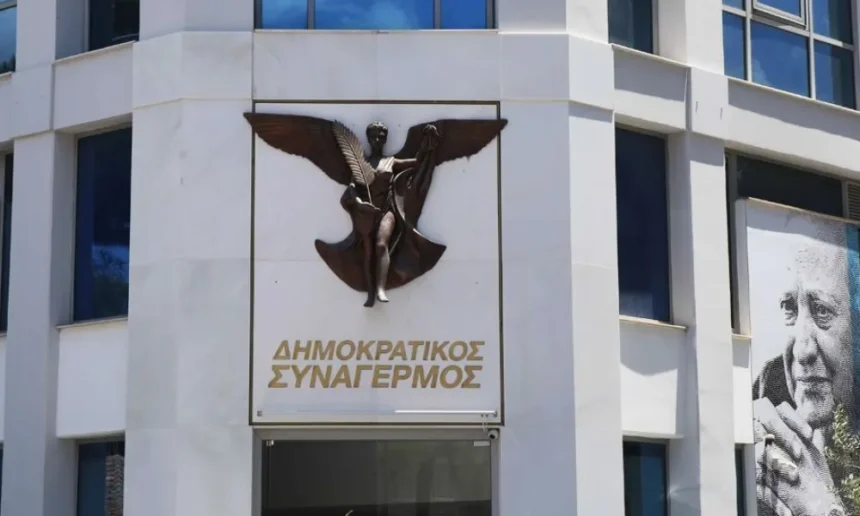
raouna term — raouna term — Disy has taken a firm stance against President Nikos Christodoulides’ last-minute effort to extend the term of European Affairs Deputy Minister Marilena Raouna until the end of the year. In a pointed statement, Disy accused the government of trying to mislead public opinion regarding the necessity of this extension.
The party asserted, “The president is attempting to turn one of his own failures into a political attack on Disy.” This remark came after the government submitted an urgent request for the extension, which was subsequently rejected by parliament. Disy raised serious concerns regarding the timing of the proposal, questioning the political motivations behind it. “If the extension was indeed so crucial for the interests of the Republic of Cyprus and for the negotiations for the multiannual financial framework, why was it not foreseen in a timely manner?” they asked rhetorically.
The multiannual financial framework, which outlines the European Union’s budget from 2028 to 2034, has significant implications for Cyprus, especially as the nation navigates complex negotiations. Disy questioned why such an important extension was not included in the original legislation, unlike similar provisions during the previous Cypriot presidency of the Council of the EU.
Disy emphasised that significant political decisions regarding extensions and new structures should not emerge at the last minute without proper parliamentary scrutiny. “It is inconceivable to attempt to cultivate the impression that the securing of European funds for the Republic of Cyprus depends on the six-month extension of the term in office of one person,” they stated.
Since joining the EU in 2004, Cyprus has successfully secured substantial European funding through various state institutions. Disy argued that the finance ministry, foreign ministry, and development office have proven their capability in this regard, thus refuting the government’s claims about the critical nature of Raouna’s continued appointment.
In defending its position, Disy claimed to be the only party that has consistently championed Cyprus’ European trajectory through calculated actions and documentation, rather than through what they termed “communication exaggerations.” They urged the president to assign accountability within his own government instead of shifting blame towards Disy. “Political expediency cannot be called a European necessity,” they concluded.
Raouna was appointed in January 2024, tasked with overseeing Cyprus’ six-month term as the holder of the rotating presidency of the Council of the EU, which has just concluded. The legislation that enabled her appointment stipulated that the position would end a month later, following the completion of Cyprus’ term. This procedure mirrors the appointment of Andreas Mavroyiannis by former president Demetris Christofias during the island’s previous presidency in 2012.
The government’s push to extend Raouna’s term met with swift opposition and a terse response from government spokesman Konstantinos Letymbiotis. He argued that the absence of a structured political framework for European issues in Cyprus contradicts the practices of the 22 other EU member states. “States evolve. Needs change. European politics today requires knowledge, continuity, contacts, presence and organised handling,” he insisted, highlighting the need for a robust political structure to handle Cyprus’ pressing European negotiations.