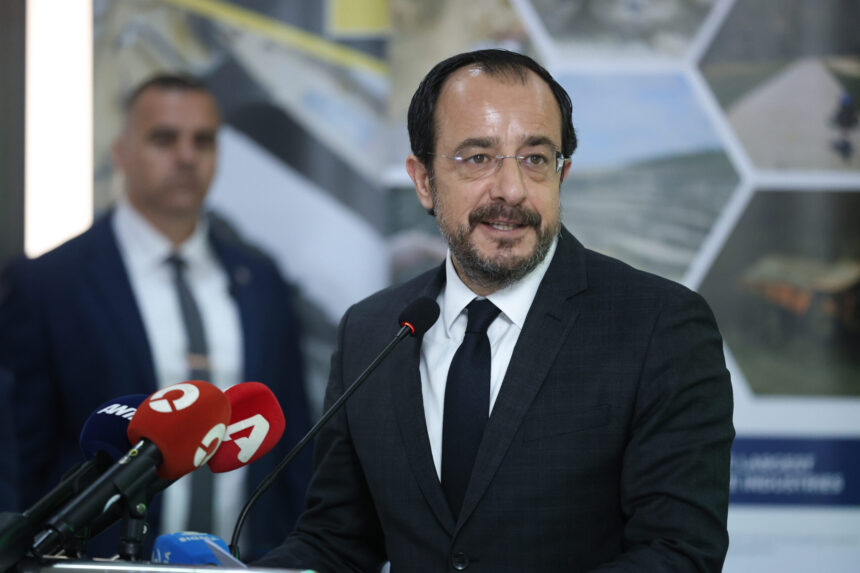
Efforts to address the Cyprus problem are ongoing, contrary to claims of being ‘frozen’, President Nikos Christodoulides affirmed on Monday. His remarks come in the wake of the postponement of a United Nations envoy’s latest round of discussions until after the upcoming NATO leaders’ summit in Ankara.
- These guarantees may involve the new Cypriot republic's accession to NATO and the presence of NATO troops from Turkey, Greece, France, the United Kingdom, and the United States on the island.
Cyprus problem: Continued Diplomatic Engagement
President Christodoulides emphasised that the diplomatic efforts surrounding the Cyprus issue are very much alive. He stated, “The only thing which is certain is that the effort is not frozen, the effort continues.” He noted that UN envoy Maria Angela Holguin is scheduled to meet with European Council President Antonio Costa in Brussels on July 13, following the NATO summit.
“All processes are in full swing, with the aim of convening an enlarged meeting during which the resumption of talks will be announced,” he added, highlighting the importance of the upcoming discussions in Ankara.
Critical Juncture for Cyprus
President Christodoulides described the current situation as a “very critical juncture” for the island, underscoring the necessity of continuous dialogue both locally and internationally. His administration has been making efforts to facilitate communication with various stakeholders, including in New York and at the European Union level. “We have one goal and one goal only, to have a positive result,” he stated.
Linking EU-Turkey Relations to Cyprus
The President also pointed to a strategic link between developments in EU-Turkey relations and the Cyprus problem. He explained that Turkey views progress on this front as essential, and there have been strides made in that direction. “We hope to have the result we expect, which is nothing other than the resumption of talks,” he said, crediting the EU for taking a more active role in recent years.
Upcoming Meetings and NATO’s Role
Holguin’s meeting with Costa is part of a larger framework of discussions that includes the NATO summit, during which security guarantees concerning a post-solution Cyprus will be addressed. The potential for NATO involvement is an important aspect of these discussions, with suggestions that security guarantees could be provided through a NATO-based structure.
These guarantees may involve the new Cypriot republic’s accession to NATO and the presence of NATO troops from Turkey, Greece, France, the United Kingdom, and the United States on the island.
Clarification on NATO Meetings
Despite speculation regarding Holguin’s potential meetings with NATO officials during her time in Brussels, a NATO official clarified to the Cyprus Mail that “there are no meetings planned with the envoy, and the topic has not been discussed at NATO.” This statement may temper expectations for immediate progress in this area.
Leadership Changes in the UK
As the NATO summit approaches, Turkish President Recep Tayyip Erdogan will host the event, which is expected to see the participation of Prime Ministers Kyriakos Mitsotakis of Greece and Sir Keir Starmer of the UK, alongside Antonio Costa and European Commission President Ursula von der Leyen. Notably, Starmer is anticipated to resign within ten days of the summit, with Manchester mayor Andy Burnham likely to take over. However, analysts suggest that this leadership change will not significantly alter the UK’s position on the Cyprus issue.
Postponements and Future Meetings
Questions regarding the momentum of the negotiations have arisen, especially since it was previously expected that Holguin would return to Cyprus by the end of this month. With her meeting with Costa postponed, her return is now likely to be in the latter half of next month.
The planned enlarged meeting, which will involve discussions between the island’s two communities, its three guarantor powers—Greece, Turkey, and the United Kingdom—and the UN, was initially set for late July or early August. However, this timeline is now expected to shift, with the meeting likely occurring later in August at the earliest.