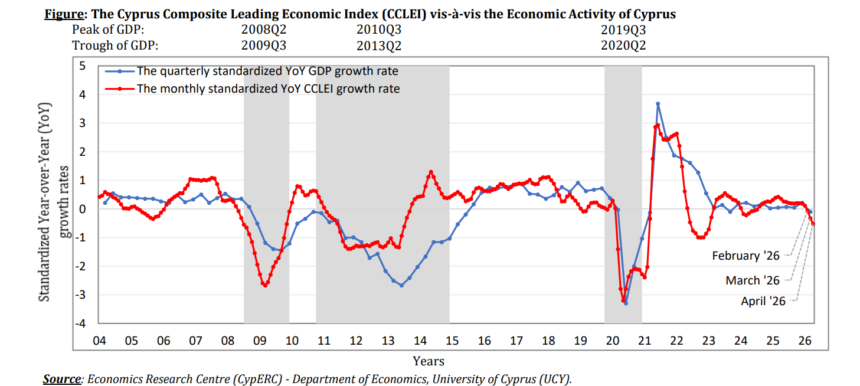
cclei trend — The CCLEI trend has shown a marked decline, highlighting growing economic challenges in Cyprus. According to the University of Cyprus, the Cyprus Composite Leading Economic Index (CCLEI) fell by 1.72% year-on-year in April, marking the second consecutive month of deterioration. This decline follows a slim annual decrease in March and a modest increase of 0.82% in February.

Photo: financialmirror.com
These figures suggest a concerning shift in the economic landscape, as international pressures and geopolitical turbulence weigh heavily on the nation’s growth prospects. The CCLEI, constructed by the university’s Economics Research Centre (CypERC), is a crucial indicator that seeks to anticipate future economic movements.
April’s figures were particularly sobering. The economic climate across the euro area, with Cyprus at the forefront, experienced a downturn compared to the same time last year. This was reflected in the Economic Sentiment Indicator (ESI), which saw a significant year-on-year decrease, indicating growing uncertainty among consumers and businesses alike.
One of the primary drivers of this decline was the behaviour of Brent crude oil prices, which saw a larger annual increase in April. Higher oil prices can strain household budgets and business costs, further complicating economic recovery efforts. Additionally, the tourism sector, a vital component of Cyprus’s economy, faced setbacks due to flight cancellations and potential fuel shortages, resulting in a notable decline in tourist arrivals compared to April 2025.
Yet, not all components of the CCLEI are contributing negatively. There were positive contributions from several sectors, including an increase in the temperature-adjusted volume of electricity production, property sales contracts, credit card transactions, and retail sales volume index. These elements suggest that while there are significant headwinds, some areas remain resilient.
The current trajectory of the CCLEI indicates that the Cypriot economy may encounter a weakening of growth dynamics in the short term. As geopolitical tensions rise and external economic pressures intensify, the potential for recovery appears more challenging. Investors and business leaders will need to closely monitor these developments, as the CCLEI serves as a key barometer of future economic activity in Cyprus.