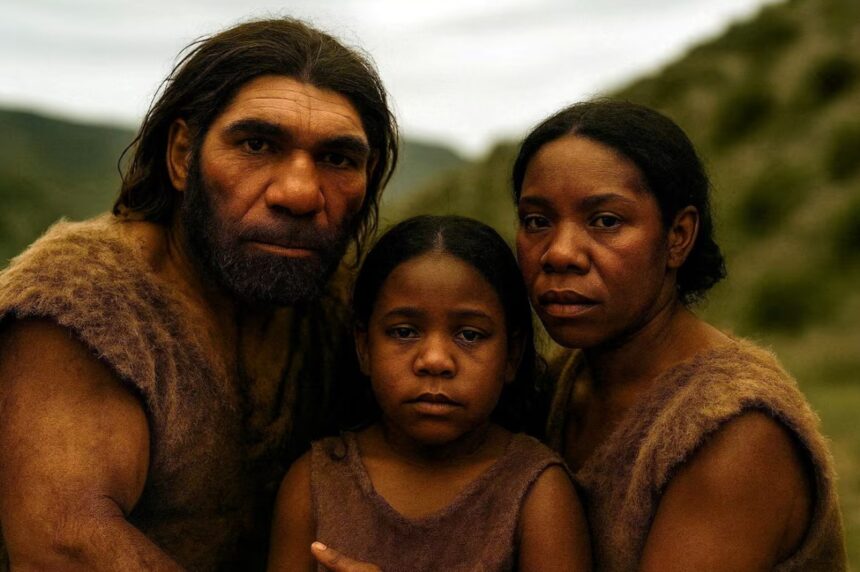
Neanderthal men and Homo sapiens women interbred during prehistoric times, shedding light on a significant chapter in human ancestry. As Homo sapiens migrated out of Africa, they encountered Neanderthal populations that had already established themselves across Europe, Asia, and the Middle East. This interbreeding is evident in the Neanderthal DNA found in modern humans, although the specifics of these interactions have been somewhat ambiguous.
Neanderthal men: New Insights from Genetic Research
Recent research focusing on the X chromosome provides new insights into these ancient pairings. The study, published in the journal Science, analyses genetic data from both contemporary humans and ancient Neanderthals, revealing a pattern that suggests mating primarily occurred between Neanderthal men and Homo sapiens women.
Understanding the Genetic Evidence
Geneticist Alexander Platt from the University of Pennsylvania’s Perelman School of Medicine, who co-authored the study, noted that the specific reasons for this interbreeding remain unclear. “The preferences of either or both parties could produce these kinds of patterns, with or without the consent of the other,” he stated. This ambiguity adds complexity to the narrative of human evolution.
In modern humans, females possess two X chromosomes, while males have one X and one Y chromosome. A striking finding from the research is that, contrary to the expectation that Neanderthal genes would be absent from modern X chromosomes due to incompatibility, there is a notable excess of Homo sapiens DNA in Neanderthal X chromosomes. This suggests a mating bias, indicating that Neanderthal males likely mated with Homo sapiens females.
Historical Context of Interbreeding
Interbreeding between these two species is thought to have begun around 250,000 years ago. A more pronounced wave of interbreeding occurred approximately 47,000 years ago during a later migration of Homo sapiens into Eurasia. Despite widespread interbreeding, many modern humans, particularly those of sub-Saharan African descent, carry little to no Neanderthal DNA due to their ancestors not having interacted with Neanderthals.
- Most non-African populations possess 1% to 4% Neanderthal DNA.
- In contrast, present-day Africans show no evidence of Neanderthal ancestry.
Challenging Previous Assumptions
Previously, scientists believed that the absence of Neanderthal contributions to modern X chromosomes was due to the biological incompatibility of Neanderthal genes, which could lead to health issues or reproductive failure. However, the new findings challenge this view, suggesting that the patterns observed in the genomes are more indicative of successful pairings between Neanderthal males and Homo sapiens females.
Exploring the Nature of Interactions
The study raises questions about the nature of interactions between Neanderthals and Homo sapiens. Sarah Tishkoff, another geneticist involved in the research, emphasised the difficulty in determining whether these relationships were consensual or coercive. “We have no way of knowing if this was a conflict scenario,” she remarked, highlighting the lack of conclusive archaeological evidence to clarify the dynamics of their interactions.
Neanderthals, who became extinct roughly 40,000 years ago, shared a common ancestor with Homo sapiens until around 600,000 years ago. As they evolved separately, Neanderthals developed their own unique traits, including a robust physique and advanced cognitive abilities, evidenced by their creation of art and complex hunting strategies.
Population Dynamics and Genetic Legacy
As Homo sapiens spread through Eurasia, they likely outnumbered Neanderthals significantly, with estimates suggesting ratios of 10 to 20 Homo sapiens for every Neanderthal. This demographic advantage could explain the substantial Neanderthal ancestry present in modern humans, suggesting that Neanderthals did not entirely vanish but rather integrated into the genetic fabric of Homo sapiens.
Platt expressed the intriguing notion that contemporary humans carry a legacy of Neanderthal ancestry. “If you consider that there may have been 10 to 20 times as many Homo sapiens in the area as Neanderthals, the observation that we had as much as 5% Neanderthal ancestry 30,000 to 40,000 years ago suggests it’s entirely reasonable to guess that there was simply so much interbreeding that we swamped the gene pool,” he explained. This perspective reshapes our understanding of human evolution and ancestry.
The Broader Implications of Neanderthal DNA
The implications of these findings extend beyond mere ancestry. With approximately 6 billion people today carrying about 2% Neanderthal genomes, the genetic contributions of Neanderthals are more significant than previously understood. “They’re doing better than ever,” Platt quipped, highlighting the enduring impact of Neanderthal genes in contemporary human populations.
The ongoing research into the genetic relationship between Neanderthals and Homo sapiens continues to unveil the complex history of our species. As scientists delve deeper into genetic analysis and archaeological discoveries, future findings may further illuminate the interactions and behaviours of these two distinct yet interconnected lineages.