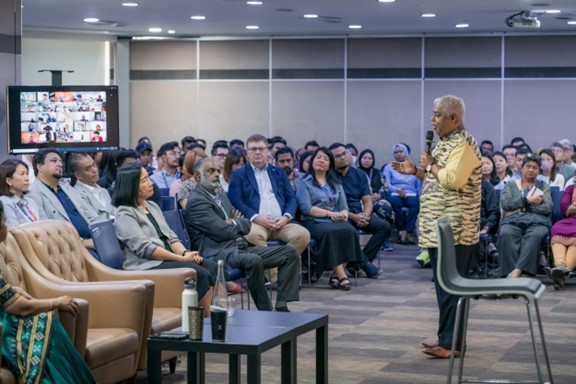
human connection — Vijay Eswaran argues that economic progress must prioritise human connection over mere metrics, calling for a re-evaluation of how prosperity is measured. Ahead of the World Economic Forum’s 2026 meeting in Davos, which has the theme “A Spirit of Dialogue,” Eswaran challenges the traditional notion of economic success defined by Gross Domestic Product (GDP). He insists that GDP alone fails to indicate whether growth genuinely enhances human lives.
Human connection: Rethinking Prosperity Metrics
Eswaran’s proposal introduces the concept of a “Growth Quotient,” a metric that assesses whether economic activities uplift individuals alongside profits. He emphasises the need for a new measure of prosperity, stating, “Instead of GDP, perhaps we should be looking at Growth Quotient, the extent to which our growth uplifts people, not just profits.” This alternative framework seeks to address the growing concerns regarding the limitations of traditional economic indicators.
The conventional approach to measuring economic success often focuses on production, consumption, and efficiency without considering how these factors affect social cohesion, fairness, and well-being. Eswaran argues that this oversight reflects a failure of intent rather than measurement. His Growth Quotient framework aims to evaluate whether advancements in development promote fairness and whether productivity gains benefit the wider community rather than being concentrated among a select few.
The Limitations of GDP
Eswaran points out that GDP can increase even as societal inequalities worsen, environmental conditions decline, and public trust diminishes. Such contradictions highlight a fundamental misalignment between what traditional economic measures offer and what societies truly require. “A nation’s true wealth lies not in what it builds, but in what it believes,” he writes, underscoring the importance of values as the cornerstone of sustainable prosperity.
Leadership in the Modern Age
Extending his critique to leadership culture, Eswaran asserts that contemporary institutions are plagued by an excess of authority coupled with a lack of understanding. He notes that decisions are often made hastily, with insufficient consideration for their broader implications. “We are not suffering from a shortage of leaders,” he observes, “We are suffering from a shortage of listeners.” Eswaran posits that dialogue, rather than being perceived as weakness, is actually a sign of strength.
His insights are informed by over twenty years of experience leading QI Group across diverse markets in Southeast Asia. Eswaran argues that navigating varying regulatory, cultural, and political landscapes has reinforced the necessity of cooperation over command. “When dialogue becomes a habit, cooperation follows,” he explains, suggesting that this approach leads to better innovation, negotiation, and societal healing.
Redefining Leadership Qualities
This perspective challenges traditional leadership models that prioritise decisiveness and hierarchy. Eswaran believes that the ability to facilitate constructive disagreement is the key skill for leaders to effectively manage economic uncertainty and social change.
Technology and Human Values
As emerging technologies such as artificial intelligence and biotechnology continue to evolve, Eswaran warns that they will inevitably reflect the values embedded within their design. He cautions that systems optimised solely for speed and efficiency may exacerbate inequality and undermine trust in institutions. “If we lack empathy, our algorithms will amplify that lack,” he cautions, emphasising the importance of integrating human values into the design process from the outset.
Eswaran refers to this approach as “authentic intelligence,” which prioritises ethical judgement, emotional awareness, and social responsibility. “The real question is not how intelligent our machines become,” he states, “but how conscious we remain as humans.” This distinction is crucial, as systems built without consideration for human impact necessitate constant corrections. Conversely, technologies designed with these considerations are more likely to scale responsibly.
From Philosophy to Practice
Eswaran grounds his theories in practical experience rather than abstract concepts. He notes that within QI Group, a sustained emphasis on dialogue has led to improved collaboration across teams and regions, breaking down internal silos. “It allows people to see one another not as rivals in a race, but as partners in a journey,” he explains.
He applies the same principles to global cooperation, arguing that as nations face challenges such as trade disruptions and climate change, dialogue offers a strategic advantage over conflict. “Global cooperation is not an agenda item,” he concludes, “It is a human instinct that needs to be reawakened.”
Whether policymakers and business leaders will embrace Eswaran’s framework remains to be seen. However, as economic systems increasingly face pressure to confront inequality and environmental challenges, his call for dialogue-centered growth presents a compelling alternative to traditional, metrics-driven paradigms. The upcoming 2026 Davos meeting will be a critical moment to determine if this human-focused economic thinking can transition from mere discussion to actionable policy.