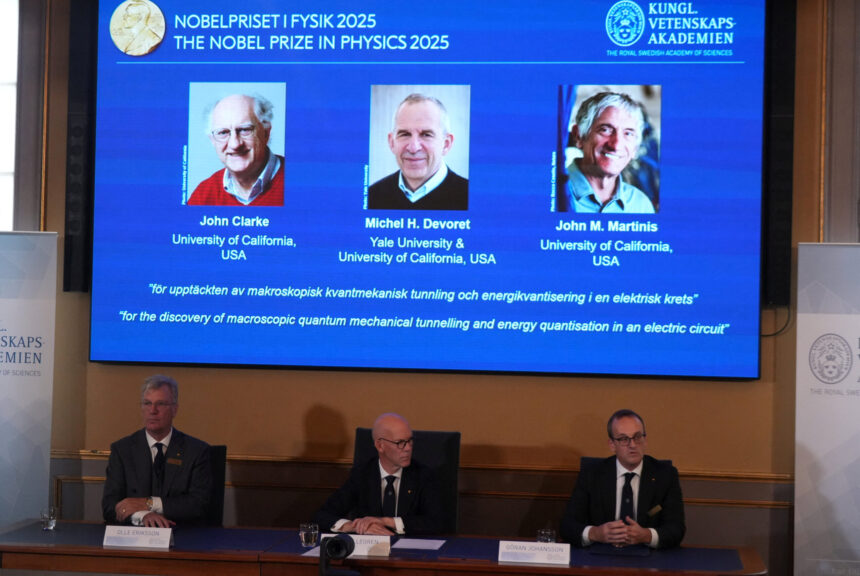
quantum physics — US-based scientists John Clarke, Michel Devoret, and John Martinis have won the 2025 Nobel Prize in Physics for their groundbreaking experiments that revealed quantum physics in action, significantly advancing the field of digital technology.
Quantum physics: Stunned Reactions from the Winners
During a press conference, John Clarke expressed his astonishment at receiving the prestigious award, stating, “My feelings are that I’m completely stunned. Of course it had never occurred to me in any way that this might be the basis of a Nobel Prize.” He further noted the relevance of their work to everyday technology, mentioning, “I’m speaking on my cell phone and I suspect that you are too, and one of the underlying reasons that the cell phone works is because of all this work.”
Exploring Quantum Mechanics
Quantum mechanics, often perceived as complex and counterintuitive compared to classical physics, has been extensively studied at the atomic and subatomic levels. However, the Nobel laureates have shown that quantum mechanics can influence larger, everyday objects under specific conditions. Their experiments in the mid-1980s involved electronic circuits made from superconductors, demonstrating the practical implications of quantum behaviours.
New Opportunities in Quantum Technology
Olle Eriksson, chair of the Nobel Committee for Physics, praised the winners, stating, “It is wonderful to be able to celebrate the way that century-old quantum mechanics continually offers new surprises. It is also enormously useful, as quantum mechanics is the foundation of all digital technology.” The Royal Swedish Academy of Sciences highlighted the significance of this year’s prize in augmenting the development of next-generation quantum technologies, including quantum cryptography, quantum computers, and quantum sensors.
The Promise and Challenges of Quantum Computing
Quantum computers harness the principles of quantum mechanics to perform complex calculations, making predictions and analyses that would take traditional computers millions of years. This revolutionary technology holds the potential to address some of humanity’s most pressing issues, such as climate change. However, the field faces significant challenges, including the need for improved accuracy in quantum chips, and the timeline for achieving commercially viable quantum computing remains uncertain.
Notable Connections to Google
Two of the Nobel laureates have notable ties to Google. John Clarke, a British-born scientist, is a professor at the University of California, Berkeley. Michel Devoret, born in France, is a professor at both Yale University and the University of California, Santa Barbara, where John Martinis is also a professor. Martinis previously led Google’s Quantum Artificial Intelligence Lab until 2020 and was part of a team that claimed to have achieved “quantum supremacy” in 2019. Devoret is also the chief scientist for Google Quantum AI, marking the second consecutive year that Nobel prizes have been awarded to scientists affiliated with Google, following the 2024 chemistry prize awarded to Demis Hassabis and John Jumper at Google DeepMind.
The Significance of the Nobel Prize in Physics
The Nobel Prize in Physics, awarded by the Royal Swedish Academy of Sciences, includes a prize sum of 11 million Swedish crowns (approximately $1.2 million) that is shared among the winners when there are multiple recipients. Established through Alfred Nobel’s will, the prizes have recognised outstanding achievements in science, literature, and peace since 1901, with economics added later. Physics was the first category mentioned in Nobel’s will, reflecting its prominence at the time, and today it remains one of the most prestigious awards in the scientific community.
Continuing Traditions in Nobel Awards
This year, the Nobel Prize in Physics is the second to be awarded, following the announcement of the medicine prize given to three scientists for their advancements in understanding the immune system. The chemistry prize is scheduled to be announced next, with the awards ceremony taking place in Stockholm on December 10, commemorating the anniversary of Alfred Nobel’s death. The peace prize will be awarded separately in Oslo, maintaining the long-standing traditions associated with these esteemed recognitions.