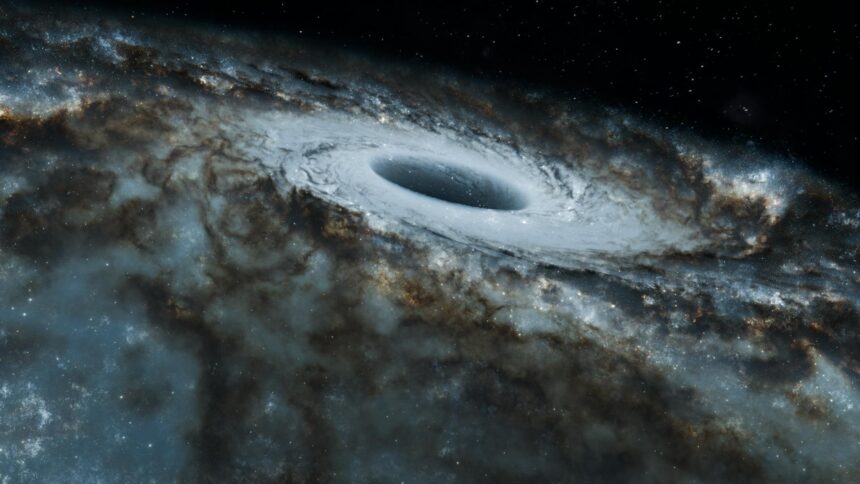
Scientists are investigating the possibility of dark matter stars, known as boson stars, which may leave distinctive ripples in the cosmos. This research offers a new avenue for exploring the invisible forces that shape our universe.
Unveiling the Mystery of GW190521
In 2019, an extraordinary event named GW190521 captured the attention of astrophysicists. This phenomenon sent gravitational waves—imperceptible ripples in the fabric of space-time—radiating through the universe and was detected by advanced observatories on Earth. Initial analyses suggested that the event marked the collision and merger of two massive black holes, each far exceeding the mass of our Sun.
Questioning Established Theories
However, Carlos Herdeiro, a physicist at the University of Aveiro in Portugal, is leading a research initiative called NewFunFiCO, supported by the European Union. This project aims to explore alternative explanations for such gravitational wave signals. “The borderline mysteries of the universe are fascinating,” said Herdeiro. “And gravitational waves give us a new way to explore them.”
A Collaborative Effort Across Borders
The NewFunFiCO team comprises physicists and astrophysicists from various countries, including Spain, Portugal, Italy, Germany, Mexico, Brazil, and China. Their collective objective is to discern whether certain gravitational wave signals might arise from exotic objects theorised to exist but yet to be observed directly.
Utilising Advanced Detection Technology
The researchers leverage real data from the LIGO-Virgo-KAGRA network, an international assembly of ultra-sensitive detectors located in the United States, Italy, and Japan. These detectors are capable of measuring minute distortions in space-time, as predicted by Einstein’s theory of relativity.
Since the first detection of gravitational waves in 2015, scientists have identified over 150 merging black hole pairs. Yet, the NewFunFiCO team posits that other exotic objects may be lurking within this data, potentially misidentified as black holes.
Insights from Recent Observation Campaigns
The latest observational campaign, designated O4, has been active from May 2023 and will continue until November 2025. Preliminary analyses have revealed approximately 250 candidate events, many of which remain under scrutiny. Nico Sanchis-Gual from the University of Valencia, who is a co-lead on the project, noted, “We are still looking carefully at the data. There may be signals that don’t quite fit what we expect from black holes.”
The Fascinating Concept of Boson Stars
Among the intriguing candidates are boson stars—hypothetical ultra-compact objects that could appear similar to black holes from a distance. However, unlike black holes, boson stars lack an event horizon, the point of no return beyond which nothing can escape. From an external viewpoint, they may appear somewhat fuzzy but are theorised to be filled with dark matter particles.
Boson stars could potentially be composed of ultralight dark matter, possibly consisting of elusive subatomic particles called axions, which are theorised to be trillions of times lighter than electrons. The idea of detecting an object the size of a planet, yet with a mass comparable to that of the Sun, captivates researchers. Sanchis-Gual remarked, “It’s mind-blowing.”
Exploring New Gravitational Wave Signals
If boson stars do exist, they might collide and merge in a manner similar to star-sized black holes, creating detectable gravitational waves. The NewFunFiCO team is on a quest to identify the signals expected from such events within LIGO’s data. Herdeiro speculated, “Were two of them to collide, they would produce a gravitational wave signal that fits that particular signal slightly better than two black holes.”
Investigating Other Exotic Objects
The researchers are not solely focused on boson stars. They are also investigating mixed stars, which could be neutron stars with dark matter cores, and gravastars, exotic entities that mimic black holes without possessing the same internal structure or event horizon. “The goal is to take advantage of the golden era of gravitational wave observations we live in, and search for objects that have never been seen before but which theoretically could exist,” Herdeiro explained.
The Broader Implications of Dark Matter Research
Findings from this study could significantly enhance our comprehension of dark matter and the universe. Even if the existence of boson stars is not confirmed, the research opens up new pathways in physics that have not been widely explored. This quest may unveil unusual phenomena in the cosmos.
The NewFunFiCO initiative is set to continue until the end of 2026, having commenced in 2023 with funding from the EU’s Marie Skłodowska-Curie Actions programme. Herdeiro emphasised the importance of international collaboration, stating, “One of the key aspects here is that we involve European partners with non-European partners. This is why EU funding has been so important.”
Public Engagement and Economic Benefits
The implications of such ambitious projects extend beyond the academic realm, capturing public imagination about black holes, cosmology, and the universe’s origins. Herdeiro noted, “Large experimental infrastructures have spin-offs that people are not aware of.” For instance, the technology developed for LIGO’s precise detectors has advanced various fields, including precision manufacturing and medical imaging.
Ultimately, the exploration of dark matter stars may lead to a transformative shift in our understanding of the universe. As Sanchis-Gual posited, “The main vision right now is that there’s some dark matter particle. So this is a possibility.” Confirmation of even one such object could provide physicists with crucial insights into the nature of dark matter, fundamentally altering our perception of the cosmos.