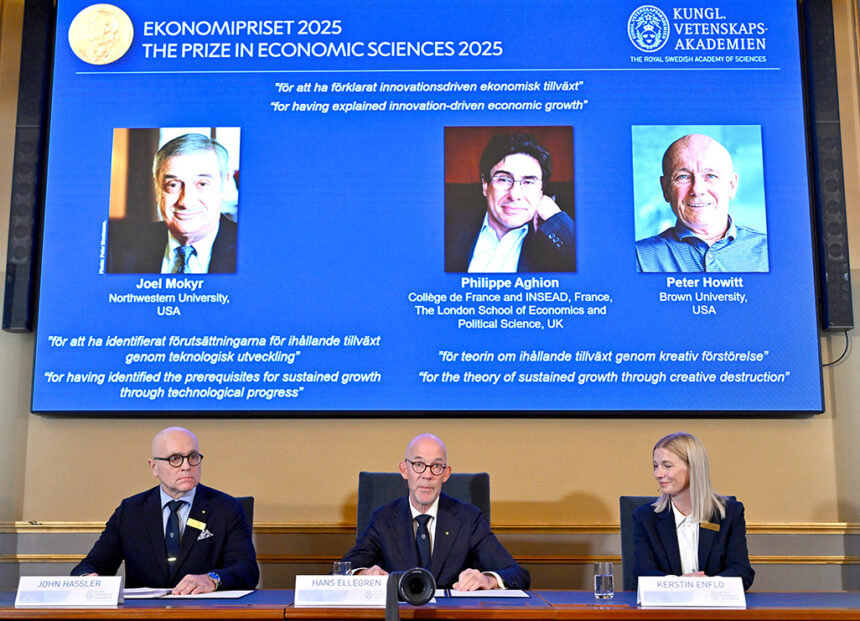
Joel Mokyr, Philippe Aghion, and Peter Howitt have been awarded the 2025 Nobel Prize in Economics for their pioneering work on innovation and the dynamics of economic growth. Their research elucidates how technological advancements foster the creation of new products and production methods, effectively replacing outdated ones and enhancing living standards globally.
Innovation and: Significance of Their Research
The Royal Swedish Academy of Sciences, which grants the Nobel Prize, highlighted that the laureates’ contributions have been pivotal in understanding how sustained economic growth over the past two centuries has lifted millions out of poverty. This growth has been unprecedented in human history, as noted in the Academy’s statement.
The Role of Creative Destruction
Mokyr, Aghion, and Howitt’s work centres on the concept of ‘creative destruction’, a term used to describe the process through which innovation displaces older technologies and practices. This cycle is crucial for driving economic growth and improving the quality of life. However, the Academy cautioned that such progress should not be taken for granted.
Challenges to Economic Growth
While the laureates have shed light on the factors that promote economic growth, they also stress that stagnation has been the norm throughout much of human history. In light of current global challenges, including trade policies, they emphasise the need for vigilance against threats to ongoing growth.
Impact of Trade Policies
Aghion specifically pointed to the trade policies under former U.S. President Donald Trump as detrimental to growth. He argued that barriers to trade hinder the exchange of ideas and technology, which are vital for fostering innovation.
Insights on Global Economic Dynamics
The Nobel-winning economists are particularly concerned about the implications of de-globalisation. Aghion remarked that larger markets facilitate greater competition and opportunities for innovation. He expressed concern over the increasing protectionist sentiments that could stifle growth.
A Call for Strategic Policy Adjustments
Aghion further urged Europe to adapt its policies to better support innovation. He argued that Europe has become overly cautious in its approach to industrial policy, particularly in sectors like climate change and artificial intelligence. He believes that a more balanced strategy, reconciling competition with industrial policy, could harness the continent’s potential.
Debating Growth and Inequality
Howitt echoed similar sentiments regarding the restrictive nature of tariff wars, suggesting they could deter innovation by reducing market size. He expressed that while the idea of bringing manufacturing jobs back to the U.S. may hold political appeal, it does not align with sound economic policy. He stated, “We’re good at designing running shoes, but it’s best for us to leave others to make them.”
Context of Previous Nobel Winners
The 2025 Nobel Prize in Economics follows last year’s award to Daron Acemoglu, Simon Johnson, and James Robinson, who focused on inequality. This ongoing discourse highlights the multifaceted nature of economic growth and its distribution, as some economists argue that technological advances often benefit the powerful more than the general populace.
Addressing Sustainable Growth Amidst Climate Change
The question of sustainable growth remains a contentious issue, especially in the context of climate change and environmental degradation. The laureates’ research encourages a dialogue on not only how to achieve growth but also how to ensure that it is equitable and sustainable.
The Nobel Prize: An Esteemed Recognition
The Nobel Prize, formally known as the Sveriges Riksbank Prize in Economic Sciences in Memory of Alfred Nobel, is awarded annually and is highly regarded in the field of economics. The 2025 prize is valued at 11 million Swedish crowns (approximately $1.2 million), with Mokyr receiving half the award and Aghion and Howitt sharing the other half.
Looking Ahead
The award comes at a critical juncture for the global economy, with many experts anticipating that advancements in artificial intelligence could lead to a new era of growth. However, the laureates’ warnings about the risks of isolationism and trade barriers serve as a reminder of the complexities involved in navigating future economic landscapes.
Final Reflections
As the world grapples with challenges such as inequality, environmental sustainability, and the impacts of de-globalisation, the insights provided by Mokyr, Aghion, and Howitt will undoubtedly continue to inform discussions on how to foster innovation and economic growth in a balanced and inclusive manner.