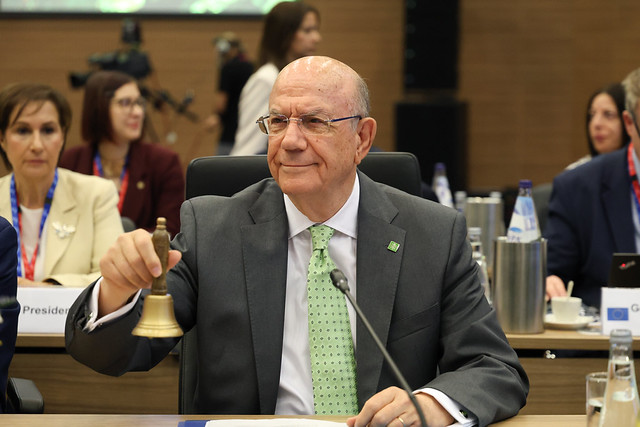
eu fragmentation — eu fragmentation — Finance Minister Makis Keravnos has voiced significant concerns regarding the potential fragmentation of the European Union (EU) as six finance ministers convene in Berlin on Thursday. This meeting, comprising representatives from France, Germany, Italy, the Netherlands, Poland, and Spain, is aimed at discussing ways to loosen financial regulations in Europe, enabling the continent to better compete with the United States’ financial sector.
Keravnos cautioned that such a meeting could undermine the unity of the EU. He stressed, “I don’t think a separate structure is feasible, because it would conflict with the prevailing perception in all member states today that fragmentation must stop.” He argues for a unified approach to the banking system and capital markets, highlighting that inclusion of all member states is crucial for future plans.
Despite Keravnos’ warnings, the E6 ministers have previously suggested a “two-speed” Europe, where an inner circle could pursue deeper integration while the outer circle remains connected but less integral to the EU. German Finance Minister Lars Klingbeil, following an E6 videoconference in January, stated, “Now is the time for a Europe of two speeds,” emphasising the need for a stronger and more resilient Europe amid unpredictable geopolitical landscapes.
The E6 ministers are positioning themselves as the driving forces of Europe, aiming to enhance competitiveness and bolster defence capabilities. Klingbeil noted, “We are providing momentum, others can join. What matters is strengthening our competitiveness and our defence capability.” The ministers plan to reconvene to explore initiatives such as strengthening the Euro and advancing towards a “capital markets union,” which would facilitate smoother investment and savings flows across the continent.
The notion of a “two-speed” Europe has surfaced repeatedly in recent decades, with critics pointing out that the current requirement for unanimity among the 27-member states often slows down decision-making processes. Concerns have been raised by smaller member states about potentially losing their voice in Brussels if the principle of unanimity were to be abolished.
Cypriot foreign ministry spokesman Theodoros Gotsis expressed Cyprus’s desire to remain closely integrated with the EU’s core, stating, “Our aim is to be on the inside as much as possible.” He highlighted Cyprus’s efforts to join the Schengen zone as part of this commitment. Gotsis also remarked that discussions surrounding a “two-speed” Europe should involve all member states and the EU’s institutions, pointing out the complexity of the issue that extends beyond legal considerations.