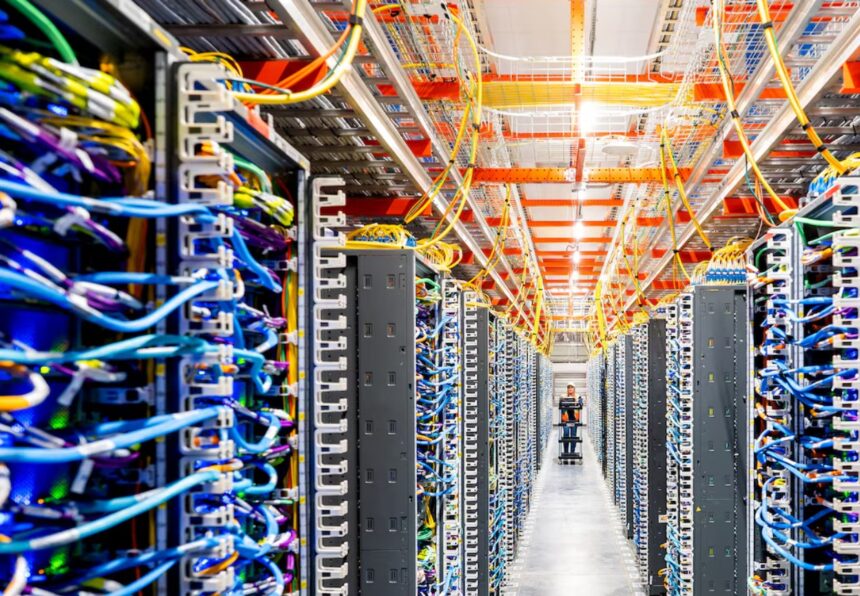
Global investment in data centres is expected to approach $1.6 trillion by 2030, as technology companies ramp up their spending on AI infrastructure. According to a report by Omdia, leading firms are forecast to invest over $600 billion on AI-related capital expenditures in 2026 alone.
The Transformation of Data Centres
The research from Omdia highlights a significant shift in the function of data centres. Traditionally viewed as mere support facilities for businesses, they are now evolving into centres for digital product manufacturing. This transformation is driven by the increasing demand for generative artificial intelligence systems, which are becoming integral to various industries.
Understanding the AI Factory Concept
Omdia introduces the concept of the AI Factory, a new category of heavy industrial infrastructure aimed at producing intelligence. The report details a four-layer architecture that includes:
- Energy and physical infrastructure
- Hardware and network fabric
- Scheduling and virtualisation orchestration
- Model as a Service (MaaS) and AI application ecosystem
This architecture underscores the capital intensity and engineering complexity involved in AI Factory development.
Shifting Metrics of Success
Omdia’s findings indicate a notable change in how success is measured in the AI industry. Historically, the focus was on accumulating computing power, but this is shifting. The report points out the phenomenon of the “Zombie GPU” effect, where expensive graphics processors remain idle while awaiting data. Consequently, performance evaluation is now leaning towards metrics such as Time-to-First-Token (TTFT) and vector retrieval speed, with some vendors reporting cost reductions of up to 75% through improved efficiencies.
Hyperscale Providers and Operational Flexibility
Hyperscale cloud providers are also adapting by balancing operational flexibility with growing sovereignty requirements. Omdia describes two emerging deployment models:
- Full-stack deployment models, exemplified by companies like Amazon Web Services and Google Cloud, which allow public cloud capabilities to be integrated into client-owned data centres.
- Separation of software and hardware layers, which enables localisation of software while hardware development is driven by broader ecosystem participation.
These approaches reflect the ongoing evolution in how AI services are delivered and managed.
Challenges in AI Factory Development
Based on a survey of over 200 companies, Omdia identified several key challenges that the AI Factory sector faces. These include:
- Long deployment timelines and the need for return-on-investment validation.
- Concerns regarding digital sovereignty.
- Shortages of skilled AI talent.
- Complexity in system-wide engineering.
These factors contribute to a landscape that can be difficult to navigate for new entrants.
Key Trends Shaping the Future
Omdia anticipates five major developments that will define the AI Factory industry by 2026:
- Shifts in success metrics away from raw computing power towards efficiency and speed.
- Emerging delivery approaches that accommodate operational flexibility and data sovereignty.
- Increased power density in data centre racks, reflecting growing demands for computational capacity.
- The “last mile” of AI industrialisation, where integration and specialised AI agents become crucial.
- The rise of sovereign data factories driven by regulatory pressures.
These trends indicate a dynamic and rapidly evolving industry landscape.
The Growing Importance of Regulatory Compliance
As regulatory frameworks such as the EU AI Act and the Digital Operational Resilience Act gain traction, Omdia notes a growing pressure for sensitive data to remain within geographically isolated facilities. This has led to the emergence of regional infrastructure operators, who are evolving from mere space providers to guardians of critical data assets.
A Competitive Landscape
Raymond Zhan, Senior Principal Analyst for Cloud and AI at Omdia, emphasises that future competition will hinge not just on technical specifications but also on factors such as energy efficiency, cooling solutions, and compliance with regulatory standards. “Future competition will no longer be defined by model parameters or GPU counts, but by a comprehensive contest of energy, liquid cooling, chips, autonomous software stacks, sovereign compliance and long-term capital endurance,” Zhan stated.
Looking Ahead: Critical Years for AI Factories
Omdia predicts that the years 2026 and 2027 will be pivotal for the development of AI Factories, with regional and industrial AI operations expected to experience the highest growth certainty. The findings reflect a broader recognition that AI infrastructure is no longer merely a technological investment but a strategic asset influenced by energy availability, regulatory compliance, and engineering capabilities.