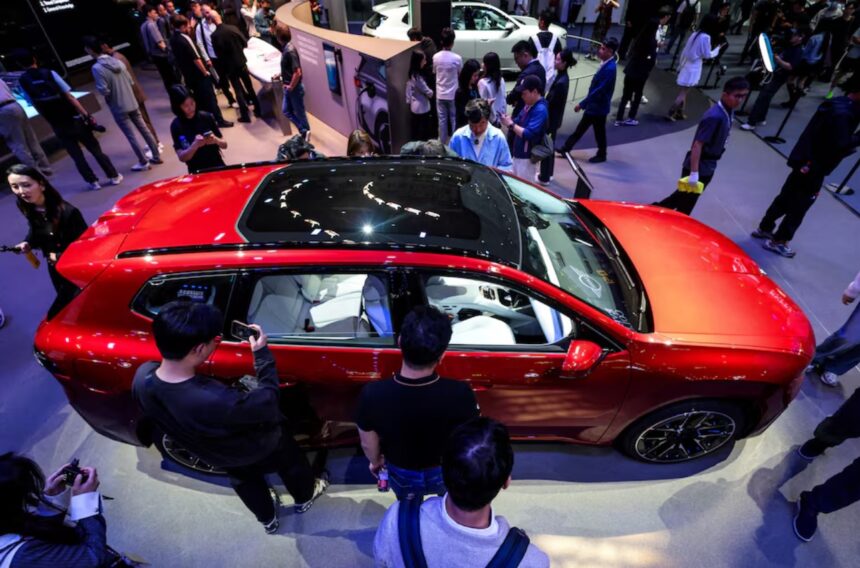
German premium carmakers face a significant challenge in the global electric vehicle race, with BMW particularly feeling the pressure in China. The automaker is pinning its hopes on the Neue Klasse electric cars to turn around its declining sales in the region.
Under the leadership of new CEO Milan Nedeljkovic, BMW recently issued a profit warning, citing a sharp 30 per cent drop in sales in China during the second quarter. This marks the third such warning in less than three years, highlighting the mounting difficulties the company faces in a rapidly evolving market.
Many analysts believe that BMW has been slow to adapt to the fast-paced developments in China’s electric vehicle sector. Yale Zhang, managing director of Shanghai-based Automotive Foresight, noted, “If this had launched two years ago, it could have been a game-changer. In today’s Chinese auto market, it is hard to stand out.”
Chinese consumers are increasingly turning to local brands like Nio, Geely’s Zeekr, and Xiaomi, which are innovating at a rapid pace. For instance, Nio has demonstrated its flagship ET9 sedan’s advanced suspension system by balancing a tower of champagne glasses on its bonnet without spilling a drop — a feat aimed at showcasing its engineering prowess.
BMW’s challenges are emblematic of a larger trend affecting German luxury automakers competing in China, where traditional combustion-engine heritage holds less appeal. Wang Xianbin, vice president of the Gasgoo Research Institute, explained that “Chinese consumers no longer buy into that,” as they seek intelligent EV features tailored to their preferences.
In stark contrast, local brands are aggressively targeting customers of well-established names like BMW, Audi, Porsche, and Mercedes. Currently, only about 5 per cent of BMW’s sales in China are fully electric, while EVs account for 46 per cent of total vehicle sales in the region. The downturn extends beyond BMW; Mercedes and Audi have also reported declines in sales, dropping 28 per cent and 19 per cent, respectively, in the first half of this year.
Hendrik Schmidt, a notable investor at DWS, raised concerns about the company’s leadership, stating that the top executives might not fully grasp the scale of the challenge in China. “From our perspective, the dynamics here have been considerably underestimated,” he remarked.
Despite these concerns, a spokesperson for BMW defended the company, stating that its senior management possesses extensive experience in China and has tailored a product strategy that emphasises integrated digital services and advanced connectivity features. However, the average transaction price for BMW’s cars in China in 2025 was reported to be 341,000 yuan ($50,200), trailing behind local competitors like Nio, Aito, and Denza. Only Audi offered a lower average price at 287,000 yuan.
In an effort to regain ground, BMW has adjusted some list prices in China, collaborating with local authorities to do so. However, analysts caution that merely lowering prices may not suffice to win back consumers. “Chinese buyers still want value for money,” Wang stated, adding that local rivals are equipped with cutting-edge features that appeal to modern consumers.
As BMW’s former production chief, Nedeljkovic is seen as an architect of the Neue Klasse platform, which underpins 40 new launches planned by next year. Although there is early demand for these models in Europe, the launch of the iX3 in China faced delays due to a shift from in-house technology to Chinese partner Momenta for assisted-driving technology, a feature now deemed essential by many local consumers.
BMW’s approach to product development appears to be more cautious than that of its local competitors, with its processes heavily influenced by its Munich headquarters. Analysts argue that this disconnect may hinder the brand’s ability to resonate with Chinese consumers, who have different expectations compared to European markets. As Chang Yan, founder of the popular EV-focused blog Supercharged, noted, the concerns that once dominated discussions around range anxiety are now outdated.
With local brands becoming increasingly aggressive in design and features, BMW faces a daunting task in re-establishing its presence in the Chinese market. As the automotive landscape continues to shift, the pressure mounts for German premium carmakers to innovate rapidly and adapt to the new realities of consumer preferences.