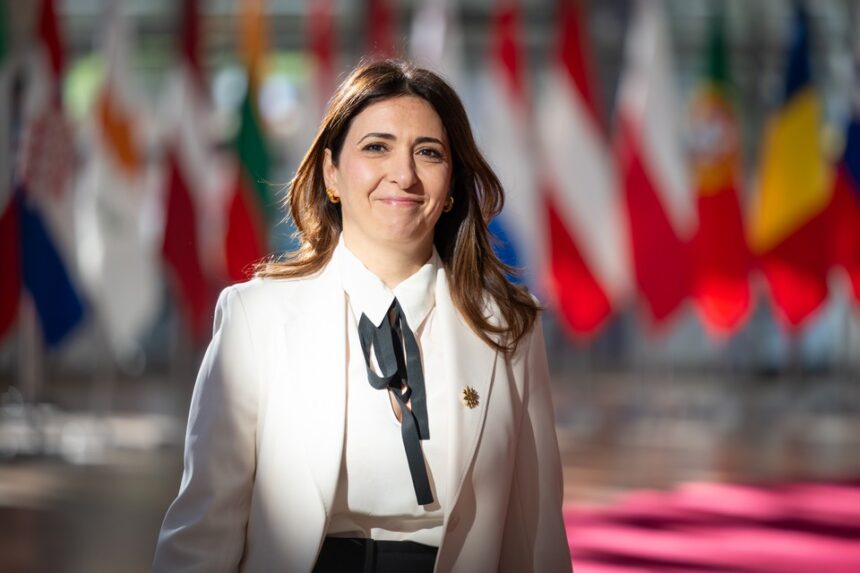
eu enlargement — Raouna hails a landmark step for EU enlargement as negotiations officially begin with Ukraine and Moldova. On Monday, Marilena Raouna, the European Affairs Deputy Minister, marked this moment as a “significant milestone” for both nations during intergovernmental conferences with the European Union.
In her remarks, Raouna highlighted Cyprus’s role as the current holder of the EU Council’s presidency, noting that the country has worked diligently to facilitate the start of these negotiations. “Since assuming the presidency in January, we have advanced the necessary consultations with a strong sense of responsibility,” she stated, emphasising the importance of coordinated efforts that have led to the formal opening of what she referred to as ‘cluster one’.
The opening of cluster one is seen as a pivotal move that transitions Ukraine and Moldova from mere political aspirations to actual commitments, bringing them closer to joining the united European family. Raouna remarked, “Enlargement remains both a strategic investment and a geopolitical necessity, as it contributes to security and stability at a time of global upheaval that is testing regional peace.”
She reaffirmed Cyprus’s commitment to advancing the enlargement agenda, stressing the need for tangible progress for all candidate countries while adhering to the merit-based principles fundamental to the accession process. Raouna articulated that accession is not just about membership; it represents a security guarantee and an expansion of the European space of security, stability, and prosperity.
As part of the discussions, Raouna pointed out that alongside the inaugural conferences with Ukraine and Moldova, another significant meeting—the 27th intergovernmental conference—was scheduled with Montenegro. She referred to Montenegro as “the frontrunner of the enlargement process”, noting that the country has successfully completed 14 of the 33 negotiating chapters thus far.
It has been nearly 13 years since Croatia joined the EU in 2013, marking the last enlargement of the bloc. In this period, the landscape has changed, not only with the addition of new potential members but also with the departure of the United Kingdom, signalling a new chapter in European unity and cooperation.