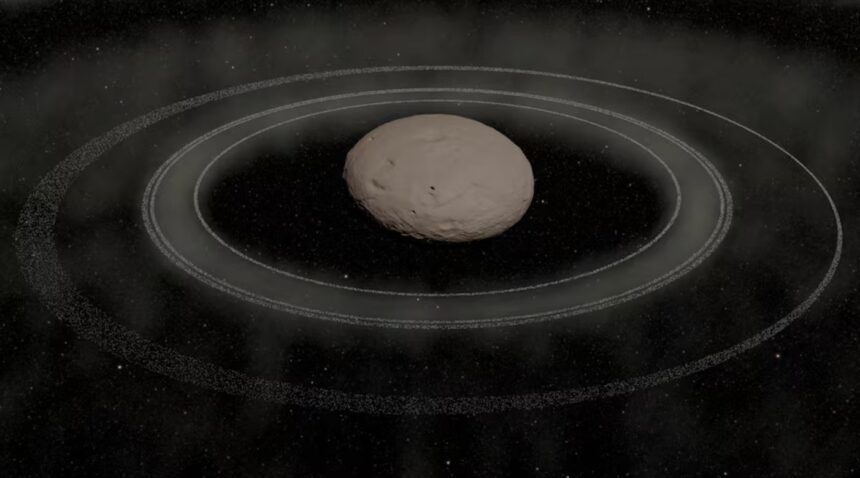
Astronomers have made a groundbreaking observation of rings forming around the icy celestial body known as Chiron. This marks the first time scientists have witnessed a ring system in the process of formation, consisting of four distinct rings and diffuse material encircling this small object that orbits the sun between Saturn and Uranus.
- Pereira remarked, “This diversity reminds us that ring formation is not exclusive to large planets. It’s a universal process that can occur wherever the right physical conditions exist.”
- Pereira concluded, “We can reconstruct the shape and environment around the object with kilometre-scale precision.”
Chiron: A Unique Celestial Object
Chiron is classified as a centaur, a type of celestial body that exhibits characteristics of both asteroids and comets. Officially designated as “(2060) Chiron,” it spans approximately 200 kilometres (125 miles) in diameter and takes about 50 years to complete a single orbit around the sun. This intriguing body resides in the outer solar system, situated between Jupiter and Neptune, and is primarily composed of rock, water ice, and complex organic compounds.
Recent Observations and Discoveries
Since its discovery in 1977, Chiron has been observed intermittently, with astronomers long aware of some material surrounding it. However, recent research has provided the clearest data to date, with observations conducted in 2023 at the Pico dos Dias Observatory in Brazil, supplemented by data from earlier years, including 2011, 2018, and 2022.
The research team discovered that Chiron is enveloped by well-defined rings. Three of these rings are positioned approximately 273 kilometres (170 miles), 325 kilometres (202 miles), and 438 kilometres (272 miles) from Chiron’s centre. The fourth ring, detected for the first time, lies significantly farther away at about 1,400 kilometres (870 miles) from the centre. This outer ring’s stability requires further study, while the inner three rings exist within a dust disk surrounding Chiron.
Real-Time Evolution of the Ring System
By analysing data from various observations, researchers identified significant changes within Chiron’s ring system, indicating that these structures are evolving in real time. Chrystian Luciano Pereira, a postdoctoral researcher at the National Observatory in Brazil and the lead author of the study published in the Astrophysical Journal Letters, stated, “This provides a rare glimpse into how such structures originate and change.”
Pereira further explained that Chiron’s rings are likely composed mainly of water ice with small amounts of rocky material, similar to those found in Saturn’s extensive ring system. The presence of water ice is crucial for the stability of ring systems, as its physical properties can prevent particles from coalescing into larger bodies, such as moons.
Chiron’s Comet-Like Activity
Chiron exhibits occasional comet-like behaviour, notably ejecting gas and dust into space. In a remarkable event in 1993, it even displayed a small tail, akin to that of comets. Researchers postulate that the rings may have originated from leftover material following a potential collision that obliterated a small moon of Chiron, or from other impacts involving space debris, or possibly even from material ejected from Chiron itself.
Implications for Understanding Ring Formation
The discoveries regarding Chiron’s evolving ring system hold significant implications for understanding the dynamics of ring and satellite formation around small celestial bodies. According to Braga Ribas, an astronomer and co-author of the study at the Federal University of Technology-Parana and the Interinstitutional Laboratory of e-Astronomy in Brazil, “It is an evolving system that will help us understand the dynamical mechanisms governing the creation of rings and satellites around small bodies, with potential implications for various types of disk dynamics in the universe.”
The Expanding Knowledge of Celestial Rings
All four of the solar system’s major outer planets—Jupiter, Saturn, Uranus, and Neptune—possess ring systems, with Saturn’s being the most prominent. Since 2014, astronomers have identified rings around smaller celestial bodies as well, with Chiron becoming the fourth known to possess such features, joining centaur Chariklo and two icy worlds beyond Neptune, Haumea and Quaoar.
Pereira remarked, “This diversity reminds us that ring formation is not exclusive to large planets. It’s a universal process that can occur wherever the right physical conditions exist.”
Techniques for Observation
The research team employed a method known as stellar occultation to observe Chiron’s rings. This technique involved monitoring how Chiron passed in front of a distant star, temporarily blocking its light. By measuring the dimming of starlight from various locations on Earth, researchers could accurately reconstruct the shape and environment surrounding Chiron with kilometre-scale precision.
Pereira concluded, “We can reconstruct the shape and environment around the object with kilometre-scale precision.”