The discovery of a fossilised skull in Nova Scotia has unveiled one of the oldest known plant-eating animals, the Tyrannoroter heberti, which dates back approximately 307 million years. This significant find marks a crucial moment in the evolutionary history of land vertebrates, highlighting the early adaptation of herbivory in terrestrial ecosystems.
- As more fossils are discovered and analysed, the understanding of vertebrate evolution will undoubtedly deepen, revealing even more about the origins of herbivory on land.
Plant-eating: Uncovering Tyrannoroter heberti
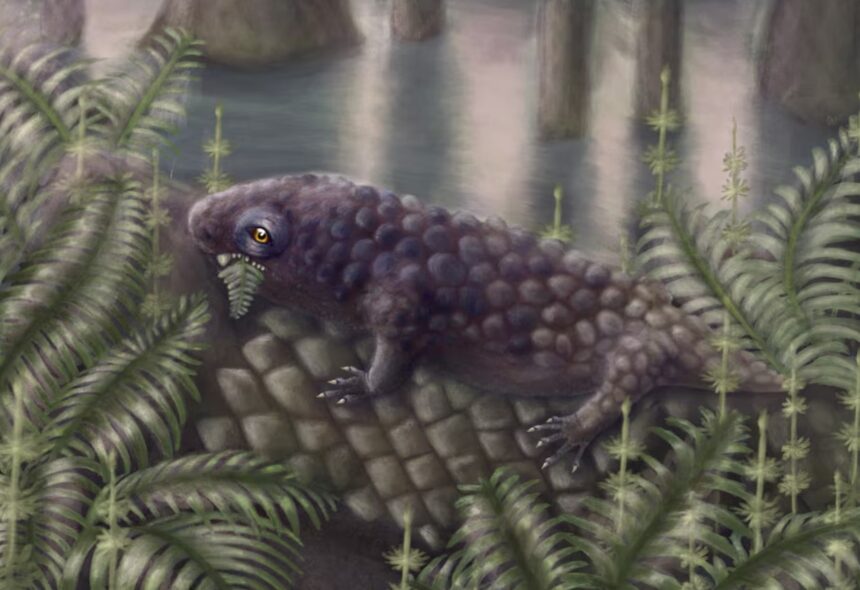
The creature, named Tyrannoroter heberti, featured a distinctive triangle-shaped skull that allowed for the development of large cheek muscles, essential for processing tough plant matter. Its mouth was equipped with specialised teeth designed to crush, shred, and grind vegetation, showcasing a sophisticated adaptation to a herbivorous diet.
A Unique Classification
While Tyrannoroter may resemble a reptile, it does not belong to that class. Instead, it is classified within a group known as microsaurs. Researchers, having only discovered its skull thus far, estimate that Tyrannoroter measured about 12 inches (30.5 cm) in length, resembling today’s blue-tongued skink in its stocky build.
The Evolutionary Context
Tyrannoroter lived during the Carboniferous Period, a time when early tetrapods emerged as the first vertebrates to transition from aquatic to terrestrial environments. These four-legged land animals are considered ancestors of modern amphibians, reptiles, mammals, and birds. The earliest skeletal remains of tetrapods date back roughly 375 million years.
Initially, these early tetrapods were predominantly carnivorous. However, over time, a shift occurred as some began to include insects in their diet, eventually leading to the herbivorous adaptations seen in Tyrannoroter.
Significance of the Discovery
Paleontologist Arjan Mann from the Field Museum in Chicago, co-lead author of the study published in the journal Nature Ecology and Evolution, emphasised the importance of this find: “This is highly important because it means that the essential components of the terrestrial ecosystems we recognise today – as herbivore-dominated – have been around and maintained since the Carboniferous Period.”
The discovery also sheds light on another contemporaneous creature, Melanedaphodon, which is believed to have consumed softer plants and insects. However, Tyrannoroter’s skull was better adapted for processing tougher vegetation, indicating a more advanced evolutionary step towards herbivory.
Fossil Analysis and Features
Tyrannoroter’s skull, measuring around 4 inches (10 cm) long, possesses several features indicative of herbivorous behaviour. According to Hillary Maddin, senior author of the study from Carleton University in Ottawa, “The skull is very robust. The traits that indicate herbivory include its downturned snout, angled optimally for snipping at low-lying plants, and large chambers for housing powerful muscles for processing plants.”
Furthermore, the skull features opposing dental fields, one on the palate and another on the lower jaw, which align perfectly – a characteristic found in other herbivorous animals. To understand the internal structure of the skull, researchers utilised a CT scan, revealing dozens of conical teeth on the roof of its mouth.
A Name with Significance
The name Tyrannoroter translates to “tyrant digger,” a nod to its relatively large size for its era and its presumed burrowing habits. The species name heberti honours Brian Hebert, the research collaborator who discovered the skull embedded in a rocky cliff on Cape Breton Island along Nova Scotia’s Atlantic coastline.
Challenging Existing Theories
Traditionally, it was believed that true vertebrate herbivores did not emerge until the end of the Carboniferous Period, which concluded about 299 million years ago. However, this discovery suggests that vertebrate animals diversified into modern-like ecological niches, including herbivory, much sooner than previously thought.
Maddin noted, “This discovery reveals vertebrate animals radiated into modern-like niches, including herbivory, much more quickly than we thought.” The shift from insect-eating to plant-eating may have been a gradual process, with insectivory serving as a precursor to herbivory.
A Preadaptation Theory
The research further supports the idea that insect-eating may have been a necessary preadaptation for herbivory. Mann explained, “By eating early herbivorous insects, tetrapods secondarily acquired the gut flora needed to process plant material.” This evolutionary pathway illustrates the complex dietary adaptations that paved the way for the rich diversity of herbivorous species we see today.
The Carboniferous Ecosystem
During the Carboniferous Period, extensive and lush forests thrived, which now constitute most of the world’s coal deposits. It was a time when pioneering tetrapods began to explore various dietary options, including the abundant plant life in mangrove-like forests. As paleontologists continue to study these ancient creatures, findings like Tyrannoroter illuminate the early steps towards the diverse ecosystems we understand today.
As more fossils are discovered and analysed, the understanding of vertebrate evolution will undoubtedly deepen, revealing even more about the origins of herbivory on land.