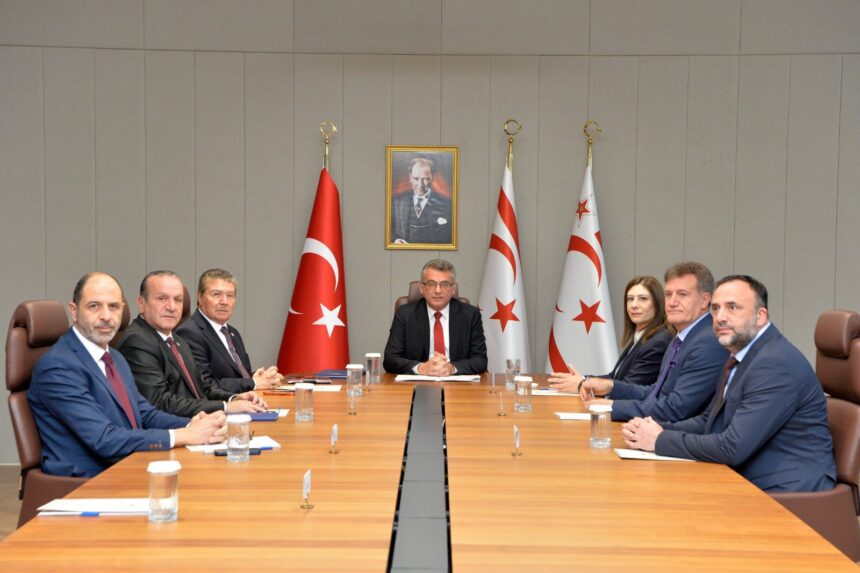
Turkish Cypriot leader Tufan Erhurman has announced that United Nations envoy Maria Angela Holguin is expected to return to Cyprus in January, with a significant enlarged meeting anticipated shortly thereafter. This announcement follows a meeting with leaders of Turkish Cypriot political parties, where Erhurman underscored the necessity for prior agreements before convening the enlarged meeting.
Erhurman emphasised that the meeting, which aims to involve both sides of the island along with the three guarantor powers—Greece, Turkey, and the United Kingdom—alongside the UN, should not proceed without a consensus on specific issues in Nicosia. He believes it would be more suitable to hold the enlarged meeting after Holguin’s visit, contingent upon meaningful progress during her discussions.
Central to his approach are four negotiation points he termed as essential for moving forward, although he refrains from calling them preconditions. These points include the recognition of political equality by the Greek Cypriot side, the imposition of time limits on negotiations, the preservation of all past agreements, and a UN guarantee to lift embargoes on Turkish Cypriots should the Greek Cypriots withdraw from negotiations.
“There is agreement on half of the first article. That is, on political equality. However, it is not possible to move onto the second point before the first point is completed,” Erhurman explained. He noted that discussions have yet to yield a clear solution model, which he describes as the essence of the negotiations.
Despite his articulated position, not all political factions are in alignment with Erhurman’s approach. Unal Ustel, leader of the UBP and the north’s current prime minister, expressed dissatisfaction, insisting that discussions must centre on the existence of two sovereign, equal states with equal international status. Ustel articulated discomfort with the UN’s recent statement that explicitly mentioned political equality, interpreting it as a reference to a federal solution.
Conversely, Sila Usar Incirli, leader of the opposition CTP, expressed a more positive outlook, noting satisfaction with the renewed momentum in addressing the Cyprus issue following Erhurman’s election. “Of course, it is not possible to say that this progress is happening in giant strides. Progress is being made in small steps,” she remarked, reinforcing her party’s advocacy for a bicommunal, bizonal federal solution based on political equality.
Erhan Arikli, leader of the YDP and currently serving as the transport minister, also acknowledged Erhurman’s stance, particularly appreciating the absence of a specified solution model during discussions. He concurred with the notion that the upcoming enlarged meeting should not occur without addressing existing gaps, citing the uncompromising position of Greek Cypriot leader Nikos Christodoulides, who is preparing for his own re-election campaign in February 2028.